A sourced illustration has not yet been added. This gap is included in the coverage record.
Overview
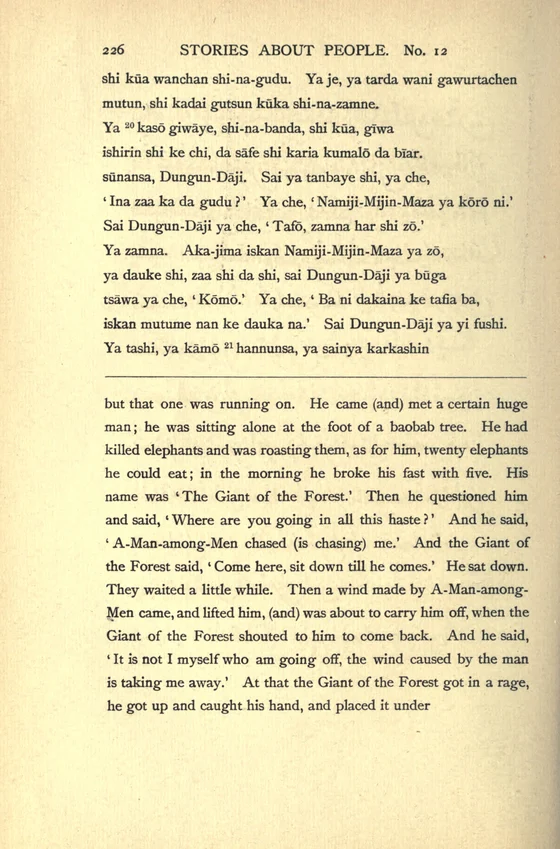
After his father and mother die, the boy is left with his father’s surviving wife and her son. She kills his hen, but he cooks it and exchanges the meat for a prince’s powerful horse. She next persuades him to seal the horse inside a house, expecting it to die. When he opens the door about ten days later, it is fat instead. She then makes him sell the horse for grain stalks and burns them, leaving three small pieces that he keeps in a bag.
In another town he is seized after climbing onto an altar. He offers to heal its blind chief and receives a hut. At night he burns one of the surviving stalks and walks behind the chief’s house; the chief begins to see. Burning a second opens both eyes. Offered half the town to govern, the boy declines because he is a passing trader. He accepts cattle, enslaved people and other wealth, then returns home. The third stalk is not used in the narrated cure.
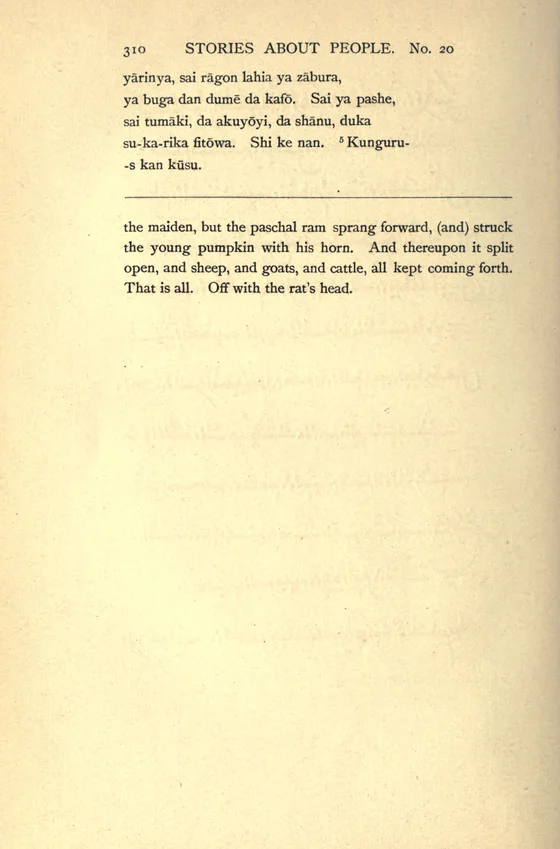
His stepmother now demands that he fetch a rat from a hole she knows belongs to a snake. She prevents his attendant from accompanying him and orders him to put aside his hoe and reach inside by hand. He draws out a bracelet and then a golden bangle. Angry, she brings her own son to try; the snake bites him, and he dies before reaching home. She dies three days later, leaving the orphan to inherit the property. The concluding skin-and-metal cloak proverb concerns how an orphan’s wealth changes his reception; it is not a bodily transformation.
Origins & earliest records
Malam Shaihu supplied written Hausa material, sometimes translated from Arabic manuscripts; Rattray transliterated and translated it into English. The author note dates the manuscript collection to 1907–1911.
Records & interpretation
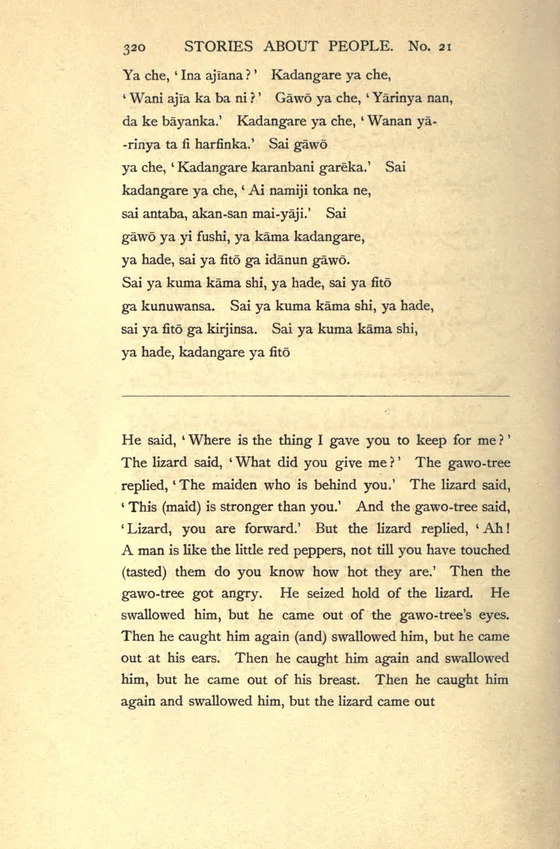
Shaihu/Rattray, Hausa Folk-Lore, Customs, Proverbs, etc., Volume I (1913), tale 13, complete pp. 232–246; extraordinary cure pp. 240–242; inheritance and proverb p. 246.
Selected bibliography
Documented works and useful reading. This is not a list of every appearance.
- 01
Hausa Folk-Lore, Customs, Proverbs, etc., Volume I
Shaihu/Rattray, Hausa Folk-Lore, Customs, Proverbs, etc., Volume I (1913), tale 13, complete pp. 232–246; extraordinary cure pp. 240–242; inheritance and proverb p. 246.
Family & connections
A source-supported family tree or inspiration record has not yet been compiled for this profile. Related reading below indicates a connection in subject matter, not a proven lineage or creative influence.
References
Sources supporting this profile. Linked pages have their own scope and editorial standards.
- Bilingual manuscript tale; digitized primary OCRShaihu/Rattray — orphan healer and skin-and-metal proverbResearch access: 2026-10-05
- Compiler methodologyAuthor’s NoteResearch access: 2026-10-05
Image credits
A sourced illustration has not yet been added. This gap is included in the coverage record.