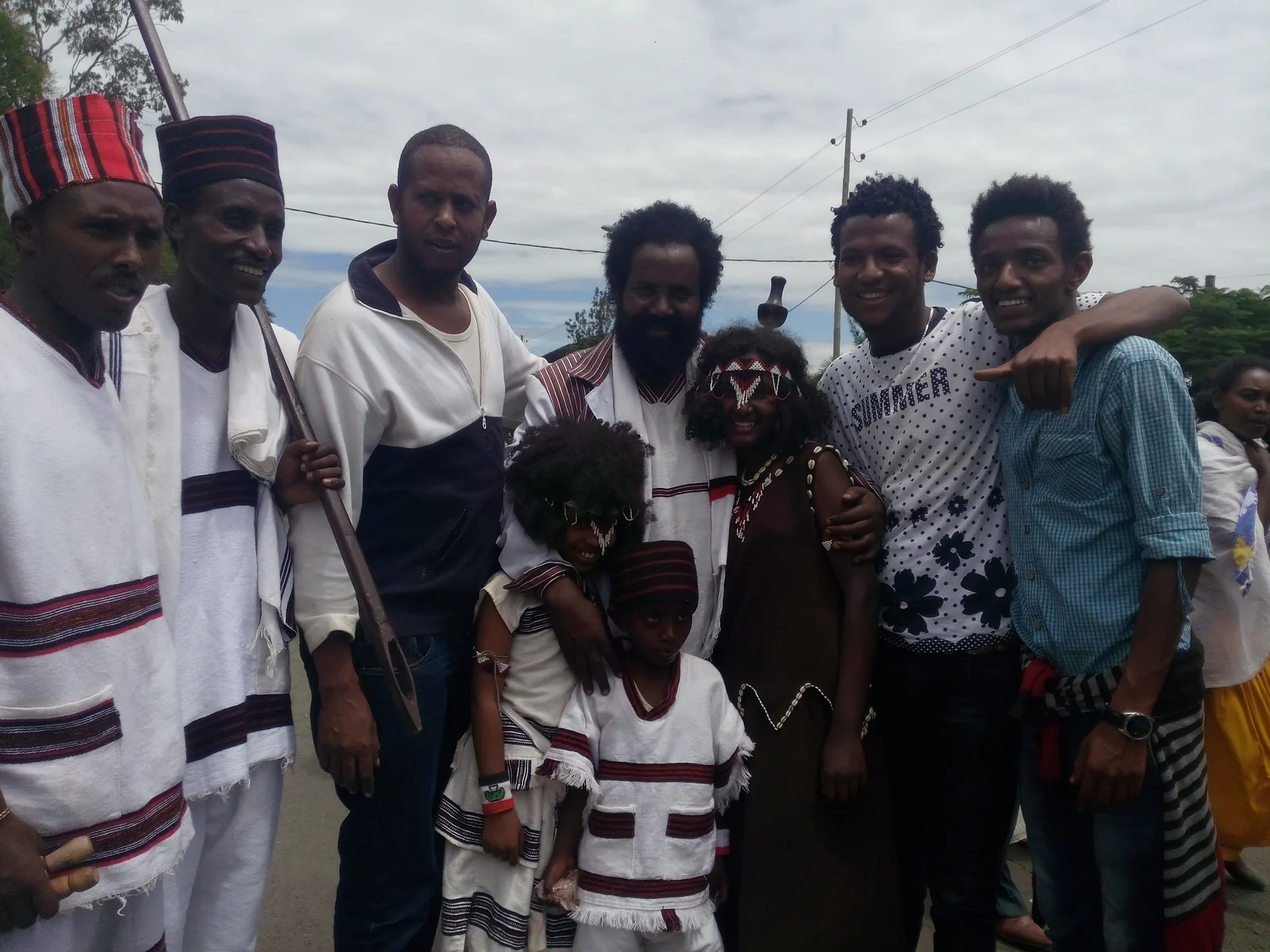
A group poses outdoors in a mixture of striped white garments, bead adornments, caps and everyday shirts; the photographer identifies the occasion as an Oromo Irreecha event.
A particular group photographed at an Irreecha event in Ethiopia on 4 October 2015. The author identifies its cultural context; individual names and a more precise event venue are not supplied. This image does not establish one shared style of dress for all Oromo people.
Overview
Oromo are a living people with homeland connections in Ethiopia and Kenya and communities abroad. Oromia 11’s project statement describes a shared language and cultural affiliation while expressly proposing attention to regional, culinary and religious variation. This self-description is valuable precisely because it does not require a uniform personal experience. Afaan Oromo, present citizenship, residence and membership in a community organisation are different dimensions of life. A diaspora project can speak about its own purposes and participants without establishing the views or circumstances of every Oromo person. Its proposed historical work also concerns a particular Minnesota community, rather than supplying an origin date for Oromo identity.
Gada is one significant governance heritage documented among Oromo in Ethiopia. UNESCO’s 2016 Representative List description presents a system addressing political, social and economic matters, including conflict resolution, reparation and community cohesion. It describes classes progressing through grades, with leadership rotating every eight years. Oral historians teach institutional history, rules and responsibilities, while transmission also involves homes and schools. The record distinguishes male class membership from women’s consultation in decisions about their rights. These documented arrangements should not be translated into a claim that all Oromo participate, that contemporary governance everywhere works identically, or that heritage recognition itself measures equality in every setting.
Community organising abroad responds to practical needs as well as cultural transmission. Oromo Community of Minnesota dates formal establishment to 1985, following informal mutual assistance, and nonprofit recognition to 2000. Its public account identifies settlement support, employment assistance, health navigation, youth tutoring and activities reducing older people’s isolation. It describes programmes as open broadly, with particular attention to Oromo and East African immigrants. Portland Oromo Community Association likewise connects language and culture with tutoring, employment and social support. Its overview records cultural events and youth sport, including a football team established in 1996. These are locally situated organisations, not national governments or universal representatives of Oromo abroad.
Community media provides another means of recording experience. Minnesota’s public funding record identifies Oromia 11 as recipient for The Oromo Story in Minnesota, a project proposing films about cultural heritage, early community members and regional diversity. Its plan includes consultation with elders, women’s and youth groups, religious communities and businesses before selecting interview subjects. Oromo production with English subtitles and narration is intended to make stories accessible to different audiences. The record still labels the project in progress, so its schedule and planned outputs cannot alone prove completion or replace viewing the films. It documents a deliberate community approach to deciding whose experiences are recorded and how they are presented.
History & identity
A living community account retaining Ethiopia/Kenya homeland relationships and distinct diaspora settings. Dates of American associations and heritage inscription document institutions, not the beginning of Oromo identity.
Sources & representation
Community organisations and Oromia 11 provide their own scoped aims and history; UNESCO supplies a specific Gada description. The public funding record documents planned storytelling, not a claim to have viewed complete films. Numerical community-size claims and generalised political assertions are excluded.
Selected bibliography
Documented works and useful reading. This is not a list of every appearance.
- 01
The Oromo Story in Minnesota
Complete project overview read; homeland/variation and proposed consultation retained. In-progress record does not prove finished films.
- 02
Gada system of the Oromo
Complete element description read; governance, rotation and transmission scoped. No ceremonies or formulas reproduced.
- 03
About and services
Complete indexed institutional history, mission and services read. Population estimates and current staff claims omitted.
- 04
Our Vision
Complete overview read; cultural, settlement and youth activities attributed to the association.
Language & cultural connections
Source-supported language and cultural connections have not yet been compiled for this profile.
References
Sources supporting this profile. Linked pages have their own scope and editorial standards.
- Community-authored public project recordThe Oromo Story in MinnesotaResearch access: 2026-10-05
- International heritage documentationGada system of the OromoResearch access: 2026-10-05
- Community self-descriptionAbout and servicesResearch access: 2026-10-05
- Community self-descriptionOur VisionResearch access: 2026-10-05
Image credits
Contextual community activity photographA group poses outdoors in a mixture of striped white garments, bead adornments, caps and everyday shirts; the photographer identifies the occasion as an Oromo Irreecha event.
A particular group photographed at an Irreecha event in Ethiopia on 4 October 2015. The author identifies its cultural context; individual names and a more precise event venue are not supplied. This image does not establish one shared style of dress for all Oromo people.