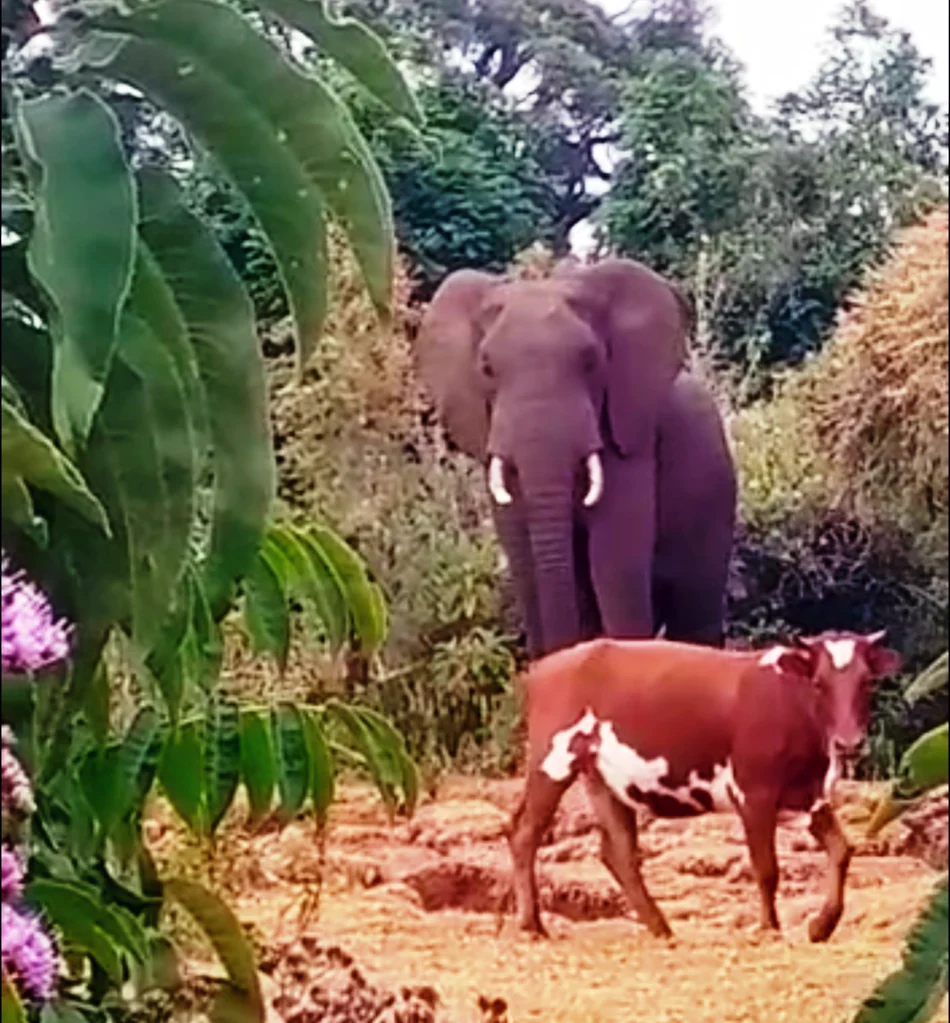
An elephant faces the camera behind a red-and-white cow amid leafy vegetation; the published caption identifies this as Ogiek cattle and an elephant beside an Ogiek habitation area on Mount Elgon.
An elephant and cattle beside an Ogiek habitation area on Mount Elgon, published as Plate 2 in Kenrick, Rowley and Kitelo’s 2023 article. Photographer credited as Torio Tenderosi, Toomoi; photograph date unspecified. This particular scene does not establish the article’s broader conservation claims or depict all Ogiek communities.
Overview
Ogiek are a living Indigenous people of Kenya whose community accounts connect cultural identity with forests, land and language. This profile centres the Mau Forest communities documented by the Ogiek Peoples’ Development Program (OPDP), rather than treating one organisation or locality as a complete account of every Ogiek person. Speaking the language, residence, citizenship and participation in a programme are distinct relationships. OPDP’s public reporting describes cultural renewal alongside land advocacy and community development; its institutional founding in 1999 dates the organisation, not the beginning of the people it serves.
The organisation’s 2023 annual report records a cultural centre within the Maasai Mau Block, on land acquired in 2020. It describes substantial construction completed in 2023, a museum holding cultural objects, a village display, and space for a library, recording room and educational activities. Adult teaching included English, Kiswahili and mathematics. Virtual Ogiek classes began at the Nkareta centre during 2023, linking young participants across the Mau region. These accounts place language transmission in contemporary educational settings rather than restricting heritage to the past. They document particular activities and facilities in that reporting year, not independently measured outcomes for the entire community.
A public statement delivered at the United Nations Permanent Forum on Indigenous Issues on 20 April 2023 gives a named younger voice to these concerns. Eunice Chepkemoi, speaking for OPDP, related language loss to displacement, migration and insecure access to ancestral territory. She asked for Indigenous languages to receive a place in school curricula and connected cultural continuity with land security. Her statement is an attributed account of community advocacy, rather than a complete survey of language use. It also distinguishes a demand for action from proof that the requested reforms have occurred.
Kenya News Agency’s August 2025 festival report locates another form of renewal at Nkareta in Narok North. Daniel Kobei described the annual gathering as both intergenerational teaching and advocacy. The account records dances, songs and staged presentations, while his discussion of honey, beekeeping and forest resources explains why environmental relationships matter to the community’s public case. Cultural practice here includes contemporary organisation and communication with government, alongside inherited knowledge. The report’s call for recognition and secure land remains a reported demand; the festival does not itself demonstrate a completed resettlement programme or establish present legal implementation.
History & identity
Living Kenyan community identity; this account concentrates on Mau-region institutional and community voices. Dates of OPDP and its centre describe institutions, not an ethnic origin.
Sources & representation
OPDP’s dated report and Chepkemoi’s complete statement supply community evidence; a Kenya News Agency report records a named festival interview. Legal demands are not treated as proof of implementation.
Selected bibliography
Documented works and useful reading. This is not a list of every appearance.
- 01
2023 Annual Report
About OPDP and complete culture/language sections, PDF pages 2 and 11–13, read; dated facilities and teaching.
- 02
UNPFII statement
Complete 20 April statement read; language, displacement and curriculum advocacy. Population estimates omitted.
- 03
Ogiek community pushes for recognition as custodians of culture and forests
Complete 26 August report read; Nkareta festival and Kobei interview, demands distinguished from outcomes.
- 04
‘We are our land’—Ogiek of Mount Elgon, Kenya: securing community tenure as the key enabling condition for sustaining community lands
Justin Kenrick, Tom Rowley and Peter Kitelo, Oryx57(3),298–312, online22May2023; DOI10.1017/S003060532300008X
Language & cultural connections
Source-supported language and cultural connections have not yet been compiled for this profile.
Located primary passages
Specific passages supporting details in this entry, grouped by their published witness.
‘We are our land’—Ogiek of Mount Elgon, Kenya: securing community tenure as the key enabling condition for sustaining community lands
Justin Kenrick, Tom Rowley and Peter Kitelo, Oryx57(3),298–312, online22May2023; DOI10.1017/S003060532300008X
- Ogiek leader Peter Kitelo coauthors this Mount Elgon study with mapping and anthropology collaborators. The methods identify community-selected observations, participatory mapping and long-term interviews. The authors argue that secure collective tenure enables local conservation. This is a source-specific argument grounded in Chepkitale collaboration, rather than a universal description of all Ogiek communities or an independent confirmation of every legal and conservation comparison cited.
Full Results, cited comparative studies and supplementary mapping data not independently examined. Legal interpretation remains the authors’2023 argument, not current legal advice. Mount Elgon context kept separate from Mau profiles; no sacred mapping or protocols reproduced.
References
Sources supporting this profile. Linked pages have their own scope and editorial standards.
- Community institutional report2023 Annual ReportResearch access: 2026-10-05
- Named community advocacy statementUNPFII statementResearch access: 2026-10-05
- Government news report with named community interviewOgiek community pushes for recognition as custodians of culture and forestsResearch access: 2026-10-05
Image credits
Contextual photograph of community livestock and wildlife; no human portraitAn elephant faces the camera behind a red-and-white cow amid leafy vegetation; the published caption identifies this as Ogiek cattle and an elephant beside an Ogiek habitation area on Mount Elgon.
An elephant and cattle beside an Ogiek habitation area on Mount Elgon, published as Plate 2 in Kenrick, Rowley and Kitelo’s 2023 article. Photographer credited as Torio Tenderosi, Toomoi; photograph date unspecified. This particular scene does not establish the article’s broader conservation claims or depict all Ogiek communities.