A sourced illustration has not yet been added. This gap is included in the coverage record.
Overview
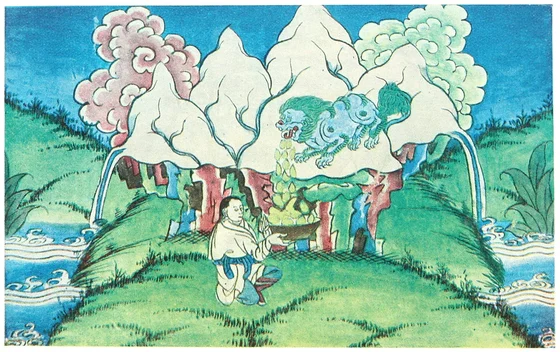
In a story set in Nepal within O’Connor’s Tibetan collection, a mouse living with her husband near the palace prays successively for strength, beauty, then wisdom, wealth and power in her children. She gives birth to a tiger, a peacock and a human boy. The first two leave for the forest after giving her hair and feathers by which they may be called; the boy remains near the nest and develops jewel-producing hair and nails.
When a king threatens to kill her and enslave the boy unless impossible tasks are met, she directs him to his animal brothers for aid. The final demand pits her against the royal elephant. In the tale she is coated with poison and enters its raised trunk, reaching and poisoning its brain; a string tied to her tail allows the boy to retrieve her after the elephant dies. This is fantastical narrative anatomy, not a zoological account or practical method. The boy receives the princess and half the kingdom, later succeeding to the throne, and the mother survives with him.
Origins & earliest records
Tibet; collected historical narrative
Records & interpretation
Full relevant tale and collection preface directly read.
Selected bibliography
Documented works and useful reading. This is not a list of every appearance.
- 01
Folk Tales from Tibet
XII, The Mouse’s Three Children, pp. 68–75
Family, evolution & connections
The Mouse’s three sons — O’Connor 1906
Explicit births and sibling relationships in Story XII, a Nepal-set tale in O’Connor’s Tibetan collection.
Scroll sideways to see all branches. With a keyboard, focus the tree and use the arrow keys.
Mother and offspring named directly in the narrative; birth sequence retained. The Mouse initially lives with a husband, but the births do not explicitly identify a father. Prayers do not establish divine parentage. Recruited tigers and peacocks are not additional siblings. This is a translated literary witness, not biological evolution.
Tiger son of the mouse
O’Connor’s Nepal-set Story XII explicitly narrates the Mouse giving birth to this son after a prayer. This is tale-specific parentage, not a relationship between real animal species.
Peacock son of the mouse
O’Connor’s Nepal-set Story XII explicitly narrates the Mouse giving birth to this son after a prayer. This is tale-specific parentage, not a relationship between real animal species.
Jewel-haired son of the mouse
O’Connor’s Nepal-set Story XII explicitly narrates the Mouse giving birth to this son after a prayer. This is tale-specific parentage, not a relationship between real animal species.
Primary records and illustrations
W. F. O’Connor, Folk Tales from Tibet (1906)
XII, The Mouse’s Three Children. pp. 68–75
Entire tale read. Mouse mother and three offspring explicitly identified; other recruited animals not given shared parentage. Original paraphrase; mythical elephant anatomy not biological evidence.
References
Sources supporting this profile. Linked pages have their own scope and editorial standards.
- Historical tale collectionO’Connor, Folk Tales from Tibet — XII, The Mouse’s Three Children, pp. 68–75Research access: 2026-10-05
Image credits
A sourced illustration has not yet been added. This gap is included in the coverage record.