A sourced illustration has not yet been added. This gap is included in the coverage record.
Overview
An ogre disguises himself as a lama and enables a queen, mare and dog each to bear three young, claiming one of each after three years. At his castle he gives the youngest prince disturbing tasks: straw becomes wolves that eat a goat, and scattered grain becomes wild cats that kill the poultry. His captive wife explains that he eats human hearts and tries to obtain power over servants through their disobedience.
The wife is a princess kept in a trance by a flower placed behind her ear. When the prince removes it she wakes and tells him how to evade the ogre’s tests. He eventually beheads the ogre while it demonstrates a bow, but must also kill a hidden boy on whom its continuing life depends. O’Connor calls this external life-support a mascot and gives the Tibetan term La in a footnote; his English choice is historical wording, not a complete account of Tibetan understandings of life or soul.
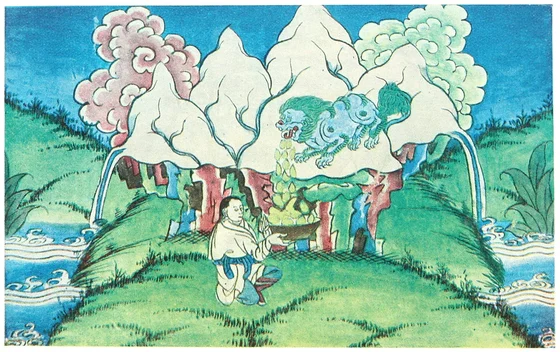
The boy holds a cup of clear liquid containing the victims’ spirits, one per drop. Applying each drop to a body restores its owner. The prince leaves the rescued princess in possession of the castle and continues his travels. O’Connor explicitly prints only this opening adventure of a longer cycle; the tale does not end with their marriage, and the lama disguise does not identify real lamas as ogres.
Origins & earliest records
Tibet; collected historical narrative
Records & interpretation
Full relevant tale and collection preface directly read.
Selected bibliography
Documented works and useful reading. This is not a list of every appearance.
- 01
Folk Tales from Tibet
XVI, The Prince and the Ogre’s Castle, pp. 103–115 and note
Family & connections
A source-supported family tree or inspiration record has not yet been compiled for this profile. Related reading below indicates a connection in subject matter, not a proven lineage or creative influence.
Primary records and illustrations
W. F. O’Connor, collector and translator, Folk Tales from Tibet (1906)
Folk Tales from Tibet. XVI, The Prince and the Ogre’s Castle, pp. 103–115 and note
Complete relevant chapter plus preface/title metadata read. O’Connor credits narrators from several social settings around Gyantse, Lhasa and elsewhere, but supplies no individual narrator for this tale. His preface acknowledges the inhibiting effect of the armed diplomatic mission and his official position, and that some collected stories were omitted. His claim of accurate translation does not remove that mediation; original Tibetan record not inspected. Original paraphrase of a historical text identified as public domain in the United States; no worldwide rights claim.
References
Sources supporting this profile. Linked pages have their own scope and editorial standards.
- Historical tale collectionW. F. O’Connor, collector and translator, Folk Tales from Tibet, XVI, The Prince and the Ogre’s Castle, pp. 103–115 and noteResearch access: 2026-10-05
Image credits
A sourced illustration has not yet been added. This gap is included in the coverage record.