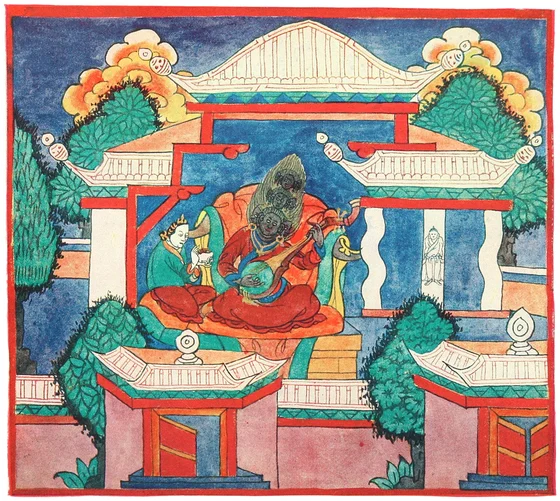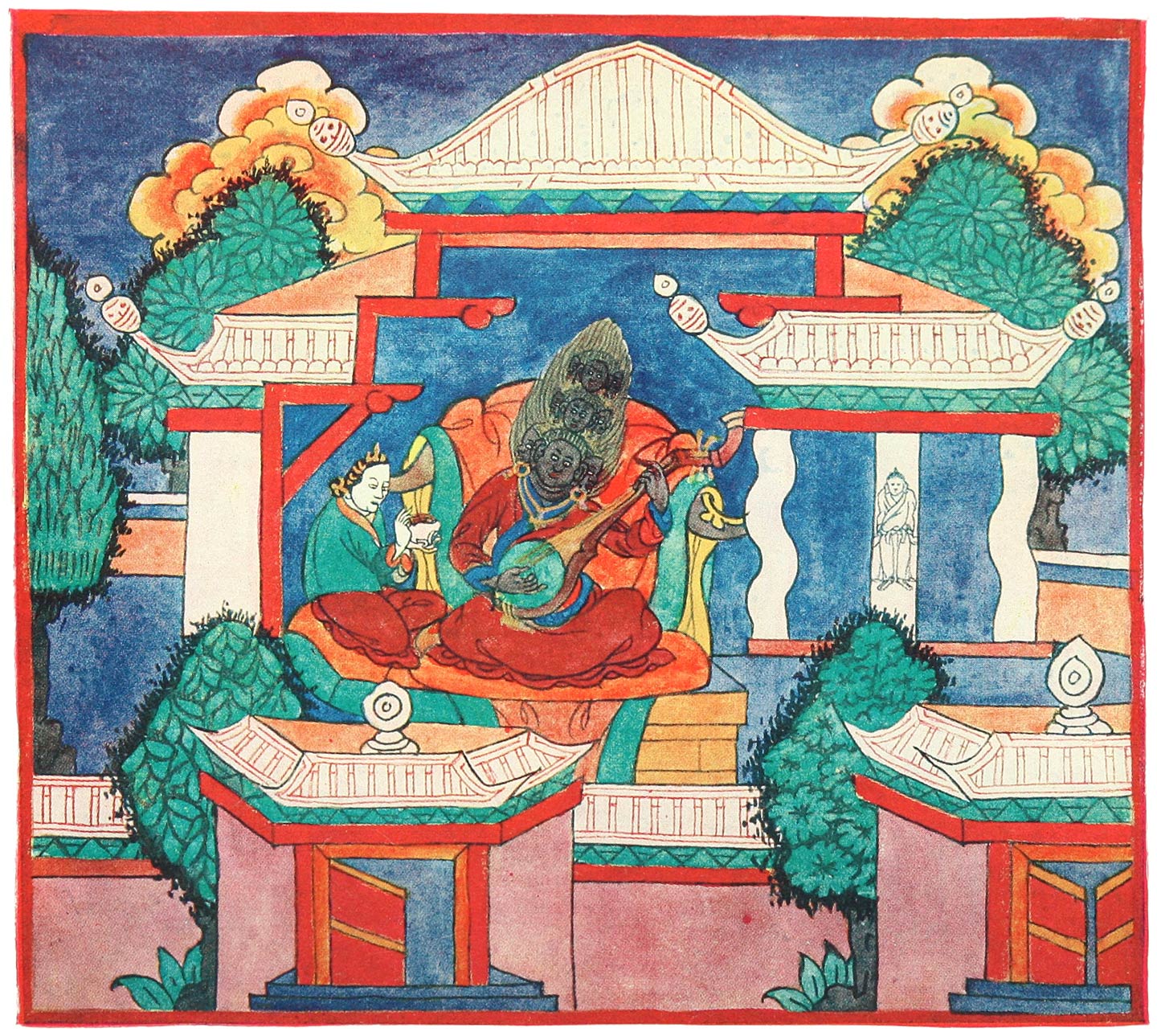
Captive woman in human form seated beside the guitar-playing ogre, anonymous Tibetan illustration published 1906
The captive woman sits to the left of the ogre, with Baki hidden in the upright glass pillar at right. This scene shows her human form inside the cavern; her earlier white-doe transformation is not pictured.
Overview
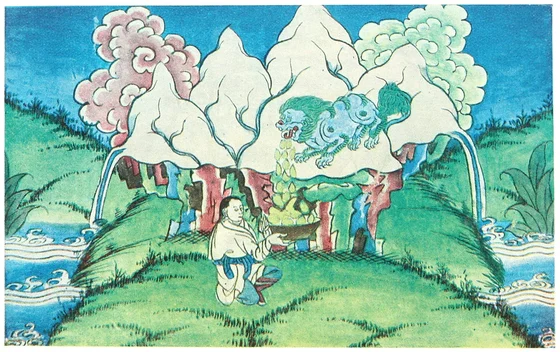
A snow-white doe pursued by Baki opens a rock entrance with her muzzle, sheds its skin and appears as a woman. Inside the cave she explains that she is human, captured by an ogre who intends to marry her. He has taught her spells allowing her to assume animal forms and move outside, yet she cannot escape his control without help.
She hides Baki inside a glass pillar and excuses its failure to dance when the ogre plays music. Later she explains where the green parrot holding the ogre’s life is concealed. After their escape she teaches Baki further spells, including his cowrie-shell transformation, and eventually becomes his wife. Her identity is that of a transformed human captive, not a separately named species of doe spirit.
Origins & earliest records
Tibet; collected historical narrative
Records & interpretation
Full relevant tale and collection preface directly read.
Selected bibliography
Documented works and useful reading. This is not a list of every appearance.
- 01
Folk Tales from Tibet
XXI, The Story of Room Bacha and Baki, pp. 147–157
Family & connections
A source-supported family tree or inspiration record has not yet been compiled for this profile. Related reading below indicates a connection in subject matter, not a proven lineage or creative influence.
Primary records and illustrations
W. F. O’Connor, Folk Tales from Tibet (1906)
XXI, The Story of Room Bacha and Baki. pp. 147–157
Entire tale and collection preface read. Anonymous girl explicitly identifies herself as human; named Baki is foretold lama-incarnation; parrot/ogre death correspondence explicit. Original paraphrase; colonial collection mediation retained in profile.
References
Sources supporting this profile. Linked pages have their own scope and editorial standards.
- Historical tale collectionO’Connor, Folk Tales from Tibet, XXI, The Story of Room Bacha and Baki, pp. 147–157Research access: 2026-10-05
Image credits
Historical illustrationCaptive woman in human form seated beside the guitar-playing ogre, anonymous Tibetan illustration published 1906
The captive woman sits to the left of the ogre, with Baki hidden in the upright glass pillar at right. This scene shows her human form inside the cavern; her earlier white-doe transformation is not pictured.