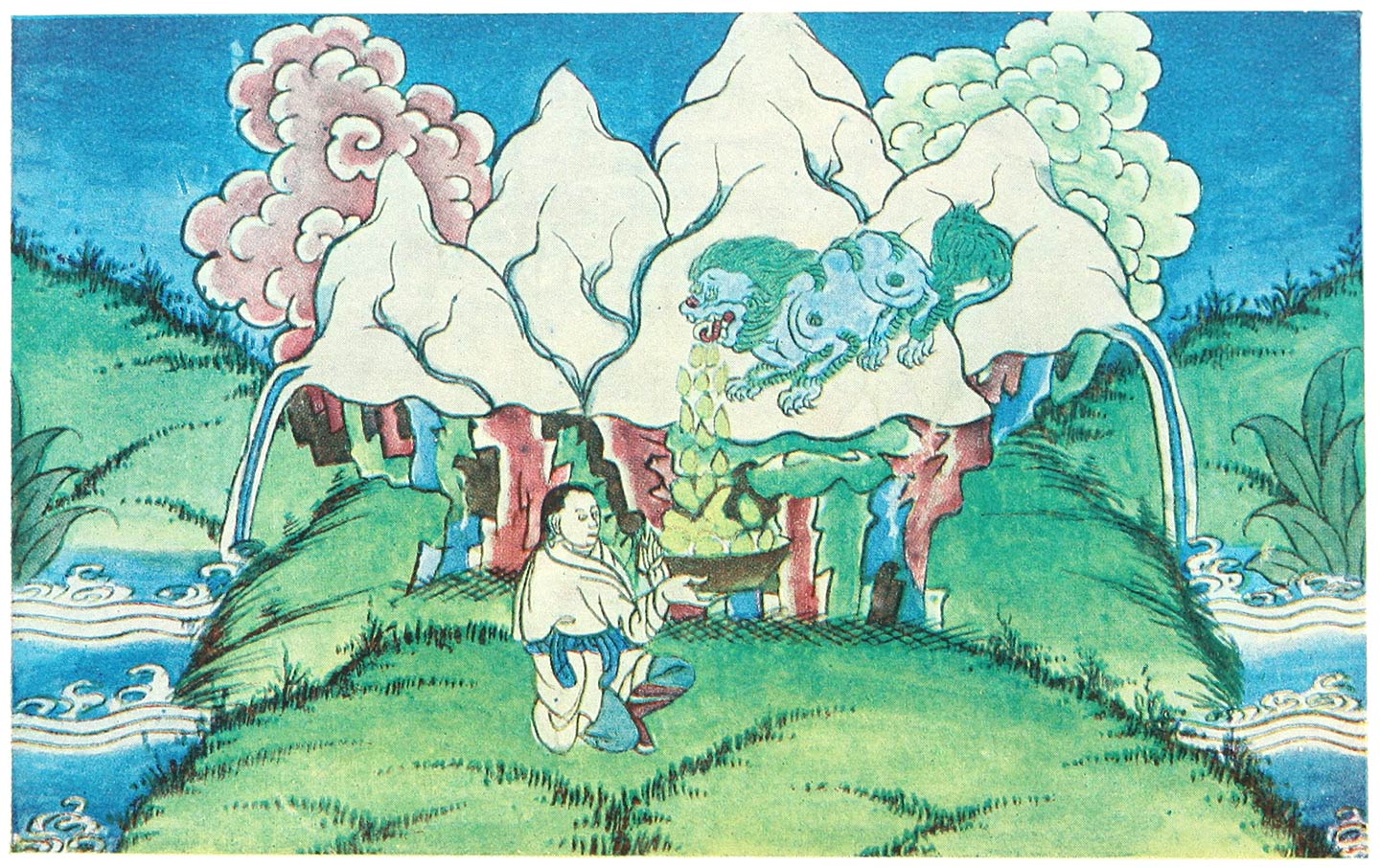
Gold-giving stone lion pouring gold into the woodcutter’s bucket, anonymous Tibetan illustration published 1906
The stone lion pours gold from its mouth into the younger woodcutter’s bucket. Its green mane, curling ornaments and mountain setting belong to the Tibetan artist’s illustration of this particular tale.
Overview
A young woodcutter finds a life-sized lion carved from stone and supposes it to be the mountain’s guardian. After his offering, the image speaks and later fills his bucket by pouring gold from its mouth. It tells him to stop before any gold falls on the ground; he obeys and uses the wealth to support his mother.
His elder brother brings a larger bucket and allows it to overflow. The lion tells him a bigger lump remains in its throat, then traps his reaching arm between its jaws. His collected gold becomes stones and earth. Months later the lion laughs at the family’s destitution and opens its mouth, letting him escape. The younger brother finally helps the impoverished household. The mountain-deity identification begins as the woodcutter’s interpretation; no named deity or specific surviving sculpture is established.
Origins & earliest records
Tibet; collected historical narrative
Records & interpretation
Full relevant tale and collection preface directly read.
Selected bibliography
Documented works and useful reading. This is not a list of every appearance.
- 01
Folk Tales from Tibet
XVII, The Story of the Stone Lion, pp. 116–123
Family & connections
A source-supported family tree or inspiration record has not yet been compiled for this profile. Related reading below indicates a connection in subject matter, not a proven lineage or creative influence.
Primary records and illustrations
W. F. O’Connor, collector and translator, Folk Tales from Tibet (1906)
Folk Tales from Tibet. XVII, The Story of the Stone Lion, pp. 116–123
Complete relevant chapter plus preface/title metadata read. O’Connor credits narrators from several social settings around Gyantse, Lhasa and elsewhere, but supplies no individual narrator for this tale. His preface acknowledges the inhibiting effect of the armed diplomatic mission and his official position, and that some collected stories were omitted. His claim of accurate translation does not remove that mediation; original Tibetan record not inspected. Original paraphrase of a historical text identified as public domain in the United States; no worldwide rights claim.
References
Sources supporting this profile. Linked pages have their own scope and editorial standards.
- Historical tale collectionW. F. O’Connor, collector and translator, Folk Tales from Tibet, XVII, The Story of the Stone Lion, pp. 116–123Research access: 2026-10-05
Image credits
Historical illustrationGold-giving stone lion pouring gold into the woodcutter’s bucket, anonymous Tibetan illustration published 1906
The stone lion pours gold from its mouth into the younger woodcutter’s bucket. Its green mane, curling ornaments and mountain setting belong to the Tibetan artist’s illustration of this particular tale.