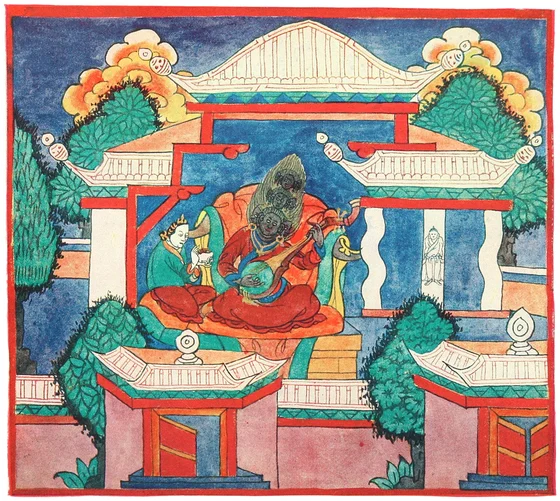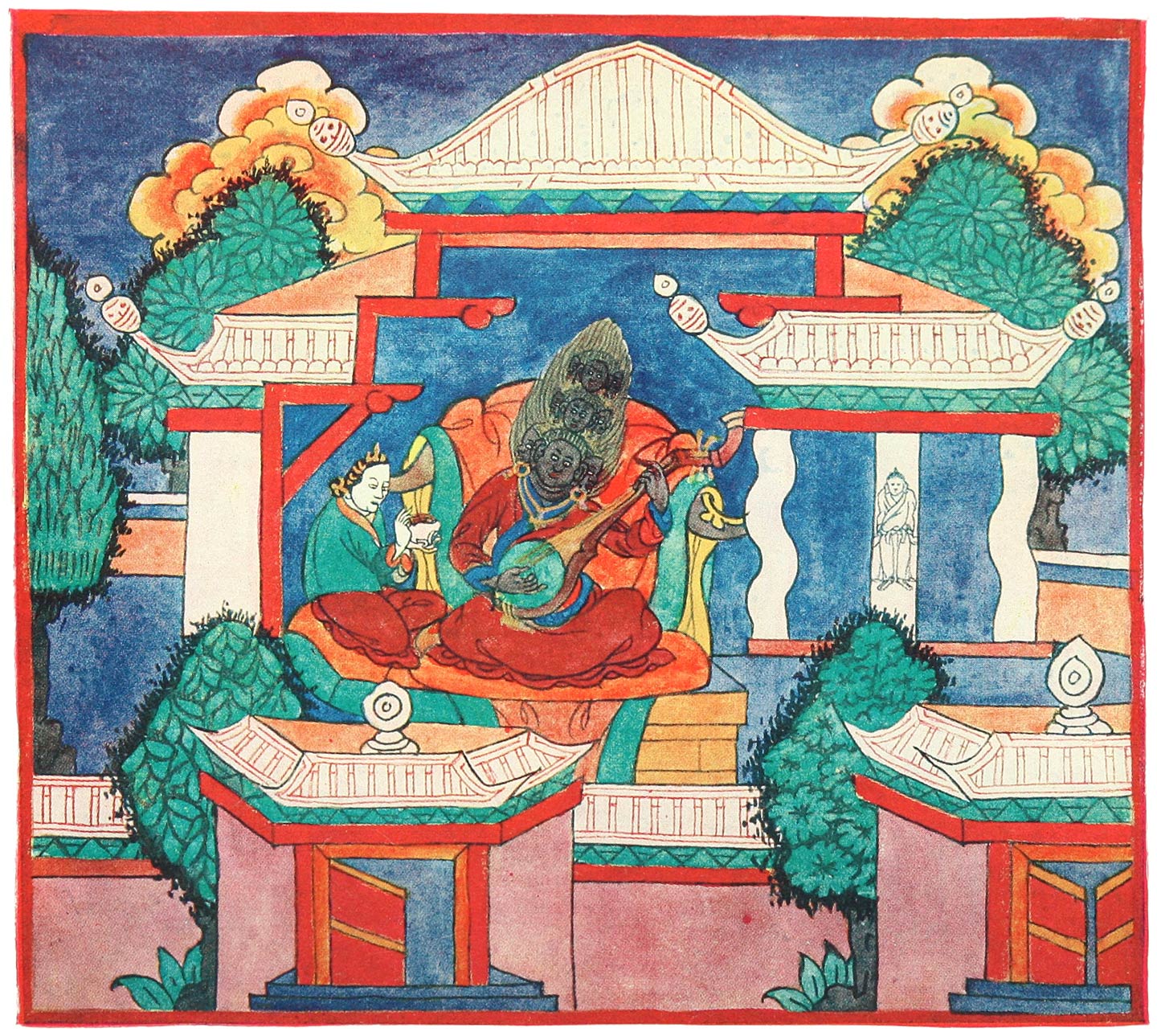
Ogre playing a guitar beside dancing glass pillars, anonymous Tibetan illustration published 1906
The ogre sits at the centre playing music while glass pillars bend around him. Baki stands hidden in the still pillar at right. The layered heads and ornate clothing belong to this artist’s representation; the green parrot holding the ogre’s life is not shown.
Overview
This huge ogre confines a woman in a richly furnished rock cavern and teaches her animal-changing spells. When he plays his guitar after dinner, the glass pillars dance. On one occasion the pillar concealing Baki remains still; the ogre threatens it with a hammer, but the captive persuades him to spare it.
His existence depends on a green parrot hidden on a red stone in another cave. Baki finds the bird and twists its neck; the ogre is then discovered dead at his own threshold with his neck correspondingly twisted. The parrot is an external support of this particular ogre’s life, distinct from the hidden boy in O’Connor’s earlier castle tale. Neither episode establishes a single universal bodily weakness for Tibetan ogres.
Origins & earliest records
Tibet; collected historical narrative
Records & interpretation
Full relevant tale and collection preface directly read.
Selected bibliography
Documented works and useful reading. This is not a list of every appearance.
- 01
Folk Tales from Tibet
XXI, The Story of Room Bacha and Baki, pp. 147–157
Family & connections
A source-supported family tree or inspiration record has not yet been compiled for this profile. Related reading below indicates a connection in subject matter, not a proven lineage or creative influence.
Primary records and illustrations
W. F. O’Connor, Folk Tales from Tibet (1906)
XXI, The Story of Room Bacha and Baki. pp. 147–157
Entire tale and collection preface read. Anonymous girl explicitly identifies herself as human; named Baki is foretold lama-incarnation; parrot/ogre death correspondence explicit. Original paraphrase; colonial collection mediation retained in profile.
References
Sources supporting this profile. Linked pages have their own scope and editorial standards.
- Historical tale collectionO’Connor, Folk Tales from Tibet, XXI, The Story of Room Bacha and Baki, pp. 147–157Research access: 2026-10-05
Image credits
Historical illustrationOgre playing a guitar beside dancing glass pillars, anonymous Tibetan illustration published 1906
The ogre sits at the centre playing music while glass pillars bend around him. Baki stands hidden in the still pillar at right. The layered heads and ornate clothing belong to this artist’s representation; the green parrot holding the ogre’s life is not shown.