Occitan language communities - AI-generated contextual illustration.
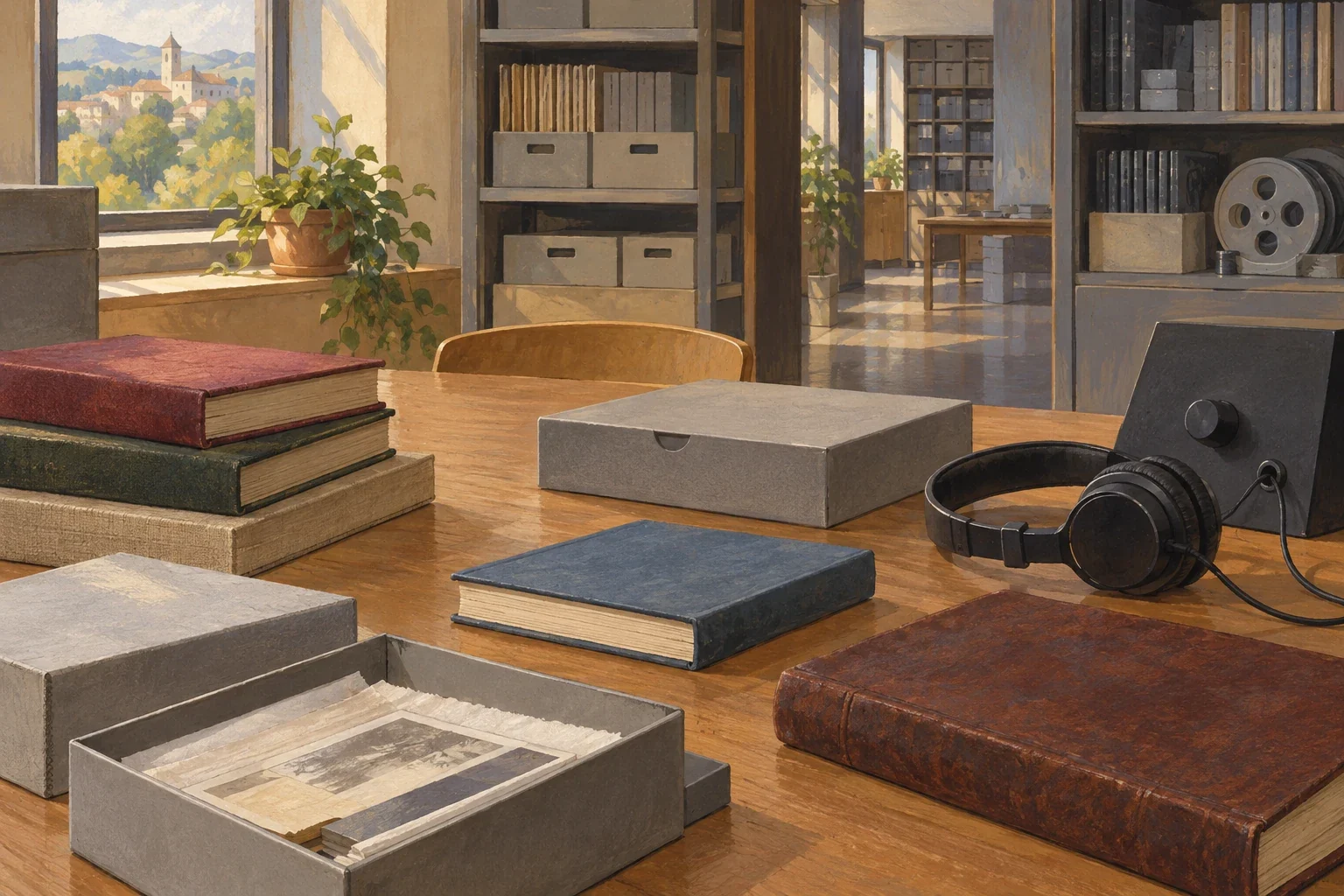
AI-generated contextual illustration of an imagined Occitan cultural archive. Books, listening equipment, archival pictures, room and landscape details are imagined; this is not a photograph of CIRDOC or proof of a collection item.
Overview
Occitan language communities connect a broad cultural space rather than a single uniform way of life. CIRDOC's Occitanica portal describes a shared heritage extending from Bordeaux and the Alps to the Occitan valleys of Piedmont and the Val d'Aran in the Pyrenees. Its account places Occitan among languages of cultural thought and creation since around the year 1000. The scope here is linguistic and cultural affiliation; it does not presume that every resident of these territories speaks Occitan or shares the same identity.
Occitanica brings together literary, musical, scientific and philosophical works, historical archives and intangible practices. The latter include local festivities, collective games, agricultural knowledge and craft. Present-day literature, theatre, music, audiovisual work and digital creation are part of the same institutional remit. These varied media matter because a living language's history cannot be reduced to a medieval literary period or a rural past.
The collaborative portal provides resources for discovery, research and language practice. CIRDOC became an associated partner of the Bibliothèque nationale de France in 2006 for digitisation. Occitanica developed from an earlier portal in 2011. CIRDOC and InOc joined complementary written and oral-heritage specialisms in 2019. The illustration imagines an archive context rather than a documented room.
A regional example is the boha, the bagpipe of the Landes of Gascony. Occitanica describes its twentieth-century revival through collection and reconstruction work: two instruments rediscovered in 1971 helped stimulate new manufacture, and the Conservatoire Occitan opened an instrument-making workshop in 1975. The Bohaires de Gasconha association followed in 1993. This is one documented regional music history, not an instrument attributed to every Occitan community.
History & identity
Occitan-speaking territories, from southwestern France to Piedmont valleys and the Val d'Aran; selected CIRDOC accounts.
Sources & representation
Selected authoritative cultural-institution accounts; source-specific findings retained in cache.
Selected bibliography
Documented works and useful reading. This is not a list of every appearance.
- 01
Le Projet Occitanica
Selected institutional account read for this overview; not a complete bibliography.
- 02
La Boha aujourd'hui
Selected institutional exhibition account read; regional case, not universal Occitan practice.
Language & cultural connections
Source-supported language and cultural connections have not yet been compiled for this profile.
References
Sources supporting this profile. Linked pages have their own scope and editorial standards.
- CIRDOC–Institut occitan de culturaLe Projet OccitanicaResearch access: 2026-10-10
- CIRDOC / OccitanicaLa Boha aujourd'huiResearch access: 2026-10-10
Image credits
AI-generated contextual illustrationOccitan language communities - AI-generated contextual illustration.
AI-generated contextual illustration of an imagined Occitan cultural archive. Books, listening equipment, archival pictures, room and landscape details are imagined; this is not a photograph of CIRDOC or proof of a collection item.