A sourced illustration has not yet been added. This gap is included in the coverage record.
Overview
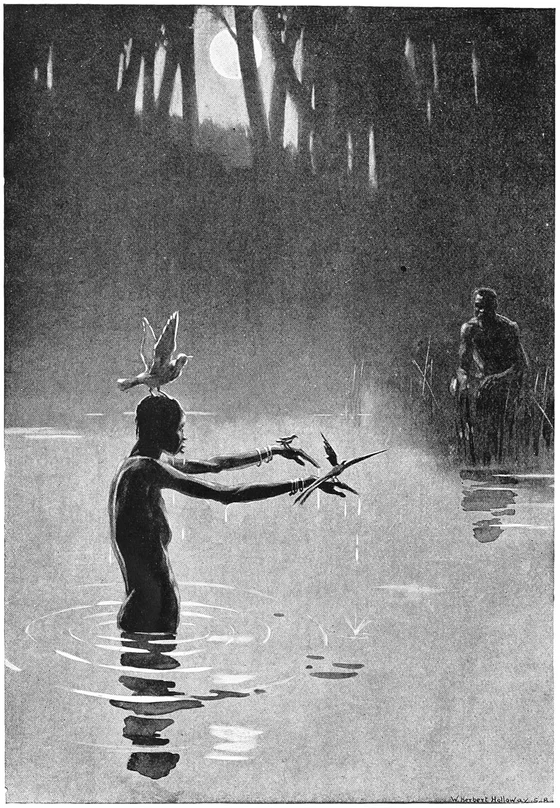
The Nya-nya Bulembu lives in water and has long teeth, claws and a skin covered with bright green moss. The printed tale glosses its name as the Despised One covered with Moss. Kitila’s father orders his hunters to find a young specimen with regular teeth and a complete coat: he intends its hide to conceal his daughter’s beauty. A song and green mealie-bread draw creatures from successive pools. The first is old, nearly toothless and without moss; the second has little moss and a single tooth three feet long. The chosen third beast emerges from a bright green pool with a full set of white teeth.
The hunters capture it alive with bread and drive it toward a line of spearmen, where it is killed. Cutting open the body releases necklaces, bracelets, girdles, embroidered bags and woven mats. More ornaments appear as the men take them out, but the supply stops when skinning begins. They preserve the teeth and claws in the hide and wrap Kitila in it; it immediately adheres to her. The beast is the donor of that enchanted skin, while Kitila remains the human wearer. Years later its ornaments furnish her wedding outfit, and the discarded hide flies back to her mother’s hut.
Origins & earliest records
Sarah F. Bourhill and Beatrice L. Drake collected and arranged the English tale for children. The publication does not name an individual contributor for this episode; its literary dialogue is not treated as a verbatim field transcription.
Records & interpretation
Complete XVII. Nya-nya Bulembu; or, The Moss-Green Princess, printed pp. 198–211, read through the final resolution.
Selected bibliography
Documented works and useful reading. This is not a list of every appearance.
- 01
Fairy Tales from South Africa
XVII. Nya-nya Bulembu; or, The Moss-Green Princess, pp. 198–211; complete English arrangement, unnamed individual contributor.
Family & connections
A source-supported family tree or inspiration record has not yet been compiled for this profile. Related reading below indicates a connection in subject matter, not a proven lineage or creative influence.
Located primary passages
Specific passages supporting details in this entry, grouped by their published witness.
Primary source witness
Sarah F. Bourhill (Mrs. E. J. Bourhill) and Beatrice L. Drake (Mrs. J. B. Drake), Fairy Tales from South Africa, London: Macmillan, 1908; selected original title page and complete headed tales in PG75833. Arranged for children; introduction pp.v–xi attributes principally Swazi, also Zulu and border-region contributions, with Shining Princess attributed to Mapoch. Individual narrators for these selected tales unnamed. Historical colonial framing is not current community consensus.
- Hunters encounter an old nearly toothless specimen, a thinly mossed one with a single large tooth, then a moss-covered specimen with many white teeth. They reject the first two, capture the third and spear it at the kraal. The variants are different encountered animals, not a single being changing its teeth repeatedly.
XVII Nya-nya Bulembu, pp.198–202; variable specimens and capture
- The killed beast’s body yields abundant crafted goods until skinning begins. Its intact skin attaches to Kitila and gives her a monstrous appearance. She is a human princess wearing a magical skin, distinct from the actual slain water beast and the two surviving rejected specimens.
Selected historical arrangement, not unmediated original-language oral testimony. Individual contributor not named; no separate manuscript inspected. Original facsimile not visually inspected in this batch.
References
Sources supporting this profile. Linked pages have their own scope and editorial standards.
- Collected historical tale in an English literary retellingBourhill and Drake — XVII. Nya-nya Bulembu; or, The Moss-Green PrincessResearch access: 2026-10-05
Image credits
A sourced illustration has not yet been added. This gap is included in the coverage record.