A sourced illustration has not yet been added. This gap is included in the coverage record.
Overview
Kitila’s father dislikes her mother and deliberately conceals the girl in the skin of a slain Nya-nya Bulembu. The mossy coat, teeth and claws adhere so completely that she looks like the water beast and eventually bears its name. Her favoured half-sister Mapindane nevertheless remains her friend. When rock-pigeons carry Mapindane to a distant king, who marries her, the family assumes she has been eaten. The bereaved queen turns against Kitila, and the king sends her to frighten birds from the crops.
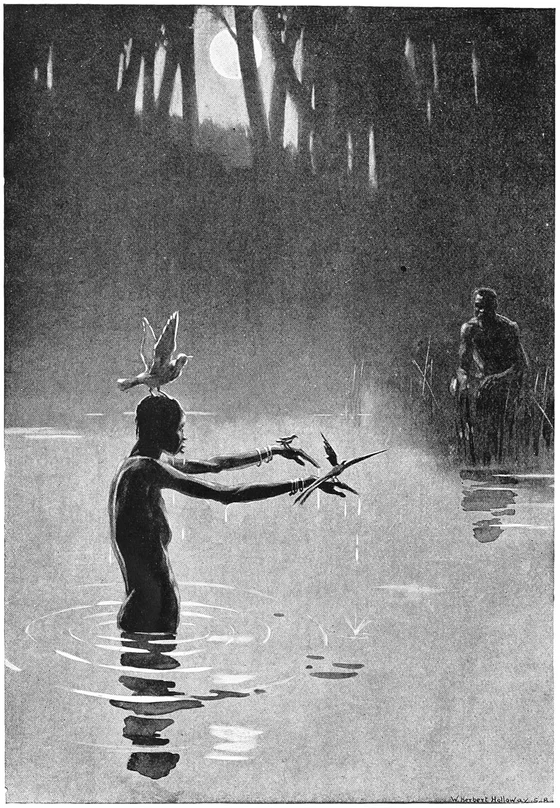
An old male fairy gives Kitila a stick that kills crop-raiding birds when waved and restores her true form when carried into water. There the green skin floats away, girls arrive at her call to play, and a commanded feast appears. Leaving the river restores the disguise. Children secretly witness her bathing and guide a visiting prince to the pool. He hears her account and chooses her despite the coat, while the treasures from the original beast supply her royal ornaments.
On the wedding morning Kitila enters a pool holding the stick. This time the hide flies into the air and lands at her mother’s doorway, rather than returning to her body. She emerges as a human princess and marries openly. The ending contrasts her acknowledged survival and happiness with Mapindane’s inaccessible good fortune: their father never learns what became of his other daughter.
Origins & earliest records
Sarah F. Bourhill and Beatrice L. Drake collected and arranged the English tale for children. The publication does not name an individual contributor for this episode; its literary dialogue is not treated as a verbatim field transcription.
Records & interpretation
Complete XVII. Nya-nya Bulembu; or, The Moss-Green Princess, printed pp. 198–211, read through the final resolution.
Selected bibliography
Documented works and useful reading. This is not a list of every appearance.
- 01
Fairy Tales from South Africa
XVII. Nya-nya Bulembu; or, The Moss-Green Princess, pp. 198–211; complete English arrangement, unnamed individual contributor.
Family & connections
A source-supported family tree or inspiration record has not yet been compiled for this profile. Related reading below indicates a connection in subject matter, not a proven lineage or creative influence.
Located primary passages
Specific passages supporting details in this entry, grouped by their published witness.
Primary source witness
Sarah F. Bourhill (Mrs. E. J. Bourhill) and Beatrice L. Drake (Mrs. J. B. Drake), Fairy Tales from South Africa, London: Macmillan, 1908; selected original title page and complete headed tales in PG75833. Arranged for children; introduction pp.v–xi attributes principally Swazi, also Zulu and border-region contributions, with Shining Princess attributed to Mapoch. Individual narrators for these selected tales unnamed. Historical colonial framing is not current community consensus.
- Kitila and Mapindane are daughters of the same chief by different mothers and remain friends. Their father forces Kitila into the beast’s skin to discourage suitors. Birds later carry Mapindane to a distant king who marries her; her home falsely believes she has been eaten. The tale does not state that the abducted sister dies.
- An old-man fairy gives Kitila a stick. In water she resumes her own body and entertains fairy companions, but the skin returns when she leaves. Children discover the change, and a prince later sees it and chooses to marry her despite the public disguise.
- Before the wedding she bathes with the stick and the skin flies away to her mother’s hut. She emerges as Kitila, marries and retains human appearance. Her father still believes Mapindane dead; the happy ending does not reconcile him with both daughters.
Selected historical arrangement, not unmediated original-language oral testimony. Individual contributor not named; no separate manuscript inspected. Original facsimile not visually inspected in this batch.
References
Sources supporting this profile. Linked pages have their own scope and editorial standards.
- Collected historical tale in an English literary retellingBourhill and Drake — XVII. Nya-nya Bulembu; or, The Moss-Green PrincessResearch access: 2026-10-05
Image credits
A sourced illustration has not yet been added. This gap is included in the coverage record.