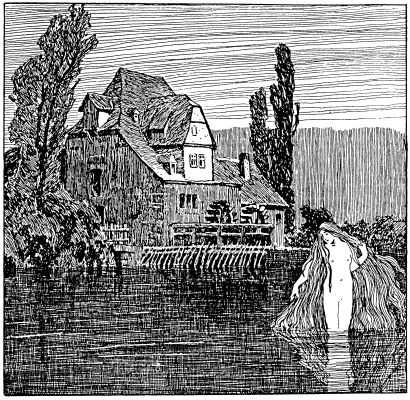
Nixie of the Mill-Pond
Image associated with the exact linked encyclopedia article; consult credited file description for its interpretation.
Overview
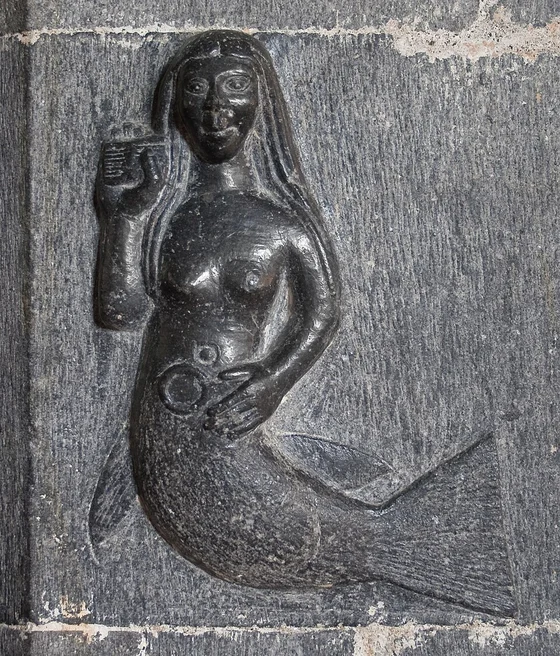
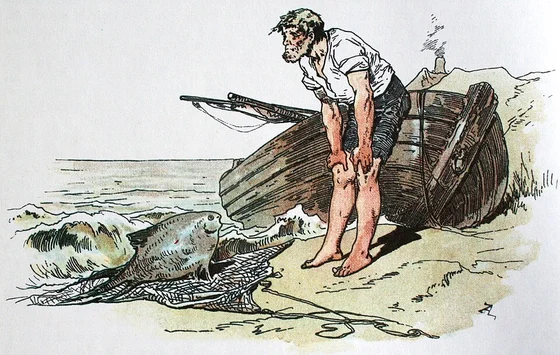
The mill-pond nixie approaches a distressed miller at dawn as a beautiful woman, her long hair covering her pale body while her hands hold it from her shoulders. She knows his name and speaks reassuringly, offering prosperity in exchange for the young thing just born in his house. Imagining a puppy or kitten, he agrees; returning home, he learns his wife has borne a son. The story represents the nixie as knowing what he did not. Wealth returns, but it cannot remove his fear of the bargain. He repeatedly warns the boy that touching the pond will expose him to a hand drawing him beneath the surface. Years pass without her appearance. The grown son becomes a huntsman and marries, then forgets the boundary while washing blood from his hands after a hunt. The nixie rises smiling, wraps wet arms around him and carries him down. The text does not describe a fish tail.
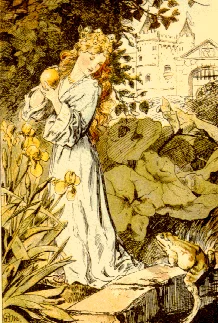
The huntsman's wife finds his hunting pouch on shore and calls in vain across an outwardly calm pond. A dream leads her to an old woman whose cottage she subsequently reaches in waking life. At successive full moons, a golden comb, flute and spinning wheel are placed beside the water and taken by waves. After the first, only the husband's head emerges; after the second, half his body; after the last, his whole body rises in a water-spout and he escapes. The pond then floods the countryside. The wife's appeal to her helper changes the couple into a toad and frog, preserving their lives but separating them. Once on dry land they regain human form and become shepherds in unfamiliar countries. Years later, under another full moon, the husband plays the sorrowful tune heard during the rescue, and shared recollection brings recognition. This prolonged aftermath distinguishes release from immediate reunion. The source records a particular water-being's bargain, captivity and pursuit; wider nix traditions require their own regional witnesses.
Origins & earliest records
This entry follows tale 181 in the Grimm brothers’ Household Tales, using Margaret Hunt’s 1884 English translation. The collection was repeatedly revised during the nineteenth century and mediates material from storytellers and earlier literature. Its publication and translation dates identify the selected witness, not the beginning of every related oral narrative.
Records & interpretation
The numbered tale supplies the being’s appearance, speech and actions in a collected literary narrative. It documents storytelling and editorial transmission, rather than biological existence or actual animal behaviour. Different editions and related oral tales may alter transformations, endings or motives; the selected passage is identified so those differences can be compared.
In the literature
“drew him quickly down under the waves, which closed over him.”
Tale 181 The Nix of the Mill-Pond; paragraph beginning “One day the huntsman was chasing a roe; and when the animal…” · Margaret Hunt
The nix captures the miller’s grown son when he washes in the pond.
Selected bibliography
Documented works and useful reading. This is not a list of every appearance.
- 01
Household Tales, tale 181: The Nix of the Mill-Pond
Specific public-domain collected tale inspected. The selected English edition is a literary witness, not a transcript of a universal oral version.
- 02
Household Tales: 181 The Nix of the Mill-Pond
Margaret Hunt’s English translation, London: George Bell and Sons, 1884; Gutenberg e-text identifies Hunt. Translation date corroborated by the Wikisource scanned title page and National Library of New Zealand catalogue.
Family & connections
A source-supported family tree or inspiration record has not yet been compiled for this profile. Related reading below indicates a connection in subject matter, not a proven lineage or creative influence.
Located primary passages
Specific passages supporting details in this entry, grouped by their published witness.
Household Tales, tale 181: The Nix of the Mill-Pond
Margaret Hunt’s English translation, London: George Bell and Sons, 1884; Gutenberg e-text identifies Hunt. Translation date corroborated by the Wikisource scanned title page and National Library of New Zealand catalogue.
- The nix captures the miller’s grown son when he washes in the pond.
- The nix’s prosperity bargain claims the newborn at the miller’s home, which turns out to be his son.
This describes the version printed in Hunt’s translation; German tale origin and other versions require separate evidence.
Encyclopedia background
An additional attributed reference, separate from the editorial profile above.
Read the open encyclopedia overview
"The Nixie of the Mill-Pond" (German: Die Nixe im Teich) is a German fairy tale that tells the story of a man captured by a nix (water spirit) and his wife's efforts to save him. The Brothers Grimm collected the tale in their Grimm's Fairy Tales (1857) as tale number 181. A note in the volume indicated that it was current in Upper Lusatia when the story was collected. Andrew Lang included a version in The Yellow Fairy Book, citing his source Hermann Kletke and titling it The Nixy.
It is classified as Aarne-Thompson Type 316, "The Nix of the Mill-Pond". This fairy tale type that falls under the larger category of "Supernatural Adversaries" and is characterized by a hero's parents being promised wealth or gifts in exchange for their child. This tale type is most common in Northern Europe and some variants have been recorded in Scotland.
Text from Wikipedia contributors, “The Nixie of the Mill-Pond”. CC BY-SA 4.0. Extracted introduction; formatting changed. Retrieved 5 October 2026. The source article may have changed since retrieval.
References
Sources supporting this profile. Linked pages have their own scope and editorial standards.
- Primary textGrimm/Hunt, Household Tales, tale 181Research access: 2026-10-05
Image credits
Reference illustrationNixie of the Mill-Pond
Image associated with the exact linked encyclopedia article; consult credited file description for its interpretation.