Enchanted Flounder
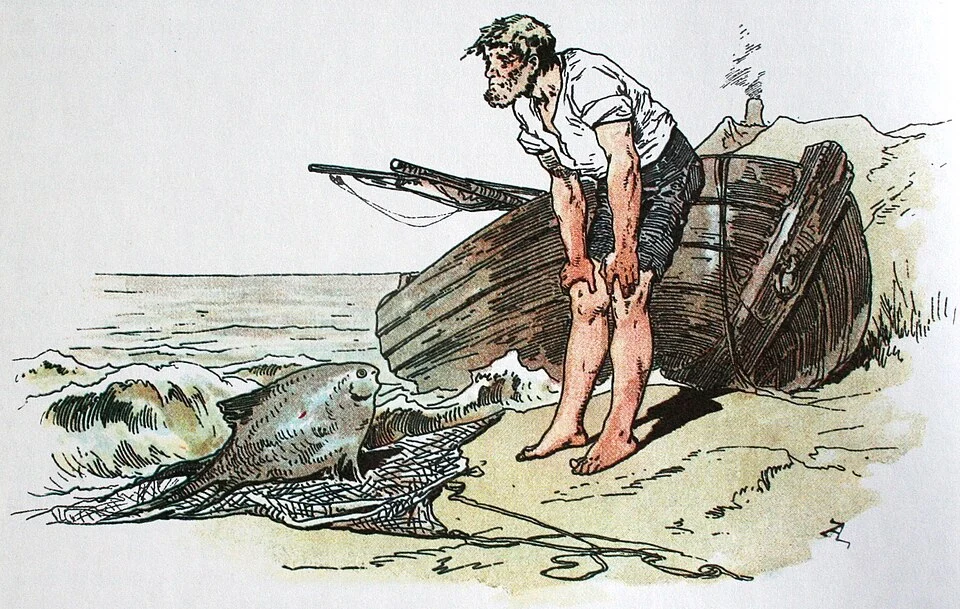
Image associated with the exact linked encyclopedia article; consult credited file description for its interpretation.
Overview
The flounder in Hunt’s Grimm tale 19 is caught by a poor fisherman living with his wife in a hovel beside the sea. It asks to be released, identifies itself as an enchanted prince and says it would not be good to eat. The fisherman lets it go because a talking fish is already sufficient reason for him to spare it. He asks for no reward at that first meeting. A trail of blood remains as the fish descends, but the tale gives no subsequent account of its injury or of how the enchantment began.
The fisherman’s wife, Ilsabil, sends him back to request a cottage. He calls the fish with a repeated verse that distinguishes his own reluctance from her wishes. The flounder asks what she wants and tells him that she already has it. At home he finds a furnished cottage, a small yard with poultry and a garden. After a week or two she wants a stone castle; the same encounter produces a palace with servants, rich furnishings, stables, gardens and a park.
The demands then shift from possessions to authority. Ilsabil asks to be king, then emperor and then pope, retaining those titles in this translation. The fisherman objects at each escalation, sometimes declaring the requested promotion impossible, yet the fish grants it. The imperial scene includes exaggerated scale: an enormous throne and a line of guards ranging from a giant to a tiny dwarf. These belong to the wish-created court; they are not a separate explanation of the flounder’s ancestry or a population of fish-princes.
The sea changes throughout the repeated journeys. It begins clear and calm, becomes discoloured and foul-smelling, then darkens and grows turbulent. By the request for papal authority, ships struggle in a violent storm. The text accompanies the escalating wishes with these disturbances but does not have the fish announce that it is personally commanding every wave or cloud.
Still dissatisfied, Ilsabil watches dawn and demands power to make the sun and moon rise, describing the wish as becoming like God. The terrified fisherman returns through a still greater storm. This time the flounder tells him that she is back in the original hovel, where the narrator says the couple remain. No restored human prince appears, and no release from the fish’s enchantment is reported. The story establishes a series of granted wishes and a final reversal, rather than a fixed three-wish bargain or a complete biography of its supernatural benefactor.
Origins & earliest records
This entry follows tale 19 in the Grimm brothers’ Household Tales, using Margaret Hunt’s 1884 English translation. The collection was repeatedly revised during the nineteenth century and mediates material from storytellers and earlier literature. Its publication and translation dates identify the selected witness, not the beginning of every related oral narrative.
Records & interpretation
Complete tale 19 in Margaret Hunt’s Grimm translation read from opening through ending. The passage supplies this narrative’s events and relationships, not observational evidence for a biological species. Complete sequence cottage, castle, king, emperor and pope precedes the final request and reversal. The prince’s identity is self-reported; neither the cause nor removal of his enchantment is narrated.
In the literature
“I am no Flounder really, but an enchanted prince.”
Tale 19 The Fisherman and His Wife; paragraph beginning “There was once on a time a Fisherman who lived with his…” · Margaret Hunt
The speaking flounder identifies himself as an enchanted prince.
Selected bibliography
Documented works and useful reading. This is not a list of every appearance.
- 01
Household Tales, tale 19: The Fisherman and His Wife
Complete selected English tale read, including the ending and transformation sequence. The translation is a located literary witness, not a claim to the first oral telling.
- 02
Household Tales: 19 The Fisherman and His Wife
Margaret Hunt’s English translation, London: George Bell and Sons, 1884; Gutenberg e-text identifies Hunt. Translation date corroborated by the Wikisource scanned title page and National Library of New Zealand catalogue.
Family & connections
A source-supported family tree or inspiration record has not yet been compiled for this profile. Related reading below indicates a connection in subject matter, not a proven lineage or creative influence.
Located primary passages
Specific passages supporting details in this entry, grouped by their published witness.
Household Tales, tale 19: The Fisherman and His Wife
Margaret Hunt’s English translation, London: George Bell and Sons, 1884; Gutenberg e-text identifies Hunt. Translation date corroborated by the Wikisource scanned title page and National Library of New Zealand catalogue.
- The speaking flounder identifies himself as an enchanted prince.
- The flounder grants the initial cottage request; check the complete paragraph for “she has it already”.
- The fish grants the wife’s request to become pope before her final demand.
- The final demand to be like God returns the couple to their original poverty.
This describes the version printed in Hunt’s translation; German tale origin and other versions require separate evidence.
References
Sources supporting this profile. Linked pages have their own scope and editorial standards.
- Primary textGrimm/Hunt, complete tale 19Research access: 2026-10-05
Image credits
Reference illustrationEnchanted Flounder
Image associated with the exact linked encyclopedia article; consult credited file description for its interpretation.