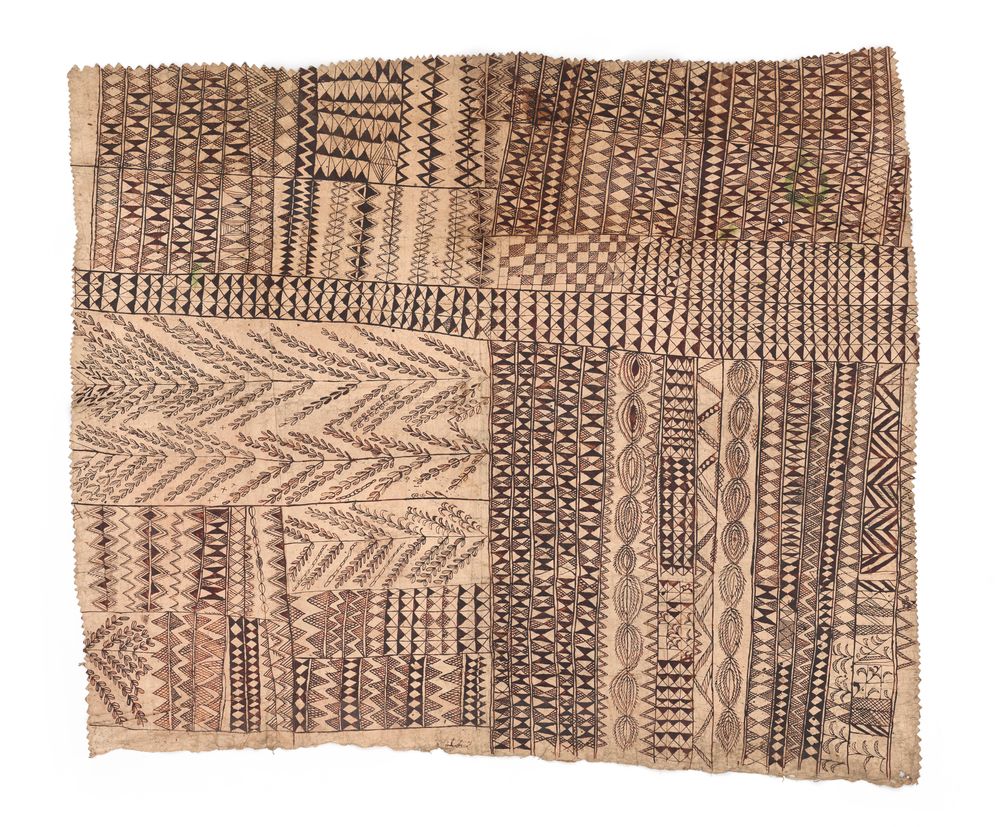
Nineteenth-century Niuean hiapo barkcloth with geometric and plant-like patterns, Te Papa FE000278
This nineteenth-century hiapo from Niue is decorated with geometric and plant-like motifs. Te Papa identifies the maker as unknown and records it in the Augustus Hamilton Collection. It is one historical example of Niuean barkcloth, rather than a portrait of contemporary community members or a complete account of their artistic practices.
Overview
Niueans are a living people with a homeland on Niue and communities abroad. The Tāoga Niue Department describes heritage as encompassing language, customs, arts, crafts and history, with responsibilities connecting individuals, families, villages and the country. Its account includes descendants overseas who retain their affiliation and people who adopt Niue as their home. The department expressly distinguishes the wider heritage from the agency that coordinates its care. This gives a community-grounded understanding of belonging rather than reducing identity to island residence or a government office. Vagahau Niue is central to transmission, but institutional language advocacy does not establish that every descendant has the same proficiency or experience.
The government’s cultural overview presents village show days as occasions for food, handicrafts and shared enjoyment. Bags and hats made with locally prepared materials are part of the arts it highlights; decorated vehicles circulating around the island feature in its account of takai. Churches and several denominations also have an important place in community life. These are selected public descriptions, not requirements that define every Niuean household. The government’s historical timeline identifies self-government in free association with New Zealand as the choice made in 1974. This constitutional milestone belongs to political history, rather than marking the beginning of Niuean culture or equating citizenship with ancestry.
Care for material heritage has involved recovery as well as display. The national museum records that Huanaki opened in 1987 and was destroyed by Cyclone Heta in 2004. Fale Tau Tāoga opened in October 2018 and houses museum and archive collections. Its holdings include carving, fishing and building tools, weaving, shell ornaments, photographs, storm-salvaged material and repatriated deposits. Shared storage presents conservation challenges; an outside auditorium supports performances and workshops. The museum’s objectives include strengthening language and identity through exhibitions and activities. These concrete institutions show heritage being collected, restored and discussed, rather than a timeless collection with an unbroken building history.
Language work continues across borders. A 2020 Ministry for Pacific Peoples report describes New Zealand’s Niue Language Week as an annual programme celebrated since 2012, with that year’s online activities encouraging daily learning and transmission to future generations. It also places Pacific-language public communication in the particular context of the COVID-19 response. Schools offer another setting: the Education Review Office’s 2025 Favona School report identifies a Niuean language-enrichment unit alongside separate Māori, Samoan and Tongan units. It describes learning that connects culture, language and identity. A particular school and a dated national programme are examples of diaspora practice, not a measure of language use throughout all Niuean communities.
History & identity
A living community account based on Niuean heritage institutions and specific diaspora programmes. The government's 1974 self-determination milestone is political history, not an ethnic founding date. Settlement traditions and early archaeological chronology require their own qualified sources.
Sources & representation
Official Niuean heritage and museum self-description is combined with the government's selected cultural overview, a dated New Zealand language-week report and a scoped school inspection. Agency responsibilities, collections and programme observations are kept distinct from universal claims about individuals.
Selected bibliography
Documented works and useful reading. This is not a list of every appearance.
- 01
Tāoga Niue: heritage, ownership and mission
Complete indexed meaning, ownership, mission and guiding-principles sections read. Heritage distinguished from the coordinating agency; no dated staff roster used.
- 02
Our History and Traditions and Culture
Complete cultural overview and chronology read. Selected crafts, village show days, takai and 1974 self-government; undated population and fixed identity-origin dates omitted.
- 03
National Museum
Complete museum history, collection and objectives read: Huanaki 1987, Heta 2004 and new facility 2018. Conflicting opening-hours text not used.
- 04
Niue Language Week lays foundations for future generations
Complete indexed report dated 18 October 2020 read. Annual programme and that year’s online learning and public communication retained; old census numbers omitted.
- 05
Favona School: 2025 school report
Complete About the School and Areas of Strength sections of 2025 report read. Niuean language-enrichment unit identified; no disputed first-opening date asserted.
Language & cultural connections
Source-supported language and cultural connections have not yet been compiled for this profile.
References
Sources supporting this profile. Linked pages have their own scope and editorial standards.
- Community institutional self-descriptionTāoga Niue: heritage, ownership and missionResearch access: 2026-10-05
- Government cultural documentationOur History and Traditions and CultureResearch access: 2026-10-05
- Museum documentationNational MuseumResearch access: 2026-10-05
- Government programme reportNiue Language Week lays foundations for future generationsResearch access: 2026-10-05
- School inspection documentationFavona School: 2025 school reportResearch access: 2026-10-05
Image credits
Contextual cultural object photographNineteenth-century Niuean hiapo barkcloth with geometric and plant-like patterns, Te Papa FE000278
This nineteenth-century hiapo from Niue is decorated with geometric and plant-like motifs. Te Papa identifies the maker as unknown and records it in the Augustus Hamilton Collection. It is one historical example of Niuean barkcloth, rather than a portrait of contemporary community members or a complete account of their artistic practices.