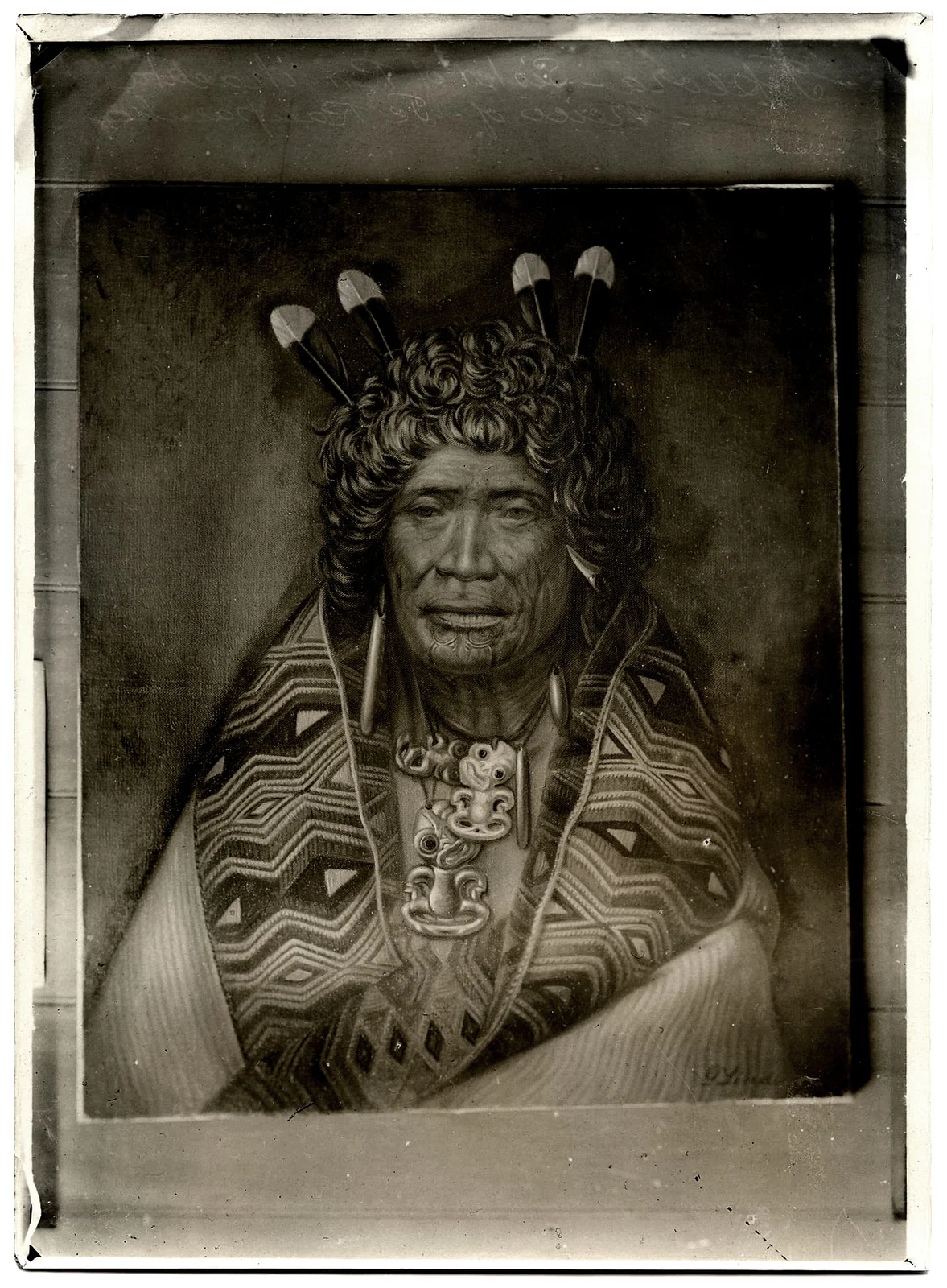
Historical monochrome reproduction of Gottfried Lindauer’s named portrait of Te Rangitopeora, with patterned cloak, hair ornaments and pendants; original photograph borders and wear remain visible.
Te Rangitopeora of Ngāti Toa and Ngāti Raukawa, as portrayed by Gottfried Lindauer. This archival reproduction is an artist’s representation of a named individual, not a photograph from life or an image of all contemporary Ngāti Toa.
Overview
Ngāti Toa Rangatira's public institutional account describes a rohe extending south from the Whangaehu River to Turakirae and across Cook Strait to Marlborough and Nelson. It identifies Te Rūnanga o Toa Rangatira as the mandated iwi authority, established in 1990 to administer collective affairs and assets. The organisation lists environmental management, public relationships, fisheries, social services and health among its responsibilities. Its mission connects self-determination and cultural identity with present-day community wellbeing. These are the institution's own descriptions of representation and purpose; its establishment date is not the origin of the iwi, and the stated range of responsibilities does not establish that every member uses its services.
Pātaka Toa's education and employment page presents support across different stages of learning and work. It lists early childhood provision, literacy development, primary and secondary support, Māori student assistance at Whitireia and a learning space grounded in Toa identity. Other services address career choices, work preparation and driving qualifications, while leadership and design initiatives include programmes still developing. This range places language and belonging within practical pathways rather than treating cultural activity as separate from employment or technology. The webpage is a service provider's account of provision and aspirations; its statements do not independently measure participation, qualifications gained or long-term changes in people's lives.
Te Kete Hāpai provides another view of cultural continuity through support for language, shared places and family connections. Its public statement proposes tailored language-learning opportunities and cooperation with marae committees on investment and care for facilities. It also describes assistance for whānau with children and support intended to preserve older members' autonomy. These are organisational priorities linking intergenerational relationships with access and practical needs. Administrative grant criteria remain distinct from the wider meaning of Ngāti Toa belonging. The account is not a description of private family circumstances, nor were the learning sessions, facilities, practical cultural procedures or individual grant applications inspected through the webpage.
Raewyn Klenner's 16 June 2026 announcement records Kathleen O'Hare's appointment as founding leader of Kura Toa. Her stated Te Ātiawa ki Waiwhetū and Ngāti Tūwharetoa affiliations are retained as individual identifications, rather than replaced by the school sponsor's iwi identity. The report describes her educational experience and the establishment board's hopes for learning that connects achievement, belonging and wellbeing. It states that the first cohort was expected in the first term of 2027, distinguishing preparation from an already operating school. This is a dated institutional announcement with named voices; future attendance, programme delivery and student results are not inferred from the appointment or the board's aspirations.
History & identity
The rūnanga establishment and programme dates concern institutions, not the origin of iwi identity.
Sources & representation
Four complete native public bodies read; actual June 2026 date metadata confirmed.
Selected bibliography
Documented works and useful reading. This is not a list of every appearance.
- 01
Te Rūnanga o Toa Rangatira
Complete written body read; collective institution distinct from iwi origin.
- 02
Education To Employment
Complete written body read; listed provision and developing initiatives distinguished.
- 03
Te Kete Hāpai
Complete written body read; public aims only, no individual applications inspected.
- 04
Kura Toa appoints founding Tumuaki
Complete announcement read; 16 June 2026 metadata, first 2027 cohort prospective.
Language & cultural connections
Source-supported language and cultural connections have not yet been compiled for this profile.
References
Sources supporting this profile. Linked pages have their own scope and editorial standards.
- Public iwi institutional self-accountTe Rūnanga o Toa RangatiraResearch access: 2026-10-05
- Public iwi institutional self-accountEducation To EmploymentResearch access: 2026-10-05
- Public iwi institutional self-accountTe Kete HāpaiResearch access: 2026-10-05
- Public iwi institutional self-accountKura Toa appoints founding TumuakiResearch access: 2026-10-05
Image credits
Contextual named historical portrait reproductionHistorical monochrome reproduction of Gottfried Lindauer’s named portrait of Te Rangitopeora, with patterned cloak, hair ornaments and pendants; original photograph borders and wear remain visible.
Te Rangitopeora of Ngāti Toa and Ngāti Raukawa, as portrayed by Gottfried Lindauer. This archival reproduction is an artist’s representation of a named individual, not a photograph from life or an image of all contemporary Ngāti Toa.