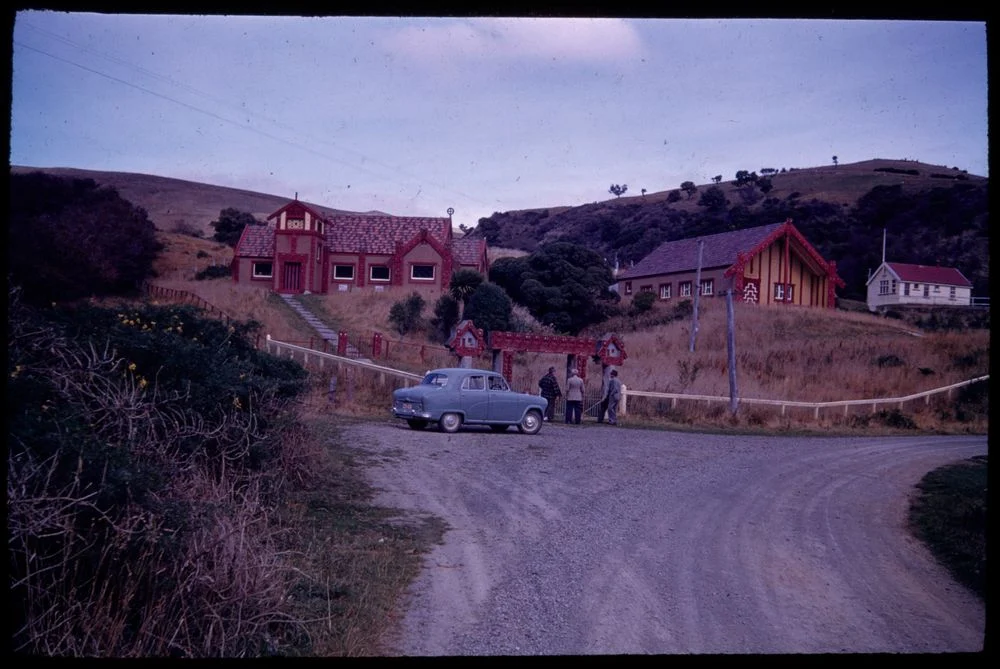
Ōtākou church, Tamatea meeting house and school on the Otago Peninsula, photographed by Leslie Adkin in 1959, Te Papa CT.010423
Adkin’s 1959 colour slide records the church, Tamatea meeting house and school at Ōtākou, a Ngāi Tahu community on the Otago Peninsula. The original slide edges and colour cast are retained. It shows these institutions at a particular date; the people near the entrance are not individually identified.
Overview
Ngāi Tahu’s own regional account describes an individual’s relationships within whānau and hapū, which collectively unite as an iwi. It identifies 18 Papatipu Rūnanga across Te Waipounamu, each with its own governance and circumstances shaped by local people, environments, towns and cities. Regional responsibilities include maintaining marae, welcoming visitors, supporting younger generations and sustaining hapū stories. Each rūnanga appoints a representative to Te Rūnanga o Ngāi Tahu, which manages collective assets and supports regional communities. The account presents a relationship between local and collective institutions, while expressly recognising that the rūnanga differ. It is a specific community framework rather than a generic model for every Māori iwi.
Cultural knowledge is also being organised through Kā Huru Manu, the Ngāi Tahu mapping project. Its institutional account describes a digital landscape recording stories, place names and older travel routes. Referenced evidence includes whānau manuscripts, published books, nineteenth-century maps, newspapers and unpublished material. The Ngāi Tahu Archive Team administers the project with Papatipu Rūnaka. The account names Trevor Howse’s research during the claim period as an important contribution and connects new mapping technology with knowledge gathered earlier. This is a community-led archival process using different documentary witnesses. The project overview does not amount to independent inspection of every mapped place or access to all underlying manuscripts.
Kotahi Mano Kāika’s strategy addresses intergenerational language use in homes and communities. Its published priorities concern making language learning attractive, enabling more people to participate and building advocates and coordinated relationships. It also identifies practical difficulties, including educator capacity, access to suitable education and competing priorities. The page retains older strategy documents and a vision of a thousand households using te reo Māori by 2025. That date belongs to the programme’s stated aspiration, not an automatic claim of success once the year elapsed. The strategy places language transmission in everyday family and community settings, while acknowledging the work required to expand those settings.
Anna Brankin’s February 2025 Te Karaka report supplies a more recent, named account of progress. It traces the programme’s launch to 2000 and identifies Hana O’Regan, Tahu Pōtiki and other advisory contributors, followed by early implementation involving Lynne Te Aika and colleagues. Programme manager Paulette Tamati-Elliffe describes learning across generations, while Charisma Rangipunga discusses raising her own children with te reo Māori. The report distinguishes the many households engaged from the still-unrealised target of a thousand homes using Kāi Tahu reo as their first language. These attributed accounts give family experience and institutional progress distinct places without treating all Ngāi Tahu households as linguistically identical.
History & identity
Contemporary iwi and programme accounts document regional relationships and cultural work; governance and strategy dates describe institutions rather than the origin of an identity.
Sources & representation
Complete regional, mapping and strategy bodies plus named sections of a 2025 community report document governance, archives and language renewal.
Selected bibliography
Documented works and useful reading. This is not a list of every appearance.
- 01
Papatipu Rūnanga
Complete explanatory body read; whānau/hapū/iwi, regional diversity and 18 representatives distinguished.
- 02
Ngāi Tahu Atlas Kā Huru Manu
Complete project account read; source types, archive team and Trevor Howse contribution retained; atlas entries not individually inspected.
- 03
Our Strategy
Complete priorities and challenges body read; older strategy framing and goals not treated as realised 2026 outcomes.
- 04
Kotahi Mano Kāika --25 years strong
Opening strategy/history and Tamati-Elliffe/Rangipunga testimony sections read; household engagement distinct from first-language goal; no full-article claim.
- 05
Making the pen mightier than the taiaha
Te Karaka community website, 5 April 2015.
Language & cultural connections
Source-supported language and cultural connections have not yet been compiled for this profile.
Located primary passages
Specific passages supporting details in this entry, grouped by their published witness.
Making the pen mightier than the taiaha
2015
- Coates describes a Ngāi Tahu writers’ gathering at Waihao and argues that writing deserves recognition alongside other artistic practices. His discussion connects publication, audiences and responsibility for other people’s stories. This is an individual dated literary position, not a comprehensive account of contemporary community life.
Complete essay, opening Waihao wānanga account through final argument for writers as artists.
Appended creative examples are not reproduced or treated as factual ethnography. No underlying novels, workshop proceedings or ceremonial materials independently inspected.
References
Sources supporting this profile. Linked pages have their own scope and editorial standards.
- Iwi governance and community self-descriptionPapatipu RūnangaResearch access: 2026-10-05
- Community archive and mapping accountNgāi Tahu Atlas Kā Huru ManuResearch access: 2026-10-05
- Iwi language-programme strategyOur StrategyResearch access: 2026-10-05
- Named community journalist and programme participantsKotahi Mano Kāika --25 years strongResearch access: 2026-10-05
Image credits
Historical contextual community institution photographŌtākou church, Tamatea meeting house and school on the Otago Peninsula, photographed by Leslie Adkin in 1959, Te Papa CT.010423
Adkin’s 1959 colour slide records the church, Tamatea meeting house and school at Ōtākou, a Ngāi Tahu community on the Otago Peninsula. The original slide edges and colour cast are retained. It shows these institutions at a particular date; the people near the entrance are not individually identified.