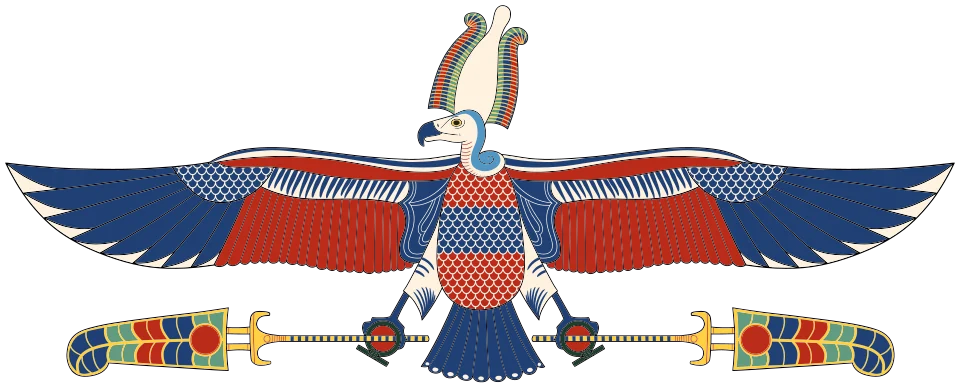
Nekhbet
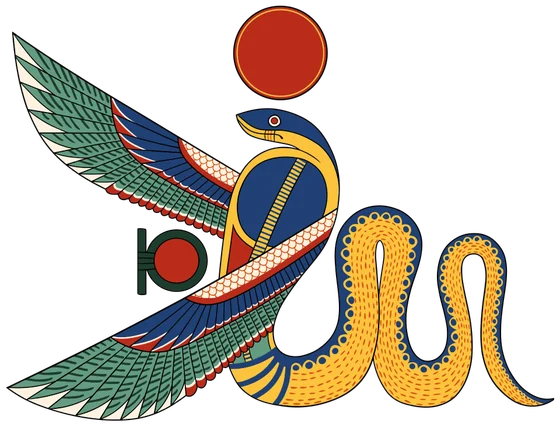
Modern vector interpretation of Egyptian deity iconography, based on historical representations; not a photograph or an original ancient painting. See the credited file description for shared iconography and artistic liberties.
Overview
Nekhebit stands with Uatchit in the winged-disk narrative, where their serpent forms overwhelm enemies through fear. The translation identifies her as the goddess of the south and associates her with one side of Horus’s emblem. The form belongs to this textual episode; it does not erase the vulture imagery known from other contexts. A catalogue identification should therefore distinguish a named narrative manifestation from a general claim about anatomy.
The text explicitly identifies Nekhebit as the southern goddess and pairs her with the northern Uatchit. Her serpent manifestation accompanies Horus in the solar setting, where the enemy’s loss of courage precedes defeat. The pair’s placement beside the emblem links animal form with territorial distinction, rather than making the two names interchangeable.
Origins & earliest records
The source spelling Nekhebit is treated as Nekhbet, not as a distinct being. The selected chapter does not date the first use of her image.
Records & interpretation
The selected attestation is Horus of Edfu and winged disk, Nekhebit in Budge’s translated collection. It documents a textual or ritual representation; commentary and later classical accounts are labeled where used. It does not establish zoological existence, a first oral telling, or a uniform belief shared by all Egyptians.
In the literature
“that they might make the enemies to quake in [all] their limbs”
Horus of Behutet and the Winged Disk; paragraph beginning “Then Heru-Behutet took upon himself the form of the Winged Disk,…” · E. A. Wallis Budge
Nekhebet and Uatchet take serpent forms beside Heru-Behutet’s winged disk during pursuit of the divine enemies.
Selected bibliography
Documented works and useful reading. This is not a list of every appearance.
- 01
Legends of the Gods: The Egyptian Texts
Selected witness: Horus of Edfu and winged disk, Nekhebit. Historical translation and commentary; not an exhaustive bibliography.
- 02
Legends of the Gods: The Egyptian Texts, edited with Translations
London,1912; historical English text edited by E.A.WallisBudge. Ancient narrative/ritual translation, separate from modern introduction and footnotes.
Family & connections
A source-supported family tree or inspiration record has not yet been compiled for this profile. Related reading below indicates a connection in subject matter, not a proven lineage or creative influence.
Located primary passages
Specific passages supporting details in this entry, grouped by their published witness.
Legends of the Gods: The Egyptian Texts
London,1912; historical English text edited by E.A.WallisBudge. Ancient narrative/ritual translation, separate from modern introduction and footnotes.
- Nekhebet and Uatchet take serpent forms beside Heru-Behutet’s winged disk during pursuit of the divine enemies.
Specific ancient textual version in a historical English witness; names Uatchet/Nekhebet/Seb/Nu are historical renderings, not separate beings. Plutarch’s version and bracketed restorations must not be universalized. Ritual speech is literary evidence, not an instruction to perform healing or protective practices.
Encyclopedia background
An additional attributed reference, separate from the editorial profile above.
Read the open encyclopedia overview
Nekhbet (; also spelt Nekhebet) is an early predynastic local goddess in Egyptian mythology, who was the patron of the city of Nekheb (her name meaning of Nekheb). Ultimately, she became the patron of Upper Egypt and one of the two patron deities (alongside Wadjet) for all of Ancient Egypt when it was unified.
Text from Wikipedia contributors, “Nekhbet”. CC BY-SA 4.0. Extracted introduction; formatting changed. Retrieved 5 October 2026. The source article may have changed since retrieval.
References
Sources supporting this profile. Linked pages have their own scope and editorial standards.
- Primary-text translation and historical commentaryLegends of the Gods — Horus of Edfu and winged disk, NekhebitResearch access: 2026-10-05
Image credits
Thematic illustrationNekhbet
Modern vector interpretation of Egyptian deity iconography, based on historical representations; not a photograph or an original ancient painting. See the credited file description for shared iconography and artistic liberties.