A sourced illustration has not yet been added. This gap is included in the coverage record.
Overview
Naro communities form part of the diverse peoples described collectively as San. This profile follows the particular cultural work documented in and around D’Kar in Botswana; it does not substitute one project for all Naro lives. The Kuru Art Project identifies both Naro and Dcui participants, keeping these identities distinct within a shared institution. Established in 1990 through the Kuru Development Trust’s cultural initiative, the project supplies facilities for experimentation rather than presenting itself as a school imposing an artistic style. Oil painting, lithography, linocut and etching become ways for participating artists to represent animals, plants, stories and their own experiences. Cultural continuity here includes the use of new materials, rather than requiring an unchanged form of expression.
Qauqaua provides a specific example of collaboration between spoken narrative, language development and a printed work. Kuru’s publication account says that artists selected the story from Naro narratives gathered at a D’Kar storytelling workshop in 1994, and credits Coex’ae Qgam, known as Dada, as its teller. The Naro-and-English translations were made through the Kuru Cultural Centre’s language programme, managed by Hessel and Coby Visser. Named artists contributed aluminium-plate lithographs, while others made linocuts combined with text. Proofing occurred in D’Kar before printing in Johannesburg at the Artists’ Press. The account identifies both local narrative and artistic contributions and the technical collaborators; it does not turn an editor or translator into the original storyteller.
Individual histories show how music and art meet everyday work. Kuru’s biography of Xgara Qoma describes childhood on farms around D’Kar and later employment erecting fences as a farm labourer. It records his thumb-piano playing and his learning guitar on farms, where he played for New Year celebrations. After returning to D’Kar in 1997, he joined the Naro Giraffe Dance Group, performing locally and for visitors. The same account dates his entry into the Kuru Art Project to 2018 and names an exhibition that year. His experience connects farm employment, different musical instruments, public dance and visual art in one person’s trajectory. It is a situated example of participation, rather than a rule about what every Naro person does.
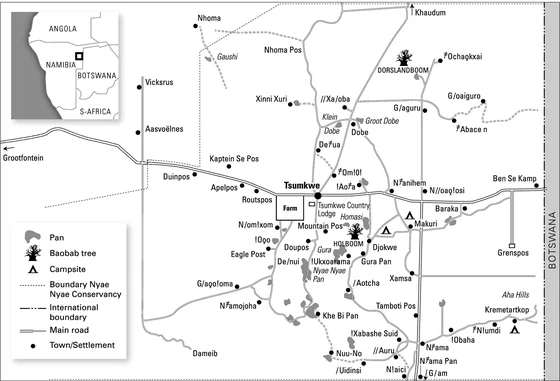
Community enterprise adds another context to the arts documented in D’Kar. Botswana Tourism’s 2024–2025 accommodation directory identifies Dqae Qare Game Reserve near Ghanzi as a community-based project owned by people of D’Kar. Its stated aims combine employment and income with sustaining indigenous knowledge through tourism. The listing offers accommodation and guided activities, locating cultural presentation within an organised visitor economy. This is a dated tourism-board account of a particular enterprise, not proof of household income gains or a definition of Naro life. The village project’s community ownership is not made an assertion that every participant has the same identity.
History & identity
This account concerns a living community and identifiable cultural projects, not a dated beginning of Naro identity. Kuru dates its art initiative to 1990 and describes later language-and-publication collaborations in D’Kar. Those institutional dates do not date the language or its oral traditions.
Sources & representation
Complete Kuru project, publication and artist-biography pages were read. They are firsthand institutional records of participating artists and collaborations, with named contributions. The Qauqaua catalogue establishes production provenance; the complete book’s narrative was not inspected here. Coverage of wider Naro communities, contemporary language use and individual perspectives remains incomplete.
Selected bibliography
Documented works and useful reading. This is not a list of every appearance.
- 01
About Kuru Art
Complete institutional history and practice account; Naro/Dcui participants,1990 initiative, facilities and materials. Generalised disappearance-of-lifestyle and automatic ancestry claims not adopted.
- 02
Qauqaua
Complete publication provenance:1994 workshop, Dada teller, named artists, language programme, proofing and printing. Catalogue read, not complete narrative.
- 03
Xgara Qoma
Complete artist biography: farm employment, thumb piano/guitar,1997 return/dance group,2018 project entry and exhibition. Individual history only.
- 04
Botswana Accommodation Directory 2024–2025: Dqae Qare
Complete Dqae Qare entry, printed231/PDF233, read; ownership and stated project aims.
Language & cultural connections
Source-supported language and cultural connections have not yet been compiled for this profile.
References
Sources supporting this profile. Linked pages have their own scope and editorial standards.
- Community arts institution documentationAbout Kuru ArtResearch access: 2026-10-05
- Community arts institution documentationQauqauaResearch access: 2026-10-05
- Community arts institution documentationXgara QomaResearch access: 2026-10-05
- Tourism-board community enterprise listingBotswana Accommodation Directory 2024–2025: Dqae QareResearch access: 2026-10-05
Image credits
A sourced illustration has not yet been added. This gap is included in the coverage record.