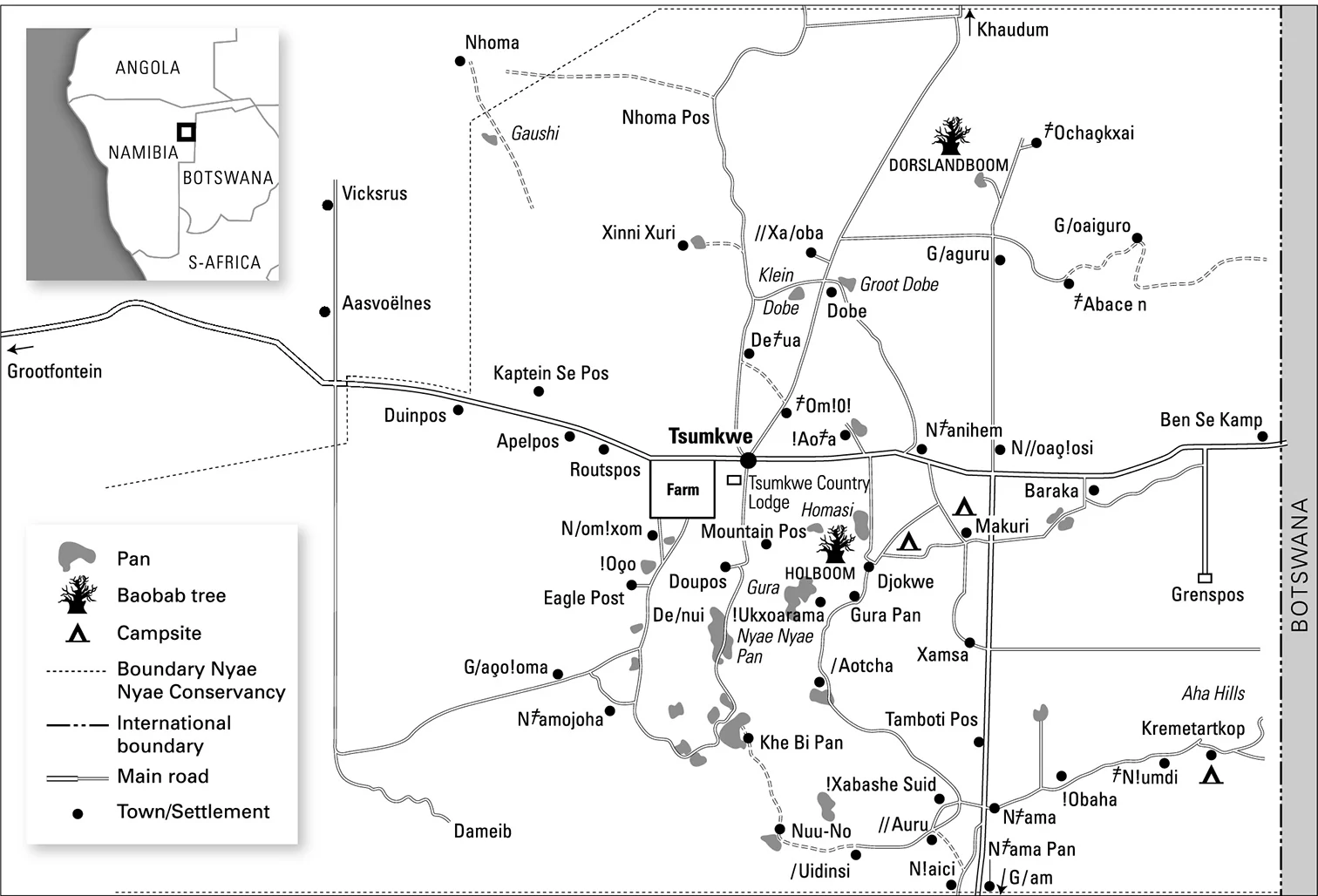
Dated Nyae Nyae Conservancy research map showing settlements, pans, roads, campsites, baobab markers, its boundary and a Namibia location inset.
Nyae Nyae Conservancy map cited to Koot’s 2013 research and reproduced in a 2017 study of Ju/’hoansi livelihoods. Its labels and boundaries describe that research context; it is not a current or comprehensive map of Ju/’hoansi communities.
Overview
Ju/’hoansi are a particular linguistic and cultural community within the wider range of peoples described as San. This account focuses on Nyae Nyae in north-eastern Namibia, rather than treating every San community as culturally identical. The Ju/’hoansi Development Fund places local life within a history of seasonal movement and knowledge of the Kalahari environment. Its account describes decisions reached through discussion and consensus, alongside changing structures of representation. The community’s name, language and relationships to land are more specific than Namibian citizenship, and the regional focus here does not exhaust Ju/’hoansi communities across the border in Botswana.
Access to ancestral land is central to the account in Water, Land and a Voice, published by the Nyae Nyae Development Foundation. It describes the n!ore system as providing access to land for hunting and gathering, alongside newer livestock activities. The book documents the June 1998 formation of Nyae Nyae Conservancy and the March 2013 community-forest gazettement as different mechanisms for managing and benefiting from resources. It also records consultation around a recognised Traditional Authority. These institutions have supported public representation while land access remained contested; the publication does not present conservation status as a complete solution to tenure.
Education brings the relationship between local knowledge and public institutions into practical view. The Village Schools Project promotes early education in the learners’ mother tongue and first-language literacy materials. Its account describes long journeys, limited food and transport, deteriorating facilities and inadequate teacher accommodation as barriers. Parents’ concerns about how children are cared for are distinguished from indifference to learning. The project also describes parents, conservancy representatives and Traditional Authorities seeking ownership of education. Those aspirations connect schooling with families and language rather than treating education as a simple replacement for community knowledge.
A dated example is the Den/ui school opening reported by the Ju/’hoansi Development Fund on 28 April 2022. The new entry-level school was staffed by Ju/’hoansi teachers and matrons for Ju/’hoansi children, through a partnership involving the education ministry, the fund, the local Traditional Authority and the conservancy. Cultural presentation has also included living museums. In a report dated 12 March 2026, the Living Culture Foundation Namibia states that the Living Hunter’s Museum at /Xa//oba closed in January and describes plans for a new site near Tsumkwe; its current museum page likewise says it is not operating. Schools, resource institutions and museums therefore document different settings of contemporary participation, rather than one unchanged historical way of life.
History & identity
The profile follows a living regional community rather than assigning a founding date to Ju/’hoansi identity. The development foundation’s 2018 review explains how reduced access to land and efforts to return to former settlement areas shaped later water, livelihood and representation projects.
Sources & representation
Community-support organisations document their own programmes and consulted participants. The 2018 foundation review explicitly describes itself as a reflection on development rather than an academic or comprehensive project evaluation. School pages provide local aims and difficulties; a dated opening report establishes a particular event, not universal educational outcomes.
Selected bibliography
Documented works and useful reading. This is not a list of every appearance.
- 01
Water, Land and a Voice
Foreword/summary pp.5–9; Land pp.22–26; Voice pp.27–29; acknowledgements. Dated institutional reflection.
- 02
San and the region
Complete regional community-support account read. Supports regional identity, distinct languages, consensus and community-based management. Its population and deep-age claims are not adopted.
- 03
Village Schools Project
Complete programme and challenges sections read: first-language education, materials, logistics, family concerns and community ownership. Organisational self-report, not measured success for every pupil.
- 04
Opening of Nyae Nyae Village School at Den/ui
Complete indexed 28 April 2022 opening report read; staff and partnership named. Direct follow-up returned429 and was not retried.
- 05
Tourism: Living Museums
Earlier web rendition described two museums; retained native page now contains different tourism material. Not evidence of current museum operation or support.
- 06
Living Hunter’s Museum of the Ju/’Hoansi-San
Current closure notice takes precedence over older visitor descriptions below it.
- 07
The development of a new Living Hunter’s Museum close to Tsumkwe
12 March report: January closure and proposed replacement site; no completed reopening asserted.
Language & cultural connections
Source-supported language and cultural connections have not yet been compiled for this profile.
References
Sources supporting this profile. Linked pages have their own scope and editorial standards.
- Community programme documentationWater, Land and a VoiceResearch access: 2026-10-05
- Community programme documentationSan and the regionResearch access: 2026-10-05
- Community programme documentationVillage Schools ProjectResearch access: 2026-10-05
- Community programme documentationOpening of Nyae Nyae Village School at Den/uiResearch access: 2026-10-05
- Community programme documentationTourism: Living MuseumsResearch access: 2026-10-05
- Community project documentationLiving Hunter’s Museum of the Ju/’Hoansi-SanResearch access: 2026-10-05
- Community project documentationThe development of a new Living Hunter’s Museum close to TsumkweResearch access: 2026-10-05
Image credits
Contextual research mapDated Nyae Nyae Conservancy research map showing settlements, pans, roads, campsites, baobab markers, its boundary and a Namibia location inset.
Nyae Nyae Conservancy map cited to Koot’s 2013 research and reproduced in a 2017 study of Ju/’hoansi livelihoods. Its labels and boundaries describe that research context; it is not a current or comprehensive map of Ju/’hoansi communities.