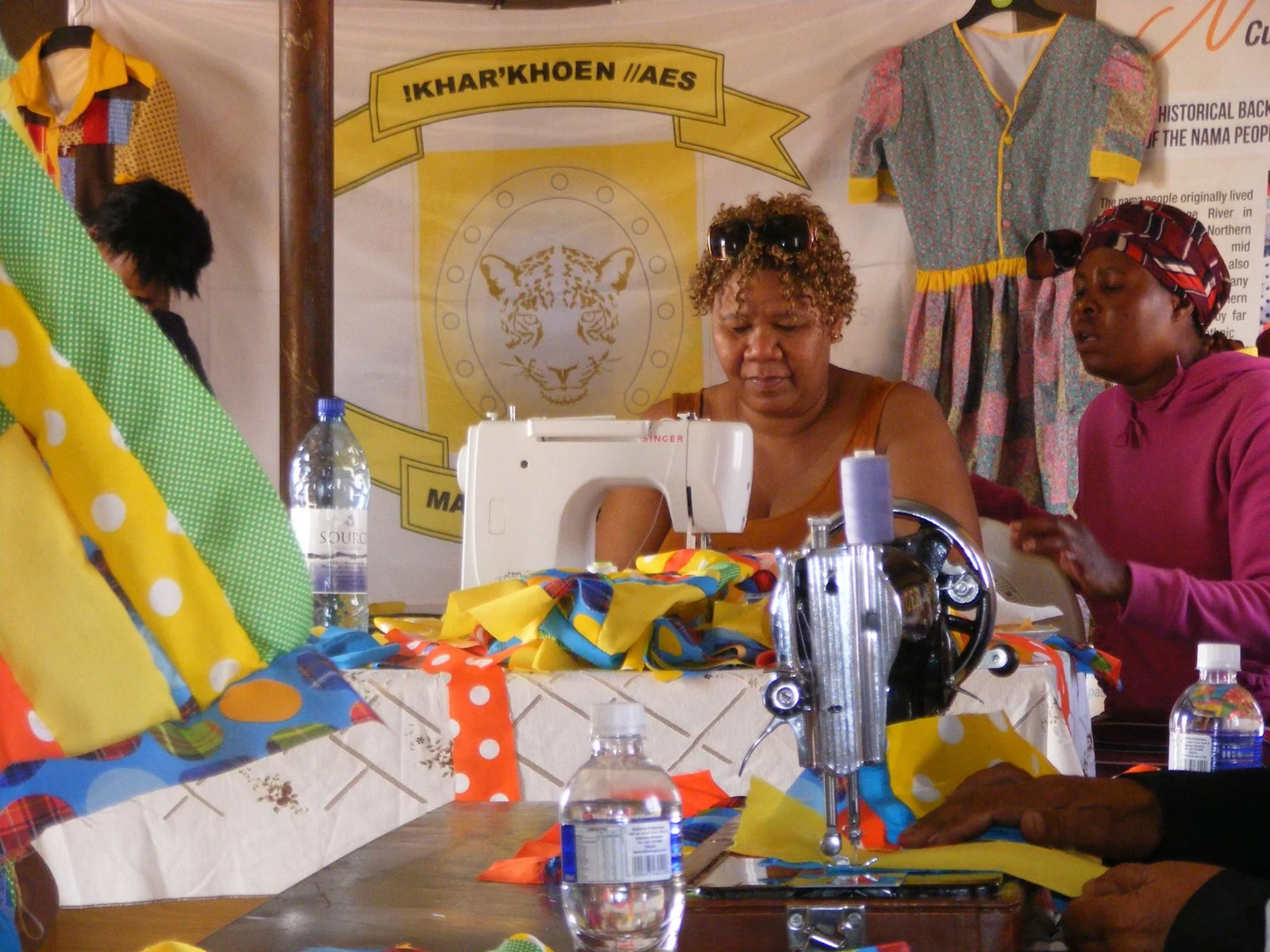
Women gather at sewing machines with colourful cloth and hanging garments during a patchwork workshop; the photographer identifies the event as Nama patchwork training in Lokgwabe.
A particular workshop in Lokgwabe, Botswana, photographed on 27 September 2017. The photographer identifies Ethelretha Isaaks of Namibia as its trainer; the caption does not assign every participant a particular identity or identify which visible person is Isaaks.
Overview
Nama communities are documented here through examples in Namibia, Botswana and South Africa, with particular organisations and localities kept distinct. The Nama Traditional Leaders Association’s German support organisation describes the association as an umbrella for traditional authorities in Namibia, while explaining that the annual cultural festival has a separate organisational structure. Its account places community interests, cultural renewal and redress for colonial genocide together on its agenda. These are the organisation’s own priorities and claims of representation, rather than proof that every Nama person belongs to it or endorses every position. Community identity extends beyond membership of a particular association.
A Botswana government news report from August 2017 records a cultural festival bringing Nama participants into discussions about language and collective action. Linguist Andy Chebanne encouraged language use in cultural activities and children’s learning. Kaptein Piet Kaartze of Tsabong called for cooperation and recognition of community leadership, while acknowledging the organisers’ limited funding. The report locates these statements at a particular event in Lokgwabe. It supplies named participants’ concerns and proposals, without turning them into a uniform view among all Nama speakers. Its broader historical assertions are not used here to establish first settlement dates or biological ancestry.
Language research also shows differences within community discussion. Niklaas Johannes Fredericks’s Keetmanshoop study used qualitative interviews with language specialists and volunteer community members. The methods explain that participants were anonymised; the findings include contrasting assessments of government support and the importance of speakers’ own cooperation. An educator described insufficient support after school and limited workshops, while other respondents discussed teacher availability and family choices between Nama and Afrikaans schooling. These are situated interview accounts, not national prevalence estimates. The study’s emphasis on speaker agency makes language maintenance an active field of negotiation involving homes, classrooms and public institutions.
Richtersveld offers a separate South African example of relationships between cultural work and landscape. UNESCO’s description identifies communal ownership and management, seasonal pastoral movement between grazing areas and stockposts, and portable mat-roofed houses known as haru oms. Its heritage account connects oral traditions with particular places and describes a management framework intended to support local land-use practice. The 2007 World Heritage inscription concerns that cultural landscape, rather than the origin date of Nama identity. This regional pastoral example is considered alongside contemporary festival, organisation and language accounts, without assigning one livelihood or housing form to every Nama household.
History & identity
Regional living identities; festival reports and heritage designations date specific events and places rather than the people’s origin.
Sources & representation
Association self-description, named event reporting, scoped qualitative interviews and regional heritage documentation; claims of representation and interview opinions remain attributed.
Selected bibliography
Documented works and useful reading. This is not a list of every appearance.
- 01
Entstehung Fördergemeinschaft der NTLA
Complete introductory organisational section read; association and independent festival distinguished.
- 02
Nama community urged to uphold language
Complete August 2017 report read; Lokgwabe statements and proposals, not universal views.
- 03
Voices of linguistic participation in language maintenance and revitalisation
Methods p. 50 and findings pp. 51–53 read; 2020 volume published 2021. Full PDF retrieval timed out.
- 04
Richtersveld Cultural and Botanical Landscape
Complete English description and value statement read; landscape scope and 2007 inscription distinguished.
Language & cultural connections
Source-supported language and cultural connections have not yet been compiled for this profile.
References
Sources supporting this profile. Linked pages have their own scope and editorial standards.
- Association self-descriptionEntstehung Fördergemeinschaft der NTLAResearch access: 2026-10-05
- Named event reportingNama community urged to uphold languageResearch access: 2026-10-05
- Primary qualitative language studyVoices of linguistic participation in language maintenance and revitalisationResearch access: 2026-10-05
- Regional heritage documentationRichtersveld Cultural and Botanical LandscapeResearch access: 2026-10-05
Image credits
Contextual community activity photographWomen gather at sewing machines with colourful cloth and hanging garments during a patchwork workshop; the photographer identifies the event as Nama patchwork training in Lokgwabe.
A particular workshop in Lokgwabe, Botswana, photographed on 27 September 2017. The photographer identifies Ethelretha Isaaks of Namibia as its trainer; the caption does not assign every participant a particular identity or identify which visible person is Isaaks.