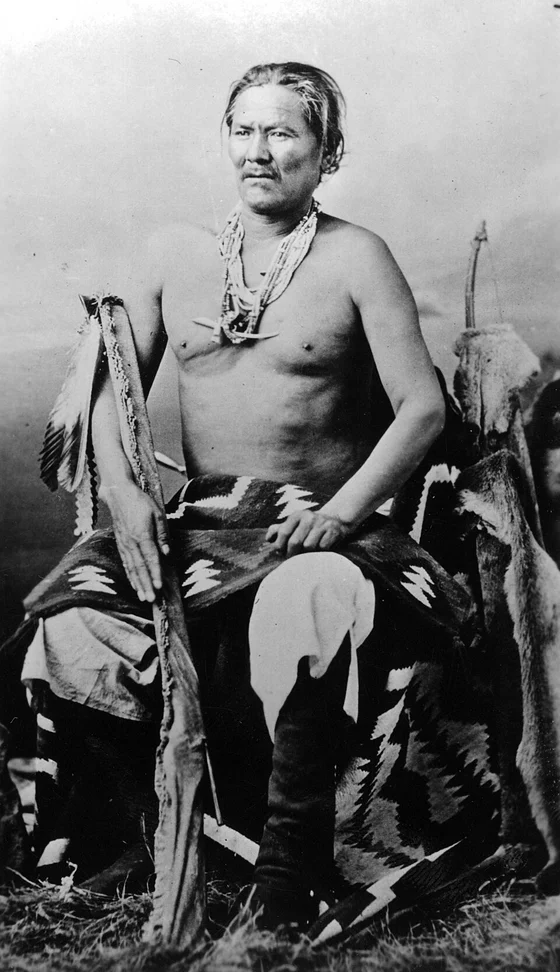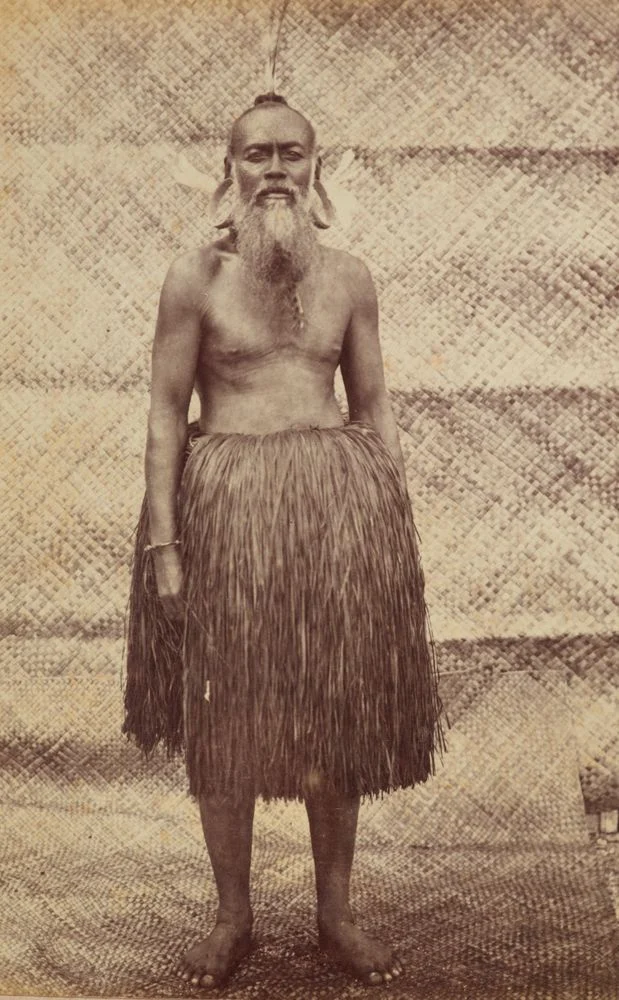
Remi, identified by Te Papa as a Majuro chief, photographed by Thomas Andrew in 1886, O.037950
Te Papa identifies this sitter as Remi, a chief at Majuro, photographed by Thomas Andrew in 1886. His name and locality make this a particular historical portrait, not a representative image of all Marshallese communities or present-day leadership.
Overview
The Marshall Islands embassy’s cultural account emphasises extended family relationships, sharing and community responsibilities. It identifies Marshallese as an Austronesian language and distinguishes Ralik and Ratak speech varieties, while presenting Marshallese and English as the country’s official languages. Its discussion of manit, cultural values and customs, connects land and social organisation; its craft section names baskets, fans, mats and other locally made objects. This is a national institutional presentation, not a survey of every family or a legal determination of individual land rights. Cultural identity and language are therefore kept distinct from citizenship and from particular claims to land.
Waan Aelõñ in Majel, or WAM, gives a community organisational perspective on continuing maritime knowledge. Its mission links canoe and boat work with literacy, mathematics and vocational preparation for young men and women. Maintaining, sailing and navigating outrigger canoes are described as opportunities for cultural learning alongside contemporary boat construction. Partnerships with government and nongovernmental bodies support the programme’s stated development goals. This account presents cultural work as adaptable and connected with livelihoods, rather than requiring a choice between inherited skills and modern employment. Claims about empowerment and economic benefits are retained as the organisation’s aims, not independently verified results for every participant.
The web-posted report for the year ending September 2017 opens with Alson Kelen’s introduction and traces the programme’s earlier canoe-documentation work. It describes training, counselling and practical placements, with cultural and vocational activities operating together. Trainees participated in the July 2017 National Youth Conference and September Manit Day, where they presented their work and explained activities using Marshallese names. An open house brought families and other community members into contact with trainees’ woodwork. These dated events document participants using cultural knowledge publicly and developing communication skills. The report’s historical programme figures and its individual success narratives are not treated as current population-wide outcomes; the separately offered complete report was not obtained.
The tourism office also directs visitors towards Alele Museum, churches, community events and local markets. Its named craft examples include woven mats, fans, kili bags and shell jewellery. This visitor-oriented account adds public exhibition and artisan settings to the educational programme evidence. It does not substitute for reading museum collection records or hearing individual makers’ accounts. Together, the sources show institutional self-description, a community organisation’s aims, dated participant activity and public heritage interpretation, while leaving room for further atoll-specific and diaspora testimony.
History & identity
Selected national and Majuro-based sources document living cultural work; institutional and programme dates do not establish a single origin for Marshallese communities.
Sources & representation
Scoped embassy and tourism accounts, a complete community mission and a complete web-posted programme report document distinct national, organisational and participant perspectives.
Selected bibliography
Documented works and useful reading. This is not a list of every appearance.
- 01
Country Profile: People, Language, Culture and Handicrafts
Complete identified sections read; language, family and named crafts retained; stale politics, population, universal land-rights claims and navigation procedures excluded.
- 02
Mission Statement
Complete mission read; cultural/vocational aims and partnerships attributed, no independent employment-outcome proof inferred.
- 03
WAM Annual Report 2016–2017
Complete web-posted report read; dated training and public events retained; separate complete-report copy not obtained, private individual cases excluded.
- 04
Things to Do: Cultural Enrichment and Night Markets & Handicrafts
Complete named sections read; Alele museum and market interpretation scoped as visitor information, no collection or ceremonial media inspection.
- 05
WAM Team
Undated institutional team page, accessed5October2026; historical roles not assumed current.
Language & cultural connections
Source-supported language and cultural connections have not yet been compiled for this profile.
Located primary passages
Specific passages supporting details in this entry, grouped by their published witness.
WAM Team
Undated institutional team page, accessed5October2026; historical roles not assumed current.
- Kelen presents cultural continuity alongside youth livelihoods. Daniel describes teaching as knowledge that learners can share with families and friends. Their named accounts show cultural transmission as active work by particular contributors, rather than an anonymous, uniform or exclusively historical tradition.
Complete public team page; Alson Kelen and Binton Daniel sections
Undated biographies cannot establish current appointments. Listed workbooks unread; private participant histories and practical protocols omitted.
References
Sources supporting this profile. Linked pages have their own scope and editorial standards.
- Official national cultural self-descriptionCountry Profile: People, Language, Culture and HandicraftsResearch access: 2026-10-05
- Community organisation missionMission StatementResearch access: 2026-10-05
- Community programme reportWAM Annual Report 2016–2017Research access: 2026-10-05
- Official visitor-oriented cultural accountThings to Do: Cultural Enrichment and Night Markets & HandicraftsResearch access: 2026-10-05
Image credits
Historical named-person photographRemi, identified by Te Papa as a Majuro chief, photographed by Thomas Andrew in 1886, O.037950
Te Papa identifies this sitter as Remi, a chief at Majuro, photographed by Thomas Andrew in 1886. His name and locality make this a particular historical portrait, not a representative image of all Marshallese communities or present-day leadership.