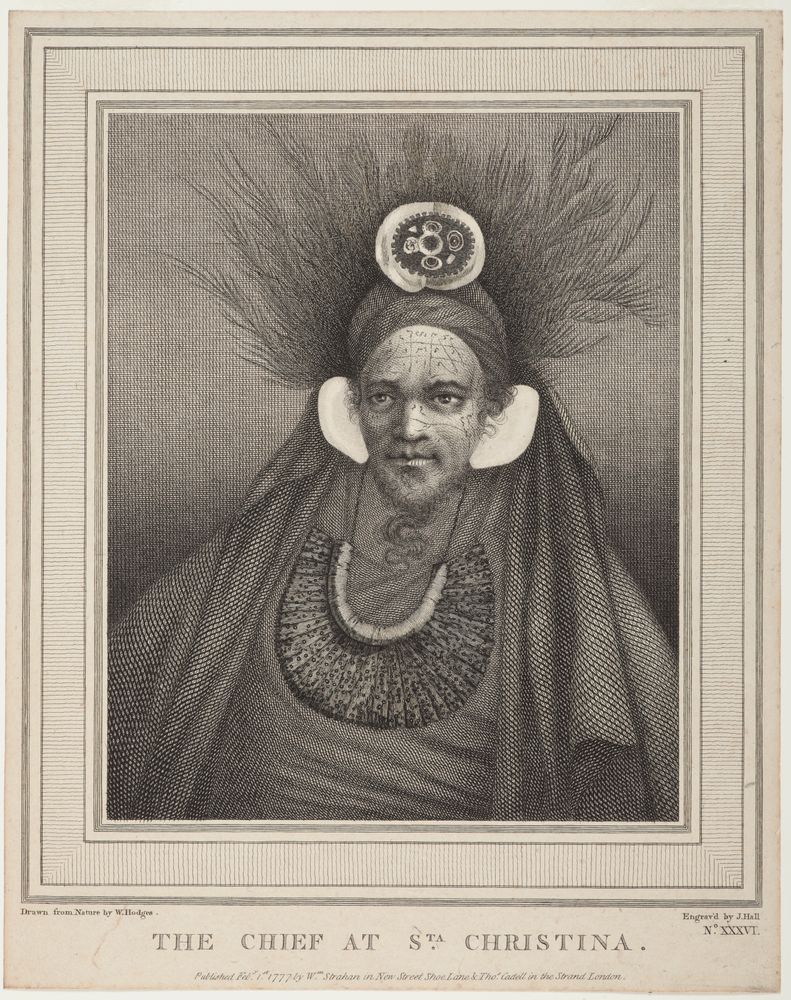
John Hall’s 1777 engraving after William Hodges portraying Honu of Vaitahu, Tahuata, with the original title The Chief at Santa Christina
Te Papa identifies the sitter as Honu, the highest-ranking chief of Vaitahu on Tahuata, whom Cook’s party encountered in 1774. John Hall made this 1777 engraving after William Hodges. It is a particular historical European representation, rather than a portrait of all Marquesans or a record of every contemporary island community.
Overview
Marquesan cultural life includes island-specific speech, creative work and relationships with the Marquesas’ valley landscapes. The municipality of Hiva Oa describes the language academy’s beginnings in consultation involving island representatives and cultural institutions in 1998. Hervé-Marie Le Cléac’h coordinated the preparatory work; statutes followed in 1999, with formal establishment spanning late 1999 and early 2000. Representatives were elected across the islands in 2000. The municipal history connects this institution with dictionary and place-name commissions, teaching resources, literary competitions and the adoption of a joined writing system in 2001. These are documented institutional developments rather than the beginning of Marquesan identity.
The Académie marquisienne’s own presentation names the institution Te Haè tuhuka èo ènana / Te Faè tuhuna èo ènata and dates its founding deliberation to 27 January 2000. Its stated responsibilities include vocabulary, grammar and orthography, language teaching and publication in the speech of each island. It also identifies place names and botanical vocabulary as linguistic heritage requiring research and preservation. Connections with other Polynesian language institutions are part of its programme. This approach makes regional forms visible within shared language work, rather than treating one academy spelling or one island’s expression as the only Marquesan voice.
A particular contemporary artistic relationship is documented by Te Papa’s commissioned 2023 ’ahu, registration FE013755. Its named makers are Sarah Vaki of Fatu Hiva and her sister Tutana Tetuanui-Peters. The museum describes the gift as intended for future generations and associates it with vaiei tupuna, the collective knowledge and art of Fatu Hiva tapa makers. Vaki’s recorded testimony was translated by her niece in conversation with Isaac Te Awa. This located account connects inherited knowledge with present-day making and future possibilities. It supplies identifiable contributors and a specific object context, rather than an anonymous assertion about every Marquesan household.
The 2024 World Heritage inscription of Te Henua Enata covers seven components of a mixed cultural and natural property. Its cultural account describes dry-stone paepae platforms, sculpted tiki and engraved rock surfaces as evidence of earlier valley settlements and chiefdom organisation. It also recognises family transmission of stories and landscape knowledge in Marquesan language, alongside historical visitors’ writings and ethnographic studies. Selected tohua gathering places in Hatiheu, Taaoa and Puamau have been restored for Matavaa festivals. The archaeological interpretation concerns earlier social arrangements; it is distinct from present community institutions and from proposed management measures that the inscription says still require implementation.
History & identity
Selected contemporary language, maker and heritage accounts document Marquesan communities in the archipelago; academy founding and World Heritage inscription dates identify institutions, not an ethnic origin.
Sources & representation
Municipal and academy accounts, a named 2023 museum commission and the 2024 inscription document different institutional, artistic and archaeological settings.
Selected bibliography
Documented works and useful reading. This is not a list of every appearance.
- 01
L’académie marquisienne
Complete account read; consultation, creation, elected members and language resources documented.
- 02
L’Académie marquisienne: présentation
French anniversary and complete mission sections read; island speech and institutional duties distinguished.
- 03
’Ahu (tapa cloth), FE013755
Complete item details and written overview read; makers, gift and translated testimony attributed; no image reproduced.
- 04
Te Henua Enata – The Marquesas Islands
English description and full value statement read; cultural criteria, restoration and living transmission used; management plans qualified.
Language & cultural connections
Source-supported language and cultural connections have not yet been compiled for this profile.
References
Sources supporting this profile. Linked pages have their own scope and editorial standards.
- Municipal institutional historyL’académie marquisienneResearch access: 2026-10-05
- Language institution self-descriptionL’Académie marquisienne: présentationResearch access: 2026-10-05
- Named makers and museum object account’Ahu (tapa cloth), FE013755Research access: 2026-10-05
- Heritage inscription and archaeological accountTe Henua Enata – The Marquesas IslandsResearch access: 2026-10-05
Image credits
Historical named-person engravingJohn Hall’s 1777 engraving after William Hodges portraying Honu of Vaitahu, Tahuata, with the original title The Chief at Santa Christina
Te Papa identifies the sitter as Honu, the highest-ranking chief of Vaitahu on Tahuata, whom Cook’s party encountered in 1774. John Hall made this 1777 engraving after William Hodges. It is a particular historical European representation, rather than a portrait of all Marquesans or a record of every contemporary island community.