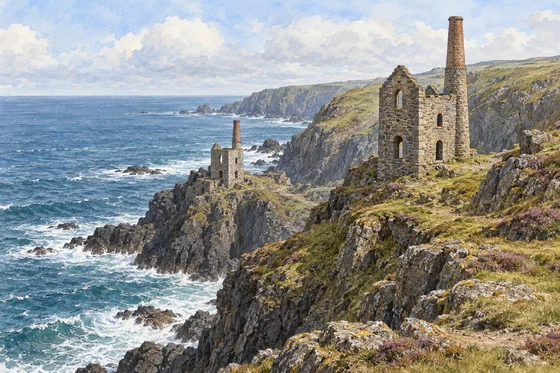
Manx cultural communities - AI-generated contextual illustration.
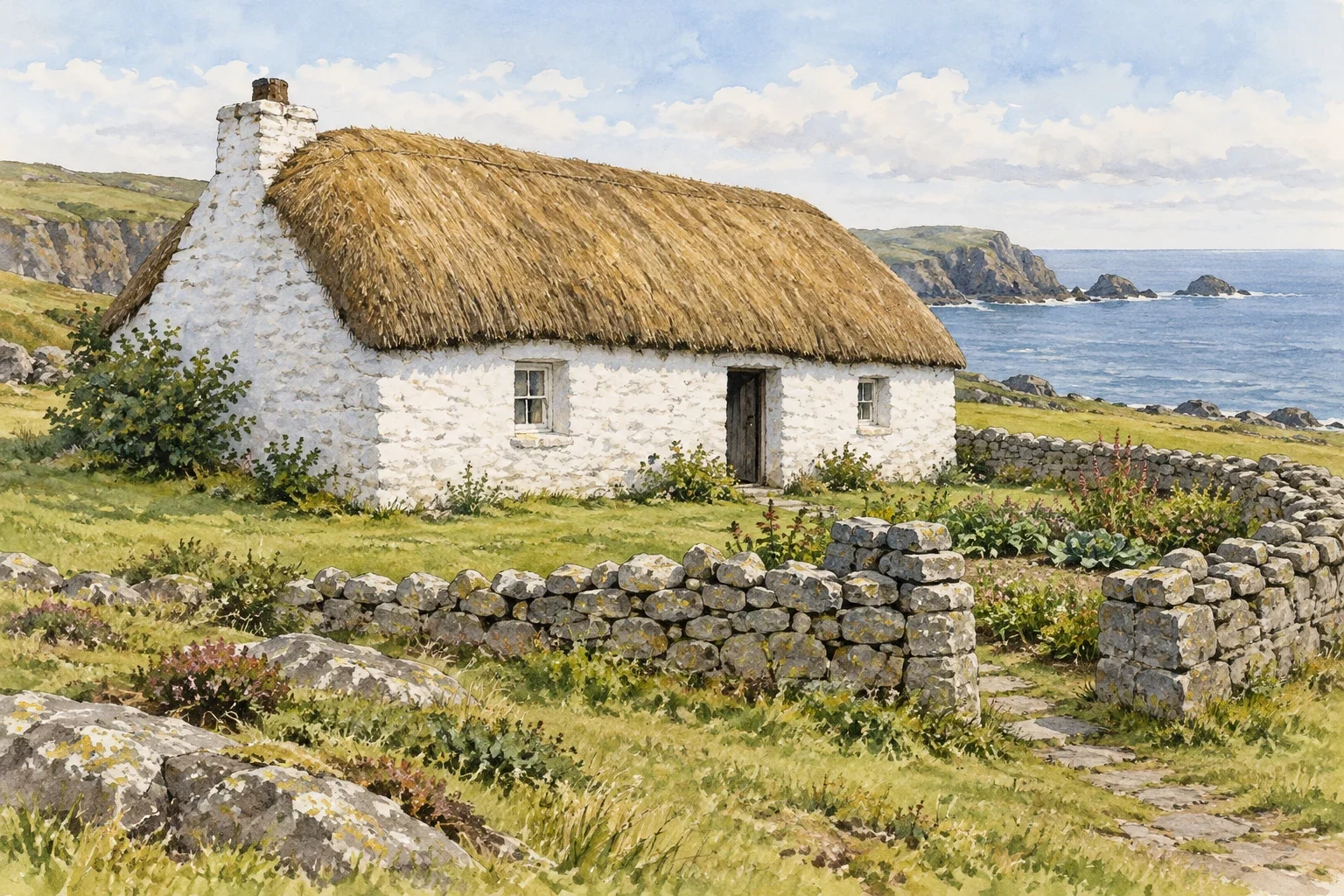
AI-generated contextual illustration of a Manx crofter’s cottage recalling the Cregneash setting documented by Manx National Heritage. Roof, building plan, garden and coastline are artistically imagined; this is not a photograph or reconstruction of a specific cottage.
Overview
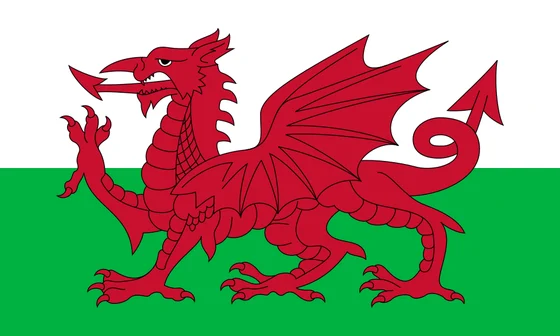
Manx cultural life includes a living language sustained by speakers, learners and institutions on the Isle of Man and beyond. Culture Vannin’s Learn Manx account places Manx within the Goidelic branch of Celtic languages and relates it to Irish and Scottish Gaelic. It distinguishes these from the Brittonic languages Welsh, Breton and Cornish. This is a relationship among languages rather than a biological ancestry tree or a rule for who may identify as Manx.
The account explains that social, economic and population changes in the eighteenth and nineteenth centuries contributed to declining language use. Community initiatives collected recordings from native speakers, organised classes and produced resources. These activities helped new learners participate. School provision began in 1992, and the Manx-medium Bunscoill Ghaelgagh opened in 2001. The account also records strengthened language protection in 2021. Language survival is therefore documented through particular people and institutional choices rather than presented as an automatic or completed recovery.
Manx National Heritage’s Cregneash account connects language history to a specific place. This farming village on a plateau overlooking the Calf of Man was one of the language’s last strongholds and is now an open-air folk museum. Traditional cottages, some with Manx-style thatching, support interpretation of crofters’ work, stories and skills. The site preserves and demonstrates selected rural practices; it cannot stand for all Manx experience, including contemporary towns and diaspora communities. Its cottage illustration is an imagined contextual setting, not photographic documentation.
History & identity
The chronology here concerns documented language decline and revitalisation, including educational milestones in 1992 and 2001 and recognition in 2021. Cregneash supplies a place-specific rural-history setting, not a universal origin story.
Sources & representation
Learn Manx is a Culture Vannin community-language resource. Manx National Heritage documents Cregneash’s museum setting and historical language association. These selected accounts do not provide a population survey or comprehensive history of every Manx community.
Selected bibliography
Documented works and useful reading. This is not a list of every appearance.
- 01
Discover the story of Manx
Selected account read for this profile; not a complete bibliography.
- 02
Cregneash – Creneash
Selected account read for this profile; not a complete bibliography.
Language & cultural connections
Source-supported language and cultural connections have not yet been compiled for this profile.
References
Sources supporting this profile. Linked pages have their own scope and editorial standards.
- Community institutionDiscover the story of ManxResearch access: 2026-10-10
- Heritage institutionCregneash – CreneashResearch access: 2026-10-10
Image credits
AI-generated contextual illustrationManx cultural communities - AI-generated contextual illustration.
AI-generated contextual illustration of a Manx crofter’s cottage recalling the Cregneash setting documented by Manx National Heritage. Roof, building plan, garden and coastline are artistically imagined; this is not a photograph or reconstruction of a specific cottage.