Cornish cultural communities - AI-generated contextual illustration.
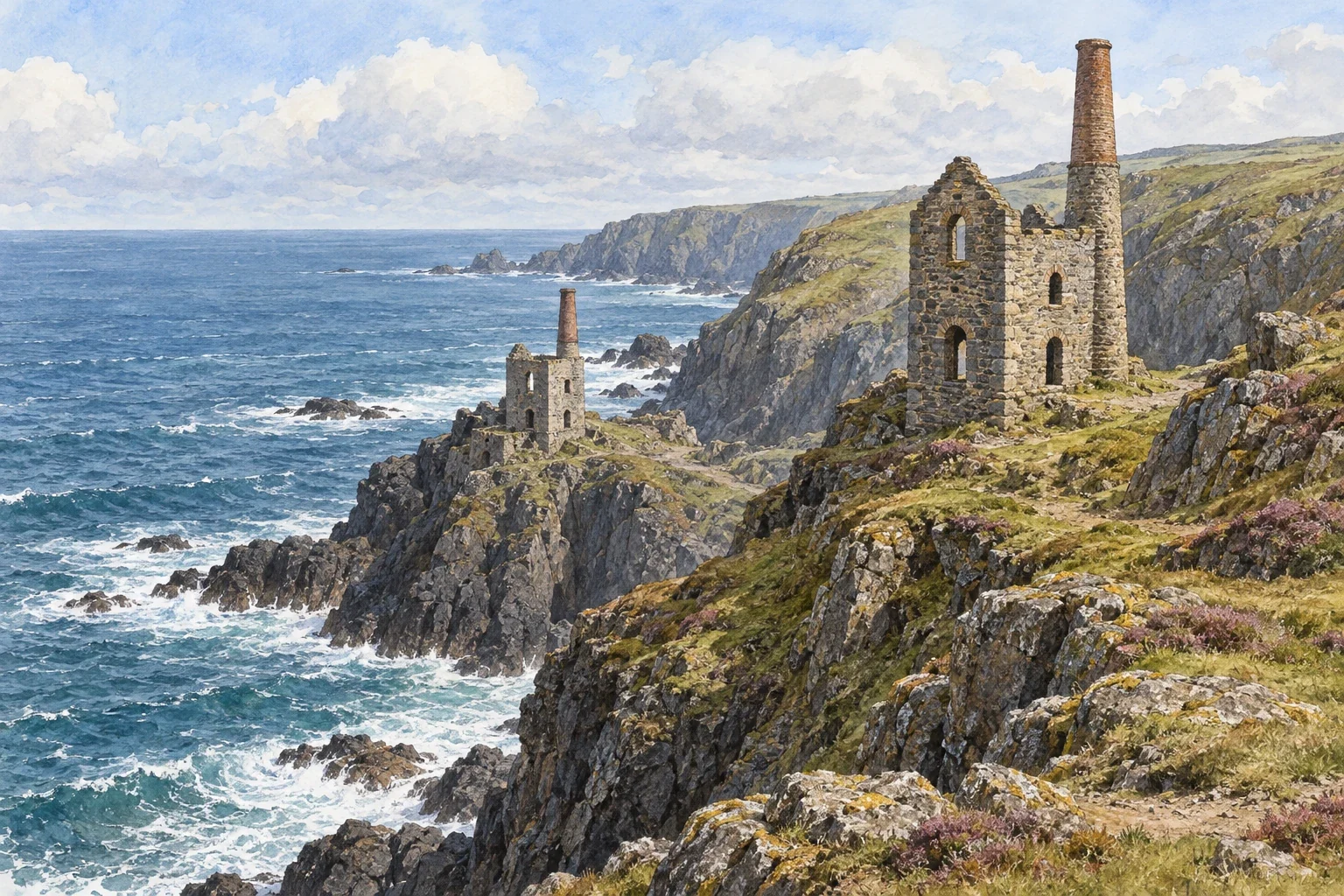
AI-generated contextual illustration recalling the nineteenth-century Crowns engine houses at Botallack documented by the National Trust. Building details, relative placement, coast and weather are artistically imagined; this is not a measured reconstruction or photograph of the site.
Overview
Cornish communities sustain a cultural identity that Cornwall Council discusses through language, history, culture and sport. The council records the United Kingdom’s recognition of Cornish people as a national minority in 2014. That administrative event recognises an identity with a longer history; it does not mark the beginning of Cornish people or require every person identifying as Cornish to speak Kernewek. This profile uses a civic and cultural framework and assigns no biological subdivision to the community.
The council’s Cornish Language Programme sets out a 2026–2036 strategy organised around learning, community and culture, status, and corpus development. Its aims include more speakers, wider social use, favourable conditions in public life and digital equality. These are programme commitments rather than demonstrated results. The account credits language-community and organisational work over decades. Its dated policy and planning documents show that language development involves practical institutions as well as personal and community attachment.
Botallack provides a selected material setting for a different part of Cornish history. The National Trust identifies the nineteenth-century Crowns engine houses at the foot of the cliffs on the Tin Coast as part of the Cornish Mining World Heritage Site. Other industrial remains include chimney stacks, engine houses and an arsenic labyrinth. The former mine office, the Count House, later served as a folk club. This landscape documents mining and subsequent cultural uses, without suggesting that mining alone defines Cornish life.
History & identity
The selected chronology distinguishes the nineteenth-century industrial buildings, national-minority recognition in 2014 and a language strategy for 2026–2036. These dates describe particular institutions and heritage events, not a cultural origin.
Sources & representation
Cornwall Council supports the identity and language-programme account; the National Trust supports the Botallack setting. The council programme page dates Part III language recognition to 2025, while its January 2026 announcement reports confirmation; this overview avoids resolving that chronology without the underlying instrument.
Selected bibliography
Documented works and useful reading. This is not a list of every appearance.
- 01
Cornish Language Programme
Selected account read for this profile; not a complete bibliography.
- 02
Cornish Distinctiveness
Selected account read for this profile; not a complete bibliography.
- 03
Botallack
Selected account read for this profile; not a complete bibliography.
Language & cultural connections
Source-supported language and cultural connections have not yet been compiled for this profile.
References
Sources supporting this profile. Linked pages have their own scope and editorial standards.
- Local authorityCornish Language ProgrammeResearch access: 2026-10-10
- Local authorityCornish DistinctivenessResearch access: 2026-10-10
- Heritage institutionBotallackResearch access: 2026-10-10
Image credits
AI-generated contextual illustrationCornish cultural communities - AI-generated contextual illustration.
AI-generated contextual illustration recalling the nineteenth-century Crowns engine houses at Botallack documented by the National Trust. Building details, relative placement, coast and weather are artistically imagined; this is not a measured reconstruction or photograph of the site.