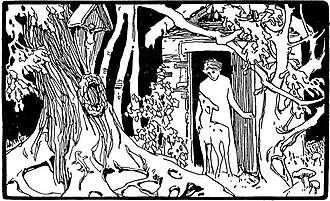
Transformed roe beside his sister at the woodland hut, Otto Ubbelohde,1909
The transformed brother stands as a deer beside his sister at their forest hut in this illustrated Grimm witness.
Overview
The brother and sister leave a cruel stepmother, unaware that she has enchanted the forest streams. His sister hears warnings that the first waters would make him a tiger and the next a wolf. At a third spring she warns of a roebuck form, but thirst overcomes his caution. The first drops transform him. She makes a golden collar and rush cord, feeding and sheltering him in an empty cottage.
He retains speech and his attachment to her, yet repeatedly begs to join the excitement of the royal hunt. A huntsman follows the speaking deer home; the king later visits and marries the sister while promising to care for him. The stepmother's subsequent attack kills the queen, whose nightly return includes tending her brother. Once her murder is exposed and the witch dies, the roe finally regains human form.
Origins & earliest records
This transformed brother belongs to Grimm's tale11, Brüderchen und Schwesterchen, selected through Margaret Hunt's1884 English Household Tales. The narrative explicitly specifies a roebuck after two avoided animal threats. Its recorded version supplies a literary attestation, not the origin of all deer-transformation stories; the colloquial little-brother designation should not be mistaken for a personal name.
Records & interpretation
The warned springs, immediate bodily change, retained speech, golden collar and final human restoration are explicit in the source. The boy's eagerness for hunting complicates his animal vulnerability without making him an ordinary wild deer. This is narrative evidence for a child under enchantment, not zoological proof or a recommendation concerning magical waters or treatment of injuries.
Additional images
 View larger
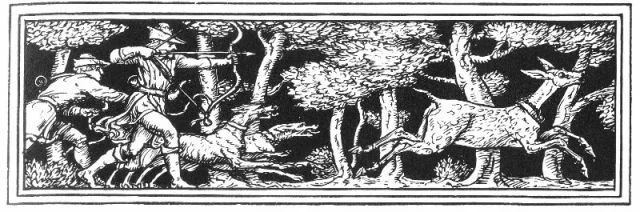
 Crane’s transformed brother as a deer is pursued by mounted hunters and hounds
The deer in this headpiece is the transformed brother pursued during the royal hunt. Lucy Crane calls his animal form a fawn; the antlers and ornamental treatment are this artist’s choices. The story restores his human form after the witch’s death.
In the literature
“the roebuck was tended and cherished”
Tale 11, Little Brother and Little Sister; Life at the palace after the sister’s marriage · Margaret Hunt
The brother remains in animal form while protected in the royal household.
Selected bibliography
Documented works and useful reading. This is not a list of every appearance.
- 01
Household Tales, tale 11: Little Brother and Little Sister
Specific numbered primary tale inspected. English translation terms and literary transmission remain distinct from oral origin.
- 02
Household Tales — Little Brother and Little Sister
Margaret Hunt historical English translation (1884); Project Gutenberg5314. Exact numbered tale and observed HTML anchor used; no inferred printed page or earliest oral date.
Family, evolution & connections
Mother of the brother who becomes a roe and his sister
Only the named numbered tale in Hunt’s 1884 Grimm translation.
Scroll sideways to see all branches. With a keyboard, focus the tree and use the arrow keys.
- Deceased unnamed mother
- Unnamed little sister, later queen
Explicit parentage and birth order in the primary narrative. The stepmother is explicitly separate from the deceased mother. The shared mother is stated; no unnamed father is inferred.
The unnamed sister in Little Brother and Little Sister
The transformed boy remains the girl’s brother. She shelters and feeds him, later becoming queen while insisting that he accompany her. His deer form does not break the stated human sibling relationship.
The deceased mother in Little Brother and Little Sister
The opening dialogue explicitly recalls the siblings’ dead mother. Their hostile stepmother is a different woman; neither is given an invented personal name.
Lambkin and Little Fish Siblings
Both tales preserve a brother–sister bond after a hostile stepmother’s enchantment. The roe story transforms only the brother; the lamb-and-fish story transforms both and uses their grieving dialogue to trigger rescue. Shared structure is a comparison, not evidence of a common first author.
Located primary passages
Specific passages supporting details in this entry, grouped by their published witness.
Household Tales, tale 11: Little Brother and Little Sister
Margaret Hunt historical English translation (1884); Project Gutenberg5314. Exact numbered tale and observed HTML anchor used; no inferred printed page or earliest oral date.
- A witch stepmother enchants the forest brooks after the children flee. The sister hears warnings that successive waters cause tiger, wolf and roebuck transformations. Her thirsty brother drinks the third and becomes a roebuck; she collars him with her golden garter and cares for him.
Tale 11, Little Brother and Little Sister; Bewitched brooks and brother’s transformation
- The roebuck repeatedly joins a royal hunt despite his sister’s fear and is slightly wounded. A hunter follows him to the cottage and hears his entry request. The king uses the request, meets the sister and marries her only with the roebuck allowed to accompany them.
Tale 11, Little Brother and Little Sister; Hunting attraction and sister’s marriage condition
- The stepmother kills the sister after childbirth and substitutes her own daughter. The true queen returns nightly to tend her child and stroke the roebuck; recognition restores her life. After she exposes the plot and the witch is burned, the roebuck regains human form.
Tale 11, Little Brother and Little Sister; Witch’s second attack and eventual restoration
Complete named tale read. Original narrative curse causes and modern species identities are not inferred; prose only, no song or ritual-formula excerpts.
References
Sources supporting this profile. Linked pages have their own scope and editorial standards.
- Primary textHunt's Household Tales — 11 Little Brother and Little SisterResearch access: 2026-10-05
Image credits
Historical illustrationTransformed roe beside his sister at the woodland hut, Otto Ubbelohde,1909
The transformed brother stands as a deer beside his sister at their forest hut in this illustrated Grimm witness.
Further credits appear with each additional image.