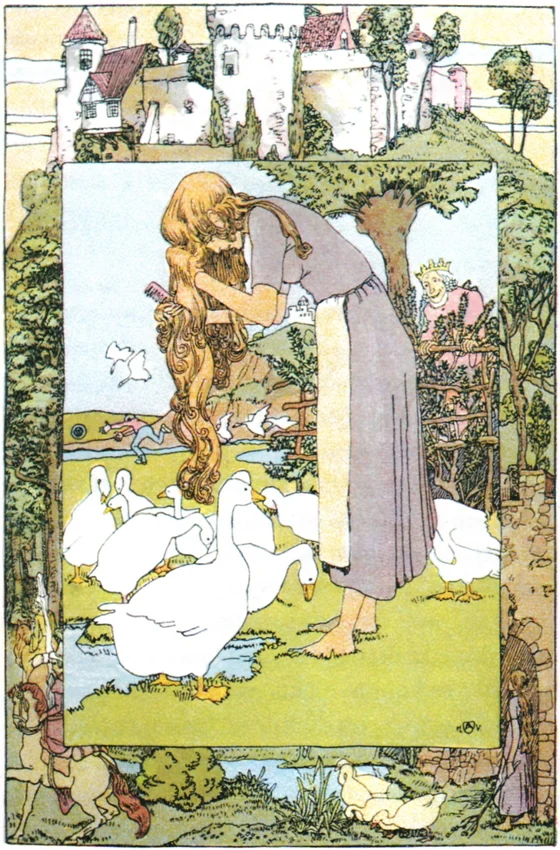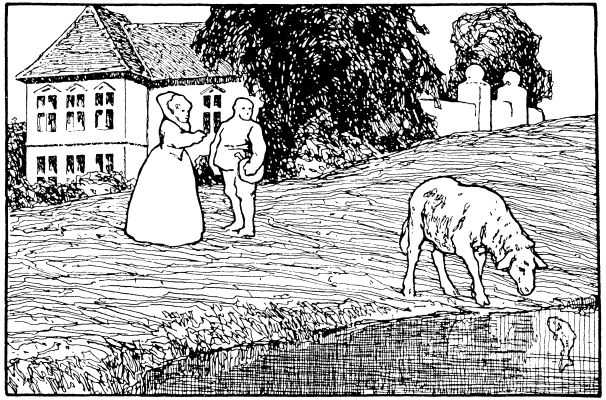
Lambkin and little-fish siblings in Otto Ubbelohde’s historical Grimm illustration (1909)
Actual original606x400 pixels inspected: lamb at water edge and fish visible in the pool; two human figures by the house. Exact source file identifies The Lambkin and the Little Fish, Grimm tale141. Animal siblings are visibly present; human background identities not independently asserted. Original Commons description specifically credits Otto Ubbelohde1909 and Directmedia scan; PDM/PD-old-70 and US pre1931 publication rights verified. No attribution to a modern unrelated artist.
Overview
The children's mother has died, and their stepmother secretly seeks to harm them. Watching their play around a meadow pond, she uses witchcraft to transform the boy into a fish and the girl into a lamb. Both remain miserable in their separate environments. When guests arrive, she orders the cook to kill the lamb for the table.
The fish follows his sister along the pond towards the kitchen. As the cook prepares, the two exchange sorrowful verses that reveal their enduring bond and the lamb's danger. He recognises that this is no ordinary animal, substitutes a different sheep and takes her to a peasant woman. She proves to be the girl's former foster-mother and consults a wise woman. A blessing restores both children, who then live peacefully in a woodland hut rather than return to the hostile household.
Origins & earliest records
Grimm's tale141, Das Lämmchen und Fischchen, is selected through Margaret Hunt's1884 English Household Tales. Its primary narrative explicitly assigns the sister lamb form and the brother fish form, followed by restoration through a wise woman's blessing. The collected text supplies an attested version; it does not establish the first oral occurrence of paired sibling transformations.
Records & interpretation
The stepmother's stated witchcraft, the siblings' different bodies, their verse dialogue and the cook's substitution are direct narrative evidence. The foster-mother's recognition and final blessing complete the rescue. These details document a wonder tale about kinship surviving transformation, not biological evidence of human-animal change or a practical account of recovering transformed children.
In the literature
“changed the little brother into a fish, and the little sister into a lamb”
Tale 141, The Lambkin and the Little Fish; The stepmother interrupts the children’s game · Margaret Hunt
The paired transformations separate the siblings into meadow and pond.
Selected bibliography
Documented works and useful reading. This is not a list of every appearance.
- 01
Household Tales, tale 141: The Lambkin and the Little Fish
Specific numbered primary tale inspected. English translation terms and literary transmission remain distinct from oral origin.
- 02
Household Tales — The Lambkin and the Little Fish
Margaret Hunt historical English translation (1884); Project Gutenberg5314. Exact numbered tale and observed HTML anchor used; no inferred printed page or earliest oral date.
Family, evolution & connections
The deceased mother in The Lambkin and the Little Fish
The tale explicitly identifies the lamb and fish as a sister and brother whose own mother is dead. Their stepmother transforms them; her role is distinguished from biological maternity.
Located primary passages
Specific passages supporting details in this entry, grouped by their published witness.
Household Tales, tale 141: The Lambkin and the Little Fish
Margaret Hunt historical English translation (1884); Project Gutenberg5314. Exact numbered tale and observed HTML anchor used; no inferred printed page or earliest oral date.
- During the children’s game their witch stepmother converts the brother into a fish and sister into a lamb, leaving them without food. Later she orders a cook to kill the lamb for guests.
Tale 141, The Lambkin and the Little Fish; Witch stepmother’s transformations and intended slaughter
- Hearing the siblings’ exchange, the cook recognizes bewitched children and substitutes another lamb. The former foster woman takes the lamb to a wise woman, who pronounces a blessing restoring both children, then shelters them in a forest hut.
Tale 141, The Lambkin and the Little Fish; Cook’s discovery and foster woman’s restoration
Complete named tale read. Original narrative curse causes and modern species identities are not inferred; prose only, no song or ritual-formula excerpts.
References
Sources supporting this profile. Linked pages have their own scope and editorial standards.
- Primary textHunt's Household Tales — 141 The Lambkin and the Little FishResearch access: 2026-10-05
Image credits
Historical illustrationLambkin and little-fish siblings in Otto Ubbelohde’s historical Grimm illustration (1909)
Actual original606x400 pixels inspected: lamb at water edge and fish visible in the pool; two human figures by the house. Exact source file identifies The Lambkin and the Little Fish, Grimm tale141. Animal siblings are visibly present; human background identities not independently asserted. Original Commons description specifically credits Otto Ubbelohde1909 and Directmedia scan; PDM/PD-old-70 and US pre1931 publication rights verified. No attribution to a modern unrelated artist.