A sourced illustration has not yet been added. This gap is included in the coverage record.
Overview
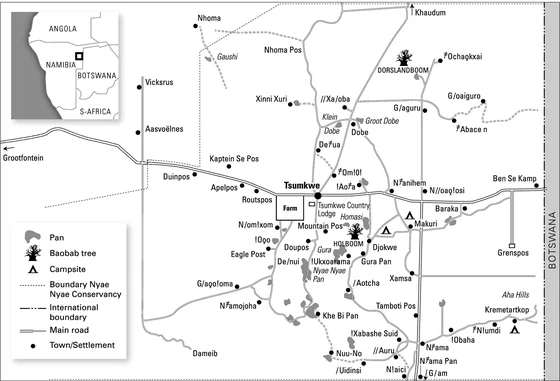
The ǂKhomani San are a living community associated with the Kalahari in South Africa’s Northern Cape. Their community site describes several historical family groups within that identity, rather than one simple lineage. It records Khoekhoegowab and Afrikaans among community languages and the recovery of memories and speakers of Nǀuu. Its account of language rediscovery names Elsie Vaalbooi: in 1997, her son Petrus identified her as a speaker, and Anthony Traill used older recordings to investigate that knowledge. The account connects language with a land claim and intergenerational memory. It does not mean that speaking one language alone determines every person’s belonging.
The community’s account describes restrictions on movement and livelihoods after the creation of Kalahari Gemsbok National Park, followed by dispersal, employment in the park and residence on farms or farther afield. It distinguishes the 1999 transfer of farms through land restitution from the later 2002 agreement concerning the !Ae!Hai Kalahari Heritage Park. The neighbouring Mier community has its own dispossession history and rights. The account describes shared management arrangements involving SANParks, Mier and ǂKhomani representatives, rather than an exclusive cultural claim over every park resident. It also acknowledges difficulties following restitution, so the return of land is not presented as automatic economic recovery.
UNESCO’s World Heritage account describes the ǂKhomani Cultural Landscape near the borders with Botswana and Namibia. It recognises relationships between environmental knowledge, place names, remembered practices and desert features. Its statement also discusses field-school learning in which elders teach young people about plants, animals and ecological relationships. Commercial farming, residential development and the national park altered the landscape and disrupted living traditions. Re-established connections and linguistic documentation are therefore important parts of the account. The 2017 inscription is a heritage milestone; evidence of ancient human occupation does not fix the age or content of a present cultural identity.
Contemporary governance remains active work. UNESCO’s report dated 13 August 2026 describes a workshop bringing community property-association representatives together with SANParks, specialists and UNESCO. Participants considered legal compliance, finances, communication with the wider community and accountability, alongside conservation and tourism. The reported next actions include reviewing governance instruments, strengthening management skills and creating clearer routes for participation. These are workshop aims and identified actions, rather than proof that every governance problem has been solved. They show community heritage being shaped through present institutions and choices, with resource management and public representation belonging alongside language and memory.
History & identity
The account follows a living community and changing relations with land, not a biological ancestry line or an uninterrupted prehistoric culture. Land restitution and the 2017 heritage inscription are separately dated institutional events.
Sources & representation
The community site supports family, language and restitution self-description, but some sections retain outdated nomination-stage text and undated speaker counts; those are excluded. UNESCO’s inscribed-landscape statement and dated2026 workshop report supply distinct heritage and programme evidence. Population, biological-ancestor and permanent-lifestyle claims are not adopted.
Selected bibliography
Documented works and useful reading. This is not a list of every appearance.
- 01
Welcome: language rediscovery
Complete indexed community welcome account read: 1997 Elsie Vaalbooi recognition, Traill recordings and land-claim context. Undated current-leadership and speaker-count claims not adopted.
- 02
About Us
Community history and restitution; undated statistics and stale nomination text excluded.
- 03
ǂKhomani Cultural Landscape
Full description and outstanding-universal-value statement read: landscape, cultural knowledge, disruption and reconnection, veldskool and 2017 inscription. Not a fixed age of contemporary identity.
- 04
Building Stronger Community Governance for Sustainable Heritage Management
Complete 13 August 2026 programme report read: workshop participants, governance challenges and planned actions. Reported aims distinguished from measured universal outcomes.
Language & cultural connections
Source-supported language and cultural connections have not yet been compiled for this profile.
References
Sources supporting this profile. Linked pages have their own scope and editorial standards.
- Community self-descriptionWelcome: language rediscoveryResearch access: 2026-10-05
- Community self-descriptionAbout UsResearch access: 2026-10-05
- International heritage documentationǂKhomani Cultural LandscapeResearch access: 2026-10-05
- International heritage documentationBuilding Stronger Community Governance for Sustainable Heritage ManagementResearch access: 2026-10-05
Image credits
A sourced illustration has not yet been added. This gap is included in the coverage record.