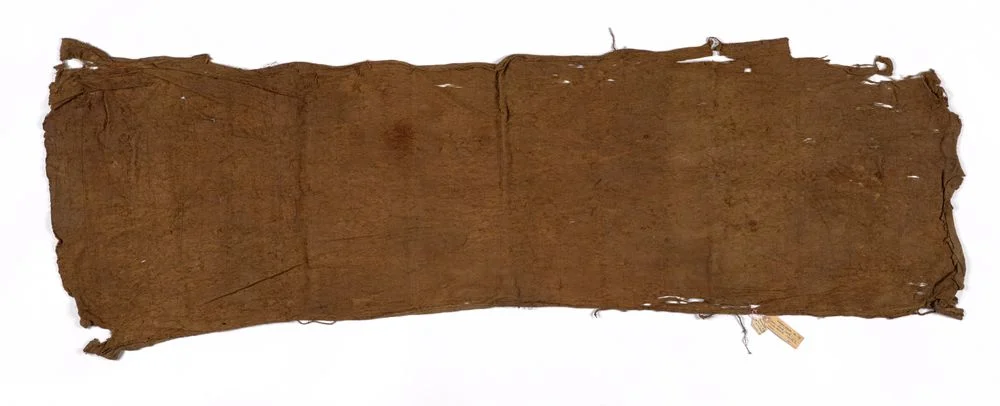
Kanak barkcloth from Ouvéa, New Caledonia, shown whole with worn edges and collection label, Te Papa FE000079
Te Papa associates this barkcloth with Kanak culture and records its production on Ouvéa in New Caledonia. The collection acquired it in 1914; that acquisition date does not establish when it was made. The full cloth, including wear and its collection label, is retained as one material example rather than a summary of all Kanak textile practices.
Overview
Kanak cultural life in New Caledonia includes distinct customary areas and languages, alongside institutions supporting their use and documentation. The Académie des Langues Kanak describes eight regional branches working with speakers in the corresponding areas. Established in 2007 following the Nouméa Accord, the academy develops writing systems with local speakers, language specialists and academicians appointed through the customary senate. Its programmes include literacy training, publishing and radio work. These activities connect language knowledge with contemporary education and public communication. The academy’s institutional structure provides a documented example of cooperation across areas; it does not make their languages or community experiences interchangeable.
The territorial museum presents material culture through architecture, maritime relationships, music, adornment and everyday work. Its exhibition account describes monumental wooden carvings associated with large houses, including doorframes, posts and roof finials. Architectural models and a house from Lifou offer examples of differences within the archipelago. A large canoe made for the 1975 Mélanésia 2000 festival connects the collection to modern cultural organising associated with Jean-Marie Tjibaou. Engraved bamboo also appears in the museum’s discussion of encounters with Europeans. This is a description of the museum’s interpretation and displayed holdings, rather than an account of objects personally inspected here.
Collection records also expose limits in historical documentation. The museum’s December 2023 account identifies holdings from the eight customary areas but explains that nearly 1,500 objects were initially recorded only as coming from New Caledonia. Other records specify Grande Terre or its north without a more precise location. Some objects have uncertain provenance between New Caledonia and neighbouring islands, while older material may be classified archaeologically. These differences matter when using a collection to investigate a particular community or locality. A broad catalogue label therefore supplies a starting point for research, without settling the original maker, collection circumstances or precise cultural affiliation.
The Inventaire du patrimoine kanak dispersé documents heritage held in museums outside New Caledonia. The government museum traces its beginnings to Jean-Marie Tjibaou’s request to Roger Boulay in the 1980s, with subsequent work by Emmanuel Kasarhérou. A sustained programme from 2011 prioritised objects through their provenance, collection history and condition, while training local heritage staff. Its work supported exhibitions in Paris and Nouméa, and the resulting database returned to New Caledonia in 2015. This was a return of documentation, distinct from physical restitution. Public online access began in November 2022 with a selected group of records; the inventory remains ongoing.
History & identity
Living regional identities; academy, festival and inventory dates concern documented institutions and projects.
Sources & representation
Public language-institution and government museum accounts document selected cultural work. Catalogue provenance gaps are retained; database return and physical restitution are separate.
Selected bibliography
Documented works and useful reading. This is not a list of every appearance.
- 01
Qui sommes-nous ?
Complete presentation and missions read; regional branches, speaker collaboration and language work.
- 02
Les expositions permanentes
Complete Kanak exhibition account read; architecture, canoe and historical interpretation, without object inspection.
- 03
La collection d’objets Kanak du musée de Nouvelle-Calédonie
Complete December 2023 account read; regional attribution and explicitly incomplete provenance.
- 04
L’inventaire du patrimoine kanak dispersé
Complete project history and online-launch account read; database return distinguished from object restitution.
Language & cultural connections
Source-supported language and cultural connections have not yet been compiled for this profile.
References
Sources supporting this profile. Linked pages have their own scope and editorial standards.
- Public language institutionQui sommes-nous ?Research access: 2026-10-05
- Government museum interpretationLes expositions permanentesResearch access: 2026-10-05
- Dated museum collection accountLa collection d’objets Kanak du musée de Nouvelle-CalédonieResearch access: 2026-10-05
- Government heritage documentationL’inventaire du patrimoine kanak disperséResearch access: 2026-10-05
Image credits
Contextual cultural object photographKanak barkcloth from Ouvéa, New Caledonia, shown whole with worn edges and collection label, Te Papa FE000079
Te Papa associates this barkcloth with Kanak culture and records its production on Ouvéa in New Caledonia. The collection acquired it in 1914; that acquisition date does not establish when it was made. The full cloth, including wear and its collection label, is retained as one material example rather than a summary of all Kanak textile practices.