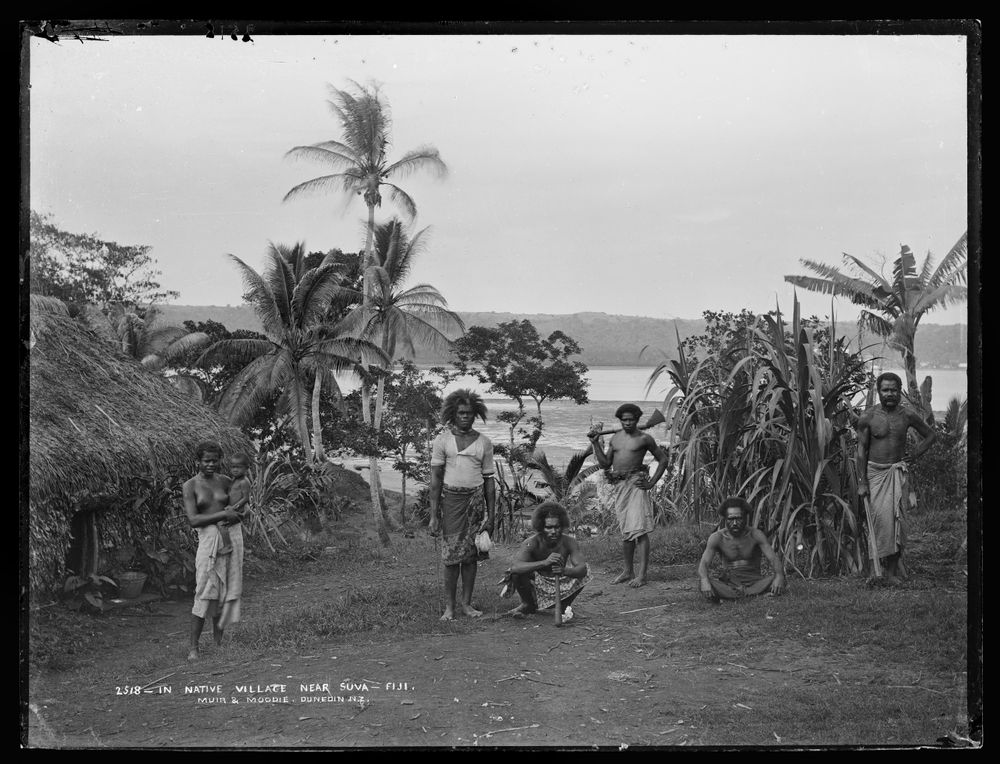
Historical group photographed near Suva on Viti Levu in July 1884, attributed to Alfred Burton, Te Papa C.017411
This 1884 photograph records a group in a village near Suva, with a thatched building and the sea behind them. Te Papa attributes the photograph to Alfred Burton; the reproduced negative bears a Muir & Moodie imprint. It supplies historical village context without identifying the sitters individually or treating their appearance as representative of all iTaukei people.
Overview
iTaukei refers here to Indigenous Fijian peoples, rather than to every citizen or resident of Fiji. The iTaukei Trust Fund Board’s self-description expressly distinguishes iTaukei and Rotuman communities while supporting both. Its aims connect languages, cultural heritage, education, leadership and economic opportunities. Those institutional purposes identify contemporary priorities without defining every person’s experience or reducing identity to membership in a board. Fiji Museum’s broader account likewise describes collections representing Indigenous inhabitants and other communities in Fiji. A national museum and a programme for Indigenous cultural development have different constituencies and should not be mistaken for interchangeable definitions of the country’s population.
Language documentation recognises variation within iTaukei life. The ministry’s divisional-responsibilities account assigns the Institute of Language and Culture work on a monolingual dictionary and custody of dialect records from fourteen provinces. It describes research, documentation, preservation and public communication as continuing responsibilities. The report’s institutional framework connects language and culture with policy and community development rather than presenting them only as relics. These are documented functions, not an independent assessment that every record is complete or every programme successful. Local forms of speech remain important even where a dictionary or a wider public programme uses a shared language label.
Masi art can be both cultural work and a livelihood. Te Papa’s written account names Liviana Qaranivalu as a Fijian maker who moved from hotel employment in Nadi to an island-based barkcloth business with her husband. The account connects orders and income with building a family home and hopes for their children. Her participation in the 2023 Tahiti gathering places a particular artist within collaboration among several distinct Pacific traditions. The museum text was read, while the linked film is not claimed as fully viewed. Her household’s experience supplies a named example of creative change, not a universal economic model for iTaukei families.
Language activities abroad provide another contemporary setting. The Ministry for Pacific Peoples’ Fijian Language Week page schedules the 2026 programme for 4–10 October and emphasises speaking the language at home every day. Its published events involve community associations in places including Hamilton, Queenstown and Whanganui, with language learning, youth activities and cultural work. These are scheduled community programmes rather than measured outcomes, and participation need not establish ethnicity or citizenship. Alongside the museum and language institute, such initiatives demonstrate different ways people maintain and develop relationships with cultural knowledge in Fiji and abroad.
History & identity
Living Indigenous Fijian identities; institutional and project dates document particular initiatives. Rotuman identity and other Fiji communities are kept distinct.
Sources & representation
The Trust Fund Board’s aims, a complete ministry responsibilities page, museum accounts and a current language-week schedule supply scoped evidence. The report’s visible cover and letter identify 2022–2023; its extractable cover text retains 2019–2022, and linked films are not claimed viewed.
Selected bibliography
Documented works and useful reading. This is not a list of every appearance.
- 01
About Us
Complete indexed aims and FAQ read; iTaukei and Rotuman constituencies distinguished.
- 02
Divisional Responsibilities
Complete printed page 4, PDF page 10, read. Visible cover and letter identify 2022–2023 reporting; extractable cover text retains 2019–2022.
- 03
About Us
Complete account read; wider collection constituency retained. Archaeological dates not used as ethnic origins.
- 04
Liviana Qaranivalu at Ahu: Ngā Wairua o Hina
Complete written artist and gathering account read; linked film not claimed fully viewed.
- 05
Fijian Language Week 2026
2026 theme and complete event schedule read; scheduled activities distinguished from attendance or outcomes.
Language & cultural connections
Source-supported language and cultural connections have not yet been compiled for this profile.
References
Sources supporting this profile. Linked pages have their own scope and editorial standards.
- Indigenous institutional self-descriptionAbout UsResearch access: 2026-10-05
- Official institutional reportDivisional ResponsibilitiesResearch access: 2026-10-05
- National museum self-descriptionAbout UsResearch access: 2026-10-05
- Museum artist documentationLiviana Qaranivalu at Ahu: Ngā Wairua o HinaResearch access: 2026-10-05
- Government community programme recordFijian Language Week 2026Research access: 2026-10-05
Image credits
Historical contextual community photographHistorical group photographed near Suva on Viti Levu in July 1884, attributed to Alfred Burton, Te Papa C.017411
This 1884 photograph records a group in a village near Suva, with a thatched building and the sea behind them. Te Papa attributes the photograph to Alfred Burton; the reproduced negative bears a Muir & Moodie imprint. It supplies historical village context without identifying the sitters individually or treating their appearance as representative of all iTaukei people.