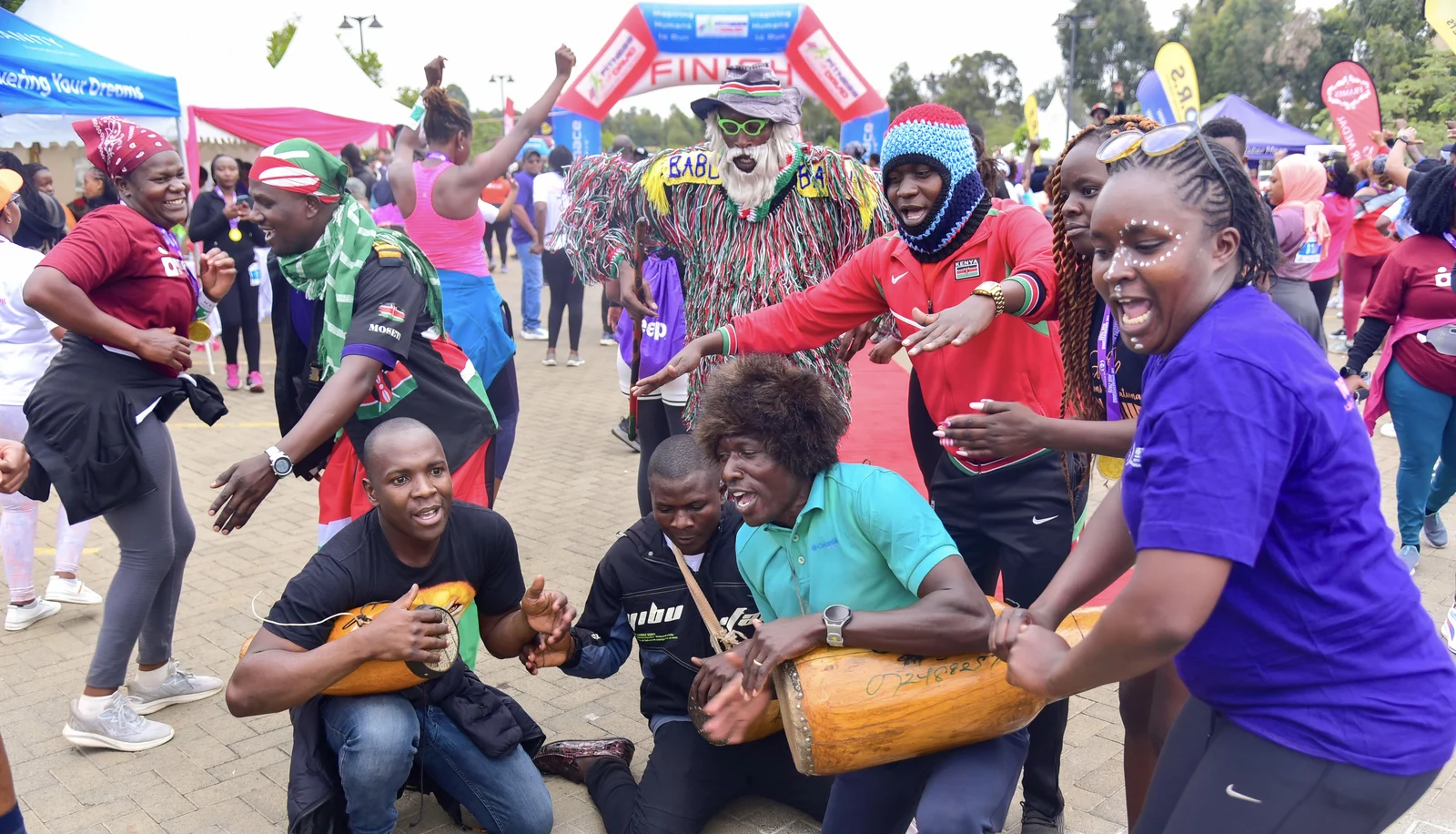
Two men crouch while playing cylindrical wooden drums beside a cheering runner and other performers at a public running-event finish line; the photographer identifies the musicians as Isukuti drummers.
Isukuti drummers at The Breastfeeding Run in Kenya, photographed on 2 August 2025. This is a contemporary performance context for the musical practice discussed in the article; the photographer does not identify the performers’ individual community affiliations.
Overview
Isukha, also called Abaisukha, are identified by the National Museums of Kenya as a community within the wider Luhya setting, speaking Lwisukha and living in parts of Kakamega County. The museum locates neighbouring Idakho and Tiriki communities separately. Its online exhibition, curated by Philemon Nyamanga, uses collection objects to discuss historical farming, trade and musical life. Sickles, a hoe, grain-processing equipment and the one-stringed shiriri provide concrete examples of its interpretation. These are selected museum witnesses to cultural history, rather than an assertion that every present household follows the livelihoods or social roles represented in the display.
Isukuti is documented as a shared celebratory performance among Isukha and Idakho communities. UNESCO’s account describes drumming, singing and energetic dance, with differently sized drums giving the performance its name and other instruments contributing to its sound. The account associates it with public gatherings and important family occasions. Inscription in 2014 on the Urgent Safeguarding List concerned the transmission of a practice, not the classification of a people. Its stated concerns about ageing bearers, materials, funding and competing forms of entertainment belong to that documentation; they are not presented here as a fresh survey of every group’s current situation.
A separate foodways project brought Isukha communities into collaboration with Eastern Pokot participants while keeping their regional settings distinct. The initial UNESCO overview gives a 2009–2013 implementation schedule and describes plans for community fieldwork, student participation and inventories. Coordinators were to receive training and questionnaires were to be refined through field experience. Documentation and public dissemination were explicit parts of the programme. This source records the project’s design and intended activities; the dates alone do not establish that every proposed task succeeded. Its attention to everyday food knowledge also broadens cultural documentation beyond performances at festivals.
UNESCO’s later case study names Muraka and Shihuli as the participating Isukha primary schools. Teachers and local coordinators trained pupils to interview relatives and other community members and record local knowledge through photography and discussion. The study contrasts Isukha farming-related documentation with the Pokot project’s pastoral setting. Community events and shared inventories made the work available to participants, and the account reports intergenerational exchange and increased interest in foodways. Those are the institutional study’s assessments, rather than independently measured outcomes supplied by this profile. Selection of the wider initiative for the 2021 Good Safeguarding Practices register concerns that collaborative method, not a claim that one project exhaustively represents Isukha cultural life.
History & identity
Selected museum interpretation and safeguarding projects document Isukha communities in western Kenya; project and inscription dates are not ethnic-origin dates.
Sources & representation
Complete museum narrative and three indexed institutional accounts distinguish regional identity, performance safeguarding, project design and reported participant work.
Selected bibliography
Documented works and useful reading. This is not a list of every appearance.
- 01
The Isukha Community of Kenya
Complete narrative and credits read; regional identity and selected objects retained, genealogy and ritual instructions excluded.
- 02
Isukuti dance of Isukha and Idakho communities of Western Kenya
Complete indexed English account read; joint community scope, instrumentation and dated safeguarding concerns retained; no current census inferred.
- 03
Safeguarding traditional foodways of two communities in Kenya
Complete indexed overview read;2009–2013 schedule and inventory aims distinguished from results; no recipes or protocol reproduced.
- 04
Youth document and revitalize traditional foodways in Kenya
Complete indexed case study read; named schools and student/relative participation retained; reported outcomes attributed, linked manual/video not inspected.
Language & cultural connections
Source-supported language and cultural connections have not yet been compiled for this profile.
References
Sources supporting this profile. Linked pages have their own scope and editorial standards.
- Museum-curated cultural accountThe Isukha Community of KenyaResearch access: 2026-10-05
- Official heritage element accountIsukuti dance of Isukha and Idakho communities of Western KenyaResearch access: 2026-10-05
- Official project overviewSafeguarding traditional foodways of two communities in KenyaResearch access: 2026-10-05
- Institutional case studyYouth document and revitalize traditional foodways in KenyaResearch access: 2026-10-05
Image credits
Contextual public Isukuti performance photograph; performers’ ethnicity unspecifiedTwo men crouch while playing cylindrical wooden drums beside a cheering runner and other performers at a public running-event finish line; the photographer identifies the musicians as Isukuti drummers.
Isukuti drummers at The Breastfeeding Run in Kenya, photographed on 2 August 2025. This is a contemporary performance context for the musical practice discussed in the article; the photographer does not identify the performers’ individual community affiliations.