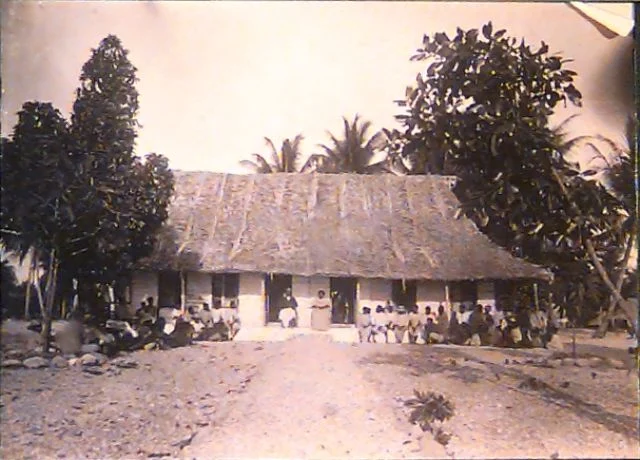
Congregation outside a thatched mission house on Arorae, Kiribati, photographed by Thomas Andrew in 1886, Te Papa O.001250
Andrew photographed this congregation outside a mission house on Arorae in 1886. Te Papa records the historical island spelling “Arorai” in the title and identifies the chief and his wife at the group’s centre. This is a particular church gathering, rather than a picture of all I-Kiribati people or religious practices today.
Overview
I-Kiribati is used here for people with Kiribati cultural and community relationships, including those living outside the islands. In a 2020 Te Papa interview, researcher Rose Namoori-Sinclair from Tabiteuea explained language as a means of interpreting histories, communicating concerns and sustaining identity in Aotearoa New Zealand. Her account places te taetae ni Kiribati within everyday relationships as well as cultural expression. It is a named perspective, rather than a test of who may belong. Island of origin, residence, citizenship and participation in a community organisation remain separate dimensions of a person’s life.
Namoori-Sinclair described learning from Baitika Toom, a cultural elder at a February 2020 family-wellbeing workshop in Blenheim. She emphasised interpreting layers of language meaning in community research and policy, and identified Wellington churches as regular language-use settings. These are dated local observations. The linked wellbeing framework remains a selected-reading lead, not a document claimed fully read.
Language teaching has other named advocates. A July 2025 ministry report presents Kinaua Ewels of the New Zealand Kiribati National Council as a teacher and tutor connecting young people’s language use with belonging. The ministry’s 2026 Language Week record separately documents a July programme and approved support for the council, with scheduled library, school, arts and community activities. The two records concern different years: a theme or funding decision does not establish proficiency gains or event attendance. They show an organised effort to make cultural knowledge accessible to younger people and wider audiences.
In Kiribati itself, contemporary public life includes people connecting cultural preservation with political service. UNDP’s March 2025 interview describes Ruta Babo-Nemta’s election for Maiana in 2024 and her earlier participation in a women’s practice parliament. She recalled learning public-service habits from her father and sought support for documenting oral histories and cultural expression. Those proposals remain aspirations in that dated account. Material documentation supplies another setting: Te Umwanibong’s own museum page identifies a Bikenibeu collection of cultural objects, contemporary history and art, a reference library and recorded songs and stories. Its holdings are research resources, not a claim that this profile has inspected every collection item.
History & identity
Living homeland and diaspora relationships. Organisational programmes, elections and museum records describe particular institutions and activities, not an ethnic origin date.
Sources & representation
Named community interviews are kept separate from programme schedules and museum collection descriptions. Linked frameworks and objects are not claimed fully inspected; current officeholding is not inferred from a dated interview.
Selected bibliography
Documented works and useful reading. This is not a list of every appearance.
- 01
Te taetae ni Kiribati and wellbeing in Aotearoa New Zealand
Complete interview read; dated named perspectives. Linked framework and collection items not claimed inspected.
- 02
Celebrating Wikin te Taetae ni Kiribati 2025
Complete report read; teacher perspective and 2025 context retained.
- 03
Kiribati Language Week 2026
2026 programme and funding sections read; scheduled activities distinguished from outcomes.
- 04
From Maiana to the Maneaba
Complete March report read; 2024 election and 2023 programme dated, cultural proposals not completed projects.
- 05
Kiribati Culture and Museum
Museum’s own location and collection sections read; copied linked Wikipedia history excluded as primary evidence.
Language & cultural connections
Source-supported language and cultural connections have not yet been compiled for this profile.
References
Sources supporting this profile. Linked pages have their own scope and editorial standards.
- Named community interviewTe taetae ni Kiribati and wellbeing in Aotearoa New ZealandResearch access: 2026-10-05
- Government report with named community teacherCelebrating Wikin te Taetae ni Kiribati 2025Research access: 2026-10-05
- Government community programme recordKiribati Language Week 2026Research access: 2026-10-05
- Named participant interviewFrom Maiana to the ManeabaResearch access: 2026-10-05
- Government museum self-descriptionKiribati Culture and MuseumResearch access: 2026-10-05
Image credits
Historical contextual community institution photographCongregation outside a thatched mission house on Arorae, Kiribati, photographed by Thomas Andrew in 1886, Te Papa O.001250
Andrew photographed this congregation outside a mission house on Arorae in 1886. Te Papa records the historical island spelling “Arorai” in the title and identifies the chief and his wife at the group’s centre. This is a particular church gathering, rather than a picture of all I-Kiribati people or religious practices today.