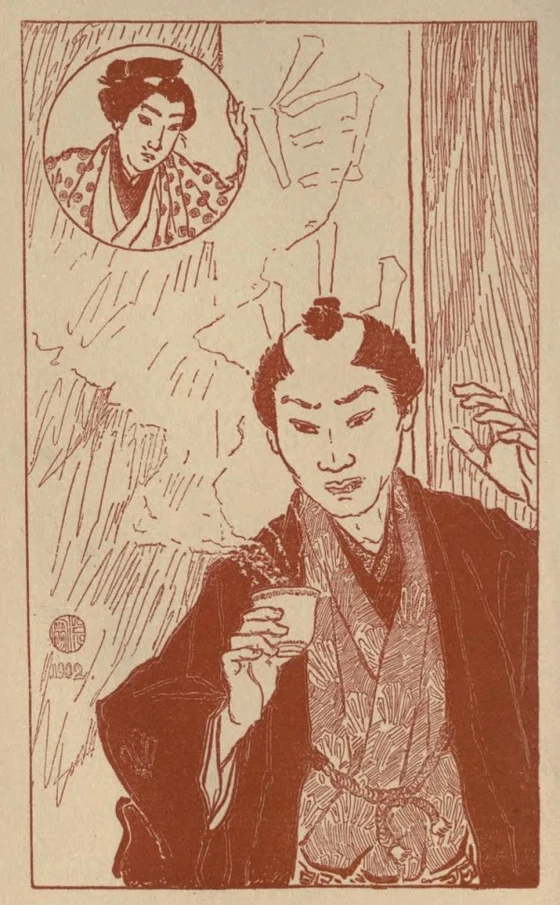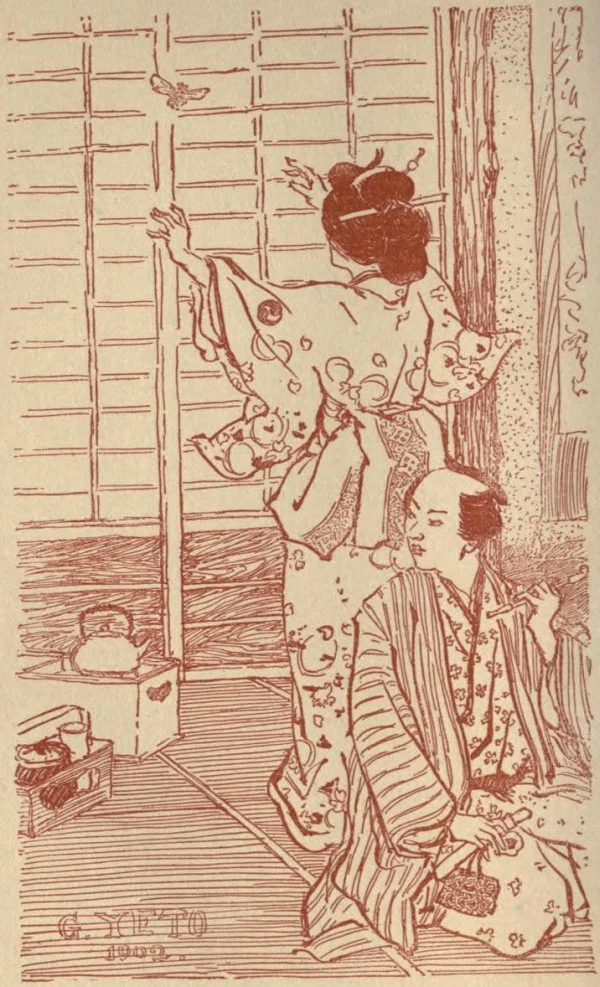
Genjiro Yeto’s illustration of Tama’s returning fly, Kottō, 1903
Yeto shows the fly near the paper window and the household watching it. The red-brown printing is the colour of the whole illustration; it does not establish that this scene occurs after Kyūbei paints the insect red. The household’s identification of the fly with Tama belongs to Hearn’s particular telling.
Overview
Tama serves the Kyoto merchant Kazariya Kyūbei and saves carefully to pay for Buddhist rites for her dead parents. After meeting that obligation she leaves thirty mommé of silver with her mistress. Hearn dates her death to the eleventh day of the first month of Genroku fifteen, adding 1702 in brackets. About ten days later a large fly repeatedly circles Kyūbei’s head, although the narrative stresses the unusual cold-season appearance.
Kyūbei carries the fly away several times. To identify it, he first clips the wing tips and later paints its body and wings red; it nevertheless returns. He and his wife come to believe that it is Tama. When the wife suggests using the remaining money for a service for Tama’s own spirit, the fly falls dead. They bring its body and the money to Jōrakuji, where Jiku Shōnin approves their response and conducts the services. The fly is buried in a box beneath an inscribed memorial marker.
The identity is established through the household’s interpretation, persistent return and the timing of death, not through spoken confirmation by the insect. Its red colour is applied by Kyūbei, not a supernatural natural marking. Hearn links insect returns with beliefs about the dead, especially gaki, but does not supply a particular insect species or state that Tama reappears again after the funeral rites.
Origins & earliest records
Japanese narrated and literary traditions as retold by Lafcadio Hearn
Records & interpretation
Complete named tale, its notes, title page and Old Stories introduction directly read.
Selected bibliography
Documented works and useful reading. This is not a list of every appearance.
- 01
Kottō: Being Japanese Curios, with Sundry Cobwebs
Story of a Fly: complete text and associated footnotes; Macmillan, New York and London.
Family & connections
A source-supported family tree or inspiration record has not yet been compiled for this profile. Related reading below indicates a connection in subject matter, not a proven lineage or creative influence.
Primary records and illustrations
Lafcadio Hearn, Kottō (1903)
Old Stories. Named complete tale: Story of a Fly
Full chapter and footnotes retained in data/cache/asia-continuation/hearn-kotto-Story_of_a_Fly.txt; title and nine-story introduction read. Narrative uncertainties preserved; no art reuse or universal taxonomy inferred.
References
Sources supporting this profile. Linked pages have their own scope and editorial standards.
- Historical primary literary retellingHearn, Kottō (1903), Story of a FlyResearch access: 2026-10-05
Image credits
Historical illustrationGenjiro Yeto’s illustration of Tama’s returning fly, Kottō, 1903
Yeto shows the fly near the paper window and the household watching it. The red-brown printing is the colour of the whole illustration; it does not establish that this scene occurs after Kyūbei paints the insect red. The household’s identification of the fly with Tama belongs to Hearn’s particular telling.