A sourced illustration has not yet been added. This gap is included in the coverage record.
Overview
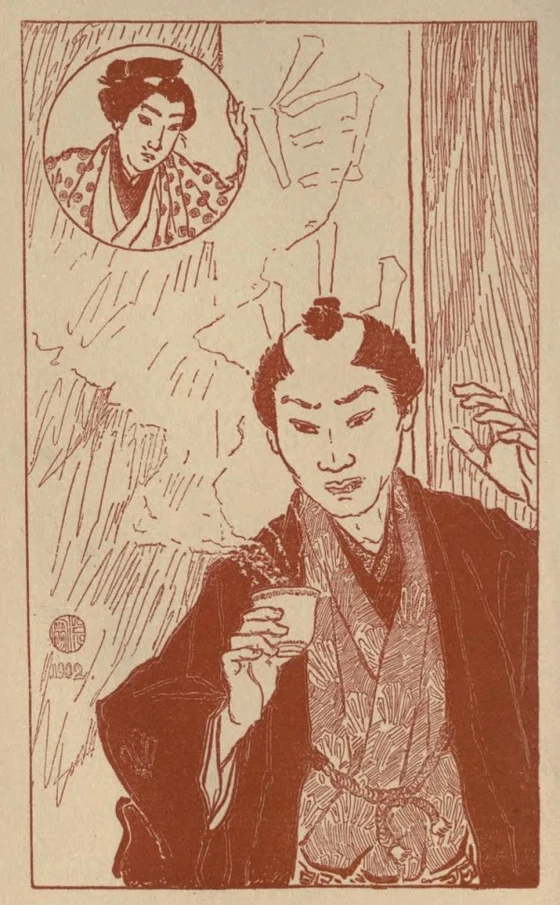
In Hearn’s account, O-Kamé of Nagoshi in Tosa dies after obtaining her husband Hachiyémon’s promise never to remarry. Their marriage has been affectionate, and the narrator does not establish earlier jealousy despite neighbours’ suspicions. After her funeral Hachiyémon steadily weakens. He finally tells his mother that O-Kamé returns every night, lies beside him and whispers, departing when the temple bell sounds at dawn. She has forbidden him to disclose these visits.
A priest warns that another visit will kill him and obtains both families’ consent to open the grave. O-Kamé sits smiling in her coffin, with no visible decay. Her body is warm and flexible when lifted, despite its long confinement in a seated posture. In the mortuary chapel the priest writes sacred Sanskrit characters on the brow, breast and limbs and performs a Ségaki service before reburial. She no longer returns, and Hachiyémon recovers.
The husband suspects that she wants him to accompany her in death, but the tale does not give her a direct confession of such an intention. No drinking of blood, biting or visible extraction of life is narrated. The preserved corpse and nocturnal visitor belong to this particular ghost story; they need not be relabelled as a European vampire. Hearn expressly leaves unanswered whether Hachiyémon ever broke his promise about another marriage.
Origins & earliest records
Japanese narrated and literary traditions as retold by Lafcadio Hearn
Records & interpretation
Complete named tale, its notes, title page and Old Stories introduction directly read.
Selected bibliography
Documented works and useful reading. This is not a list of every appearance.
- 01
Kottō: Being Japanese Curios, with Sundry Cobwebs
The Story of O-Kame: complete text and associated footnotes; Macmillan, New York and London.
Family, evolution & connections
Gonyémon of Nagoshi
The opening identifies O-Kamé as Gonyémon’s daughter. Her mother is not named in this telling; Hachiyémon’s mother is a separate figure.
Hachiyémon
The opening establishes the marriage. His promise not to remarry survives as a promise; the ending expressly leaves his later compliance unstated, so no second wife is invented.
Primary records and illustrations
Lafcadio Hearn, Kottō (1903)
Old Stories. Named complete tale: The Story of O-Kame
Full chapter and footnotes retained in data/cache/asia-continuation/hearn-kotto-The_Story_of_O-Kame.txt; title and nine-story introduction read. Narrative uncertainties preserved; no art reuse or universal taxonomy inferred.
References
Sources supporting this profile. Linked pages have their own scope and editorial standards.
- Historical primary literary retellingHearn, Kottō (1903), The Story of O-KameResearch access: 2026-10-05
Image credits
A sourced illustration has not yet been added. This gap is included in the coverage record.