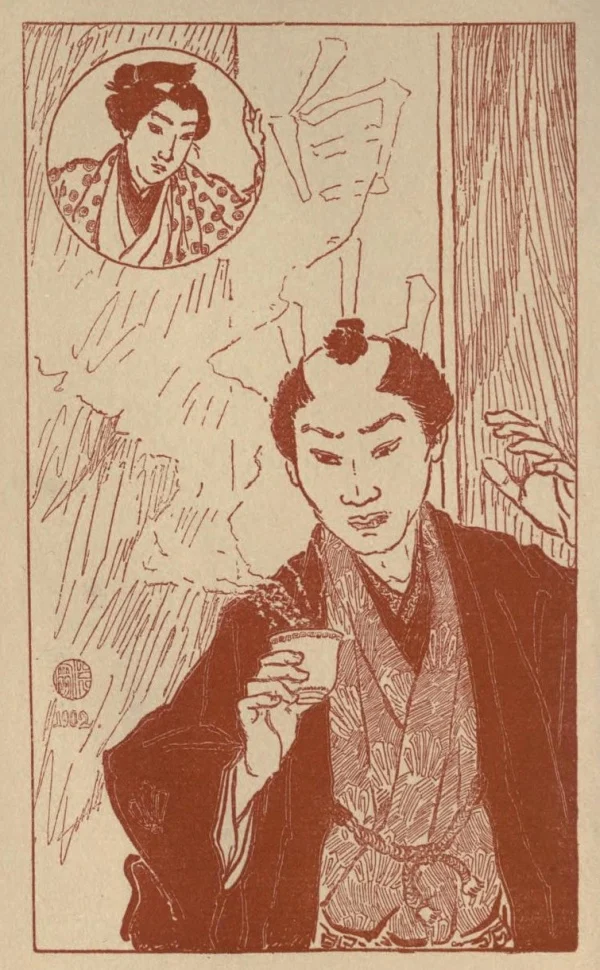
Genjiro Yeto’s Shikibu Heinai face appears beside Sekinai’s tea cup, Kottō,1903
Yeto places the delicate samurai face in a circular inset above Sekinai and his cup, with a faint larger outline behind him. This represents the apparition in Hearn’s unfinished In a Cup of Tea; the picture supplies no conclusion to the threatened revenge or explanation of the ghost’s origin.
Overview
Hearn’s “In a Cup of Tea” begins with Sekinai, an armed attendant of Nakagawa Sado, stopping at a tea-house in Hakusan, Yedo. A handsome young samurai’s face appears in his tea, moving its eyes and lips. Changing the cup and the tea fails to remove it. Sekinai finally drinks the tea together with the image, wondering whether he has swallowed a ghost.
That evening a richly dressed stranger silently enters the guarded residence and identifies himself as Shikibu Heinai. His face matches the image. Accusing Sekinai of an injury, he provokes a dagger thrust; the blade seems to encounter no substance, and the visitor passes through the wall without leaving a mark. On the next night three men calling themselves his retainers—Matsuoka Bungō, Tsuchibashi Bungō and Okamura Heiroku—say their master is treating his wound at hot springs and will return for revenge. Sekinai attacks, but they move up a wall like shadows.
The old narrative stops during that escape. Hearn explicitly refuses to supply a conclusion: neither the promised return nor Sekinai’s eventual fate is narrated. The retainers’ claim of a wound sits beside the earlier apparently insubstantial body; it should not be silently resolved into a rule about ghostly invulnerability. No death history, species or explanation for the face in the tea is given. This is a named apparition in a fragment, not a complete account of a class of tea spirits.
Origins & earliest records
Japanese narrated and literary traditions as retold by Lafcadio Hearn
Records & interpretation
Complete named tale, its notes, title page and Old Stories introduction directly read.
Selected bibliography
Documented works and useful reading. This is not a list of every appearance.
- 01
Kottō: Being Japanese Curios, with Sundry Cobwebs
In a Cup of Tea: complete text and associated footnotes; Macmillan, New York and London.
Family & connections
A source-supported family tree or inspiration record has not yet been compiled for this profile. Related reading below indicates a connection in subject matter, not a proven lineage or creative influence.
Primary records and illustrations
Lafcadio Hearn, Kottō (1903)
Old Stories. Named complete tale: In a Cup of Tea
Full chapter and footnotes retained in data/cache/asia-continuation/hearn-kotto-cup.txt; title and nine-story introduction read. Narrative uncertainties preserved; no art reuse or universal taxonomy inferred.
References
Sources supporting this profile. Linked pages have their own scope and editorial standards.
- Historical primary literary retellingHearn, Kottō (1903), In a Cup of TeaResearch access: 2026-10-05
Image credits
Historical illustrationGenjiro Yeto’s Shikibu Heinai face appears beside Sekinai’s tea cup, Kottō,1903
Yeto places the delicate samurai face in a circular inset above Sekinai and his cup, with a faint larger outline behind him. This represents the apparition in Hearn’s unfinished In a Cup of Tea; the picture supplies no conclusion to the threatened revenge or explanation of the ghost’s origin.