A sourced illustration has not yet been added. This gap is included in the coverage record.
Overview
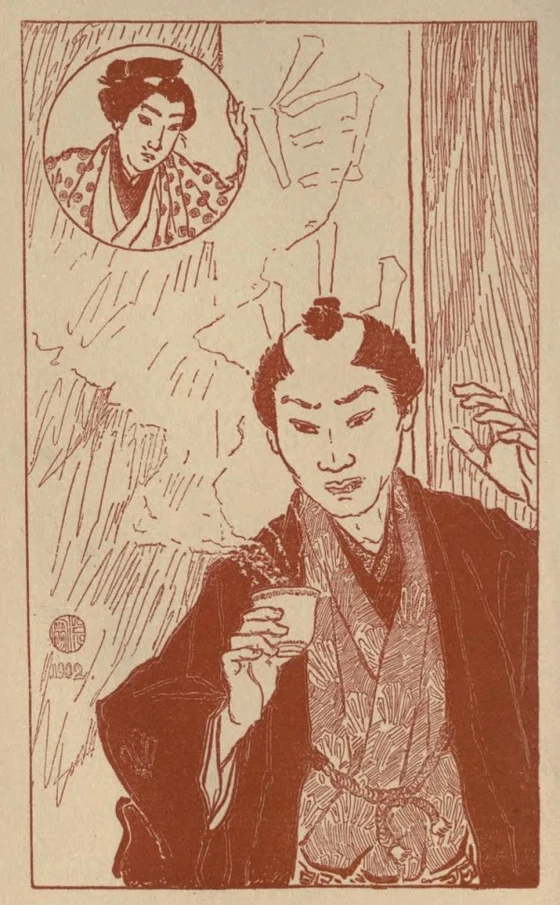
In Hearn’s “Ikiryō,” a young man joins the Setomonodana porcelain business in Reiganjima, Yedo, as assistant to his uncle Rokubei. His commercial success is followed by a severe decline. He explains that a woman’s shadow follows him everywhere, whether alone or with others, and tries to strangle him whenever he closes his eyes. He identifies it as the shadow of his employer Kihei’s living wife, rather than the ghost of someone dead.
The wife admits that she fears the capable clerk will deceive her inexperienced son and acquire the business. Although he has done nothing wrong and she has tried to hide her dislike, she has repeatedly wished him dead. Hearn’s narrative explains that intense hatred can produce an ikiryō without the originating person’s knowledge. Kihei sends Rokubei and the young clerk to establish a branch elsewhere; the persecution ceases, and the clerk recovers.
The woman’s fear is presented as unjustified, not evidence that the clerk planned fraud. Her spirit is a hostile manifestation while she remains alive, and the resolution is removal from her immediate surroundings rather than an exorcism or her death. Hearn’s footnote says an ikiryō is visible only to its victim, a statement about the belief represented in this retelling. The wife and nephew receive no personal names; neither should be supplied from another version.
Origins & earliest records
Japanese narrated and literary traditions as retold by Lafcadio Hearn
Records & interpretation
Complete named tale, its notes, title page and Old Stories introduction directly read.
Selected bibliography
Documented works and useful reading. This is not a list of every appearance.
- 01
Kottō: Being Japanese Curios, with Sundry Cobwebs
Ikiryo1: complete text and associated footnotes; Macmillan, New York and London.
Family & connections
A source-supported family tree or inspiration record has not yet been compiled for this profile. Related reading below indicates a connection in subject matter, not a proven lineage or creative influence.
Primary records and illustrations
Lafcadio Hearn, Kottō (1903)
Old Stories. Named complete tale: Ikiryo1
Full chapter and footnotes retained in data/cache/asia-continuation/hearn-kotto-Ikiryo1.txt; title and nine-story introduction read. Narrative uncertainties preserved; no art reuse or universal taxonomy inferred.
References
Sources supporting this profile. Linked pages have their own scope and editorial standards.
- Historical primary literary retellingHearn, Kottō (1903), Ikiryo1Research access: 2026-10-05
Image credits
A sourced illustration has not yet been added. This gap is included in the coverage record.