A sourced illustration has not yet been added. This gap is included in the coverage record.
Overview
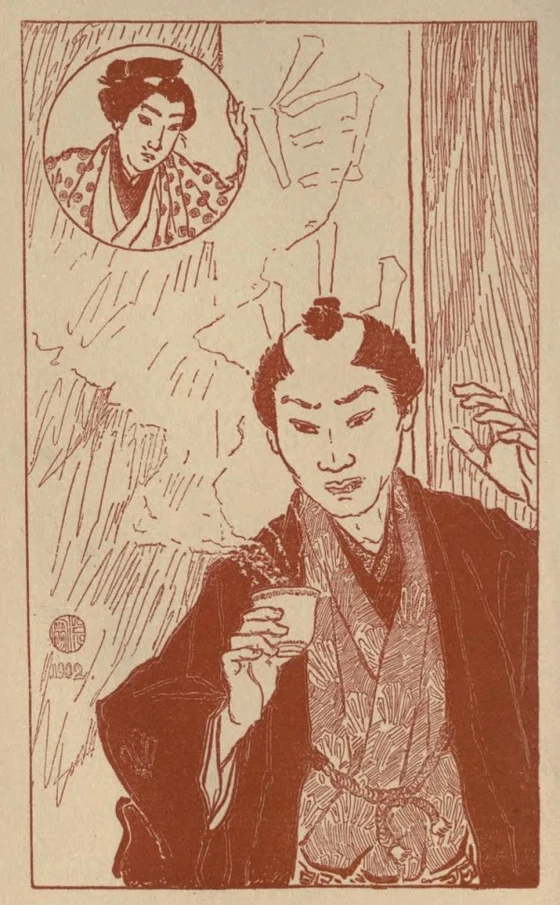
Nomoto Yajiyémon is a deceased district governor in Echizen in Hearn’s “Shiryō.” His clerks seize his property and fabricate debts, obtaining an order that his widow and children be banished. When the decree is announced, a maid suffers convulsions and then speaks in Nomoto’s voice, declaring that he has returned from the dead in anger and grief. He demands the household and official accounts together with the inspector’s books.
Through the maid he performs the reckoning, corrects false entries and writes in his own recognizable handwriting. The comparison proves that he left a treasury surplus rather than unpaid obligations. After saying that his work is finished and he must return, the possessing spirit departs. The girl sleeps for two days and nights, then resumes her ordinary voice and manner with no memory of the possession.
The authorities revoke the banishment, reward the family and later confer posthumous honours; the clerks are punished, without a specified method. This spirit acts through another person rather than appearing as an independently visible body or resurrecting its own corpse. Hearn contrasts shiryō, a dead person’s ghost, with ikiryō, the spirit of someone living. The maid remains unnamed, and her prolonged sleep is attributed to the possession episode rather than offered as a general medical explanation.
Origins & earliest records
Japanese narrated and literary traditions as retold by Lafcadio Hearn
Records & interpretation
Complete named tale, its notes, title page and Old Stories introduction directly read.
Selected bibliography
Documented works and useful reading. This is not a list of every appearance.
- 01
Kottō: Being Japanese Curios, with Sundry Cobwebs
Shiryo1: complete text and associated footnotes; Macmillan, New York and London.
Family & connections
A source-supported family tree or inspiration record has not yet been compiled for this profile. Related reading below indicates a connection in subject matter, not a proven lineage or creative influence.
Primary records and illustrations
Lafcadio Hearn, Kottō (1903)
Old Stories. Named complete tale: Shiryo1
Full chapter and footnotes retained in data/cache/asia-continuation/hearn-kotto-Shiryo1.txt; title and nine-story introduction read. Narrative uncertainties preserved; no art reuse or universal taxonomy inferred.
References
Sources supporting this profile. Linked pages have their own scope and editorial standards.
- Historical primary literary retellingHearn, Kottō (1903), Shiryo1Research access: 2026-10-05
Image credits
A sourced illustration has not yet been added. This gap is included in the coverage record.