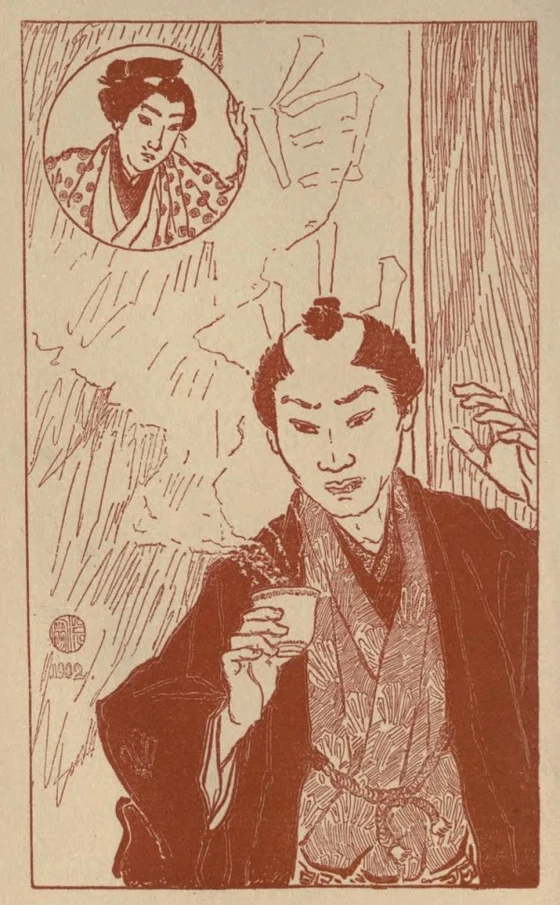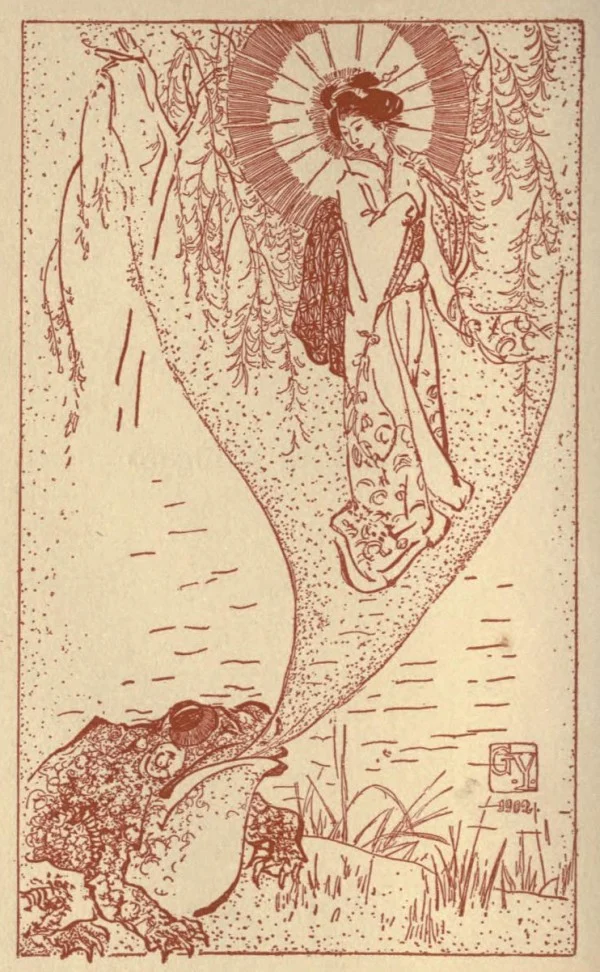
Genjiro Yeto’s paired frog and human bride in Chūgorō’s story, Kottō, 1903
Yeto combines the richly dressed woman and a large frog in one composition. This illustrates the creature’s concealed identity, rather than a transformation witnessed in Hearn’s narrative: the physician supplies the frog identification after Chūgorō dies. No feeding or biting act is pictured.
Overview
Chūgorō, a retainer in Suzuki’s household near the Yedogawa in Yedo, secretly meets a beautiful, richly dressed woman by Naka-no-hashi. Her touch makes him helpless, and she draws him into deep water. He next finds himself dry and warm in an immense illuminated residence. They exchange marriage vows, and she permits nightly visits while insisting that he leave before dawn and keep the relationship secret.
After months of declining health, Chūgorō confesses to an older retainer. That night the woman fails to meet him. He returns trembling, becomes gravely ill by dawn and dies at sunset despite treatment. A physician says that his veins contain water instead of blood and explains that the river-haunting creature has destroyed other young men. Asked whether she is a fox, serpent or dragon woman, he rejects each identification and calls her a great, ugly frog, which could be seen under the bridge by daylight.
The physician supplies the final identification; the narrative does not show the woman changing back into a frog before witnesses. Chūgorō’s earlier comparison with Urashima and speculation that she might be a god’s daughter are his mistaken or unconfirmed interpretations. Her appetite for young people’s blood is stated, but no biting or feeding act is directly described. The splendid underwater home is likewise his reported experience, not independently inspected architecture.
Origins & earliest records
Japanese narrated and literary traditions as retold by Lafcadio Hearn
Records & interpretation
Complete named tale, its notes, title page and Old Stories introduction directly read.
Selected bibliography
Documented works and useful reading. This is not a list of every appearance.
- 01
Kottō: Being Japanese Curios, with Sundry Cobwebs
The Story of Chugoro: complete text and associated footnotes; Macmillan, New York and London.
Family, evolution & connections
Chūgorō, Suzuki’s retainer
Chūgorō recounts a wedding feast and exchanged vows. His guess that the woman is a god’s daughter supplies no verified parent; the frog identification comes later from the physician.
Primary records and illustrations
Lafcadio Hearn, Kottō (1903)
Old Stories. Named complete tale: The Story of Chugoro
Full chapter and footnotes retained in data/cache/asia-continuation/hearn-kotto-The_Story_of_Chugoro.txt; title and nine-story introduction read. Narrative uncertainties preserved; no art reuse or universal taxonomy inferred.
References
Sources supporting this profile. Linked pages have their own scope and editorial standards.
- Historical primary literary retellingHearn, Kottō (1903), The Story of ChugoroResearch access: 2026-10-05
Image credits
Historical illustrationGenjiro Yeto’s paired frog and human bride in Chūgorō’s story, Kottō, 1903
Yeto combines the richly dressed woman and a large frog in one composition. This illustrates the creature’s concealed identity, rather than a transformation witnessed in Hearn’s narrative: the physician supplies the frog identification after Chūgorō dies. No feeding or biting act is pictured.