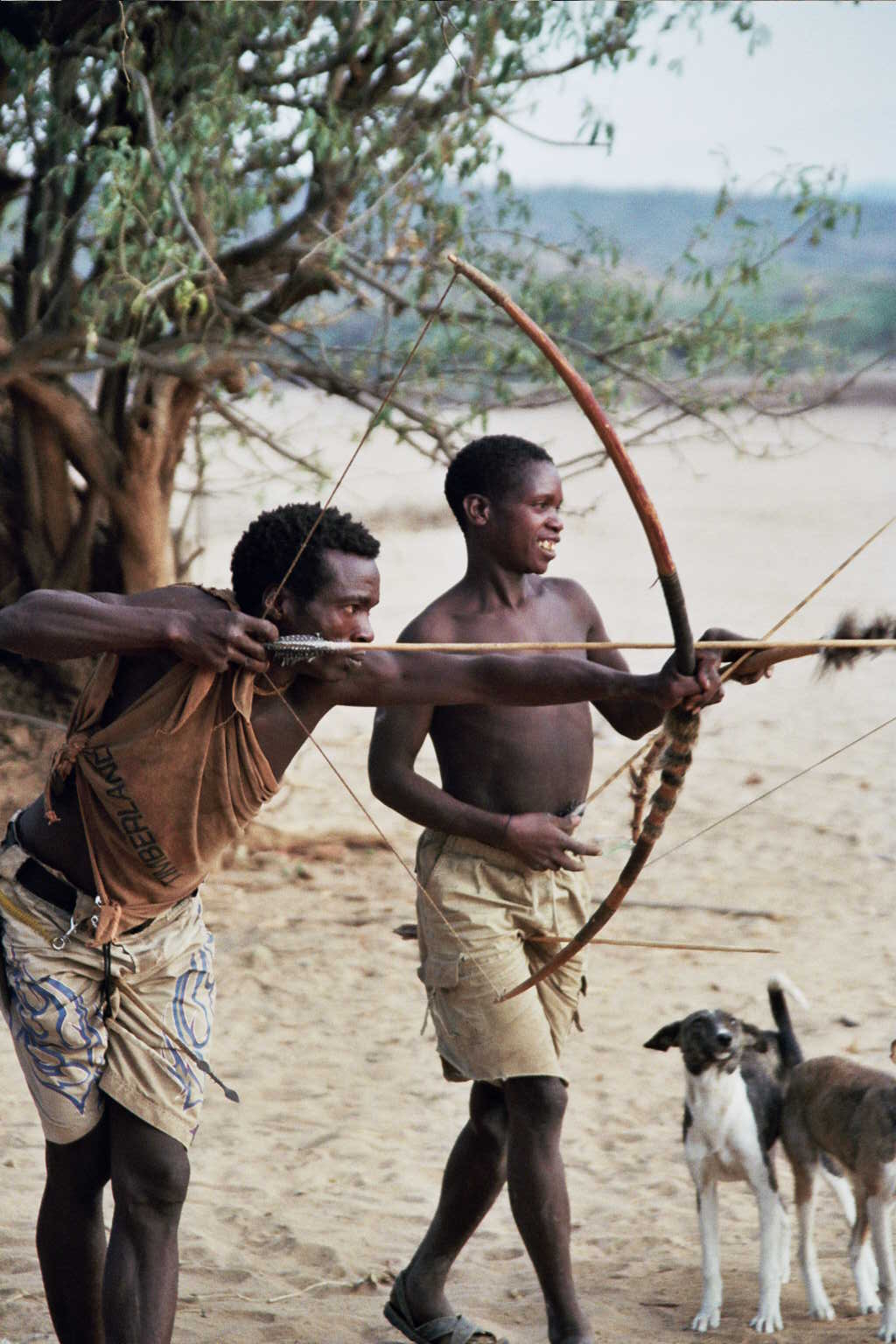
Two men identified by the photographer as Hadza stand beneath a tree, one drawing a bow while the other holds archery equipment; a dog stands beside them.
Photographer Idobi identifies these men as Hadza, September 2007. The particular village is not supplied, so the photograph is contextual rather than a verified portrait of a named Yaeda or Eyasi settlement.
Overview
Hadza communities in northern Tanzania are represented here through selected accounts of land and livelihood work, rather than as an unchanged remnant of the past. The Nature Conservancy describes gathering and hunting in relation to woodland resources and discusses pressures from expanding agriculture and livestock grazing. Its historical project account reports communal land recognition in October 2011, involving Ujamaa Community Resource Team, Dorobo Fund and other partners. It also distinguishes nearby Datoga pastoralists' land arrangements from Hadza tenure. These are the conservation organisation's descriptions of a regional programme; neither its broad cultural characterisations nor its reported legal and environmental outcomes establish every Hadza person's circumstances.
Ujamaa's specific Hadzabe land account provides a named community voice. Athumani Magandula, identified there as a Mongo wa Mono resident and chairman of the Hadzabe Survival Council, describes spending woodland-related revenue on students' school fees, hospital bills, shared food, community scouts and a maize-grinding machine. His testimony connects forest stewardship with changing communal needs and local economic decisions. The organisation explains its participation in village planning and applications for communal occupancy certificates, followed by cooperation with Carbon Tanzania. These statements remain a participant's account and a partner's institutional history, without assigning Magandula's position to every community member or independently verifying payments, title deeds and ecological changes.
Ujamaa's broader programme statement places Hadza youth education within work supporting communities' ability to represent themselves. Its public approach describes participation beyond a small set of leaders, with attention to women and other marginalised members, alongside cooperation with organisations including the Pastoral Women's Council. The same page distinguishes land tenure, governance, resource management, livelihood development and policy advocacy as organisational themes. This helps explain why contemporary Hadza documentation includes schooling, negotiations and institutional partnerships as well as woodland use. It describes the organisation's intended approach, not proof that every consultation was equally representative or that all Hadza communities participate in the same programmes.
Carbon Tanzania's March 2024 account describes a separate land repurchase following community discussions begun in 2021. According to the company, a village committee requested the use of carbon revenue, and village and district authorities consulted buyers before an agreement was reached. The article reports repurchase on 8 March 2024 and an intention to allow natural regeneration. It explicitly says the land was not incorporated into the carbon-credit project area or its occupancy certificate. That distinction prevents treating every community land arrangement as the same legal or commercial mechanism. This is a project operator's narrative; the agreement, consultation record and subsequent regeneration were not separately inspected here.
History & identity
Land-project and publication dates concern recent documentary events, not the age or origin of Hadza identity.
Sources & representation
Four complete public written bodies read; named community testimony distinguished from partner self-report.
Selected bibliography
Documented works and useful reading. This is not a list of every appearance.
- 01
Helping the Hadza Protect Their Homeland
Complete written body read; conservation partner account, no original legal records inspected.
- 02
Securing Land Rights for the Hadzabe
Complete written body read; Magandula testimony attributed, deep-age assertion excluded.
- 03
Programmes
Complete written body read; organisational participation and education aims.
- 04
This Land is Our Land: Protection leads to repurchase
Complete written body read; operator account, repurchase and carbon-title distinction retained.
Language & cultural connections
Source-supported language and cultural connections have not yet been compiled for this profile.
References
Sources supporting this profile. Linked pages have their own scope and editorial standards.
- Public institutional account with qualified participant testimonyHelping the Hadza Protect Their HomelandResearch access: 2026-10-05
- Public institutional account with qualified participant testimonySecuring Land Rights for the HadzabeResearch access: 2026-10-05
- Public institutional account with qualified participant testimonyProgrammesResearch access: 2026-10-05
- Public institutional account with qualified participant testimonyThis Land is Our Land: Protection leads to repurchaseResearch access: 2026-10-05
Image credits
Contextual community activity photographTwo men identified by the photographer as Hadza stand beneath a tree, one drawing a bow while the other holds archery equipment; a dog stands beside them.
Photographer Idobi identifies these men as Hadza, September 2007. The particular village is not supplied, so the photograph is contextual rather than a verified portrait of a named Yaeda or Eyasi settlement.