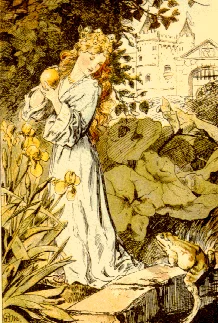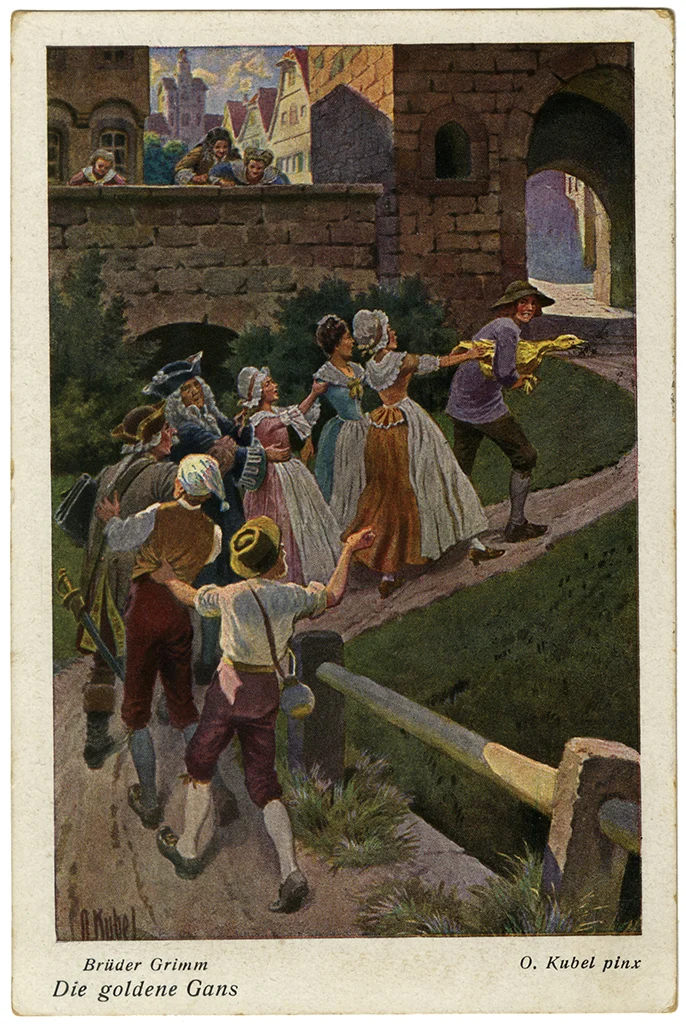
The Golden Goose, Otto Kubel historical postcard
Named tale postcard, dated1922 or earlier; artist1868–1951. The institution credits the historical artwork and reproduction. Creature and procession shown.
Overview
Dummling receives help from a little man after sharing his food and drink, and discovers a golden-feathered goose in a felled tree’s roots. At an inn, the eldest daughter tries to steal a feather and becomes attached to the bird. Her sisters stick to one another in turn. The animal’s precious appearance therefore invites the contact that activates its extraordinary effect.
As Dummling carries the goose onward, a parson, sexton and labourers join the chain when they try to separate its members. The resulting procession reaches a princess who has never laughed and prompts an uncontrollable response. This selected bird is neither a goose laying golden eggs nor a biological animal with metallic plumage. Its distinctive action is making touch bind a growing group together.
The gift follows a three-part encounter in the forest. Dummling’s older brothers each refuse to share their cake and wine with the grey-haired little man. Both suffer axe injuries, one to the arm and the other to the leg, which the narration attributes to the little man. Dummling is mocked by his family and receives only a cake baked in the ashes and sour beer. He nevertheless offers to share them. When he brings them out, the poor provisions have become sweet cake and good wine.
The little man directs Dummling to a particular old tree as a reward for his generosity. After felling it, Dummling finds the goose among its roots and takes it with him. The text describes feathers of pure gold, but does not explain the bird’s birth or how long it has occupied that place. There is no egg-laying episode. Finding a magical animal at a tree’s roots is a narrative event here, not a claim about natural goose nesting or metallic coloration.
The innkeeper’s three daughters want feathers for themselves. The eldest grips the goose’s wing and her hand stays fixed; the second sticks to her sister. The youngest comes despite their shouted warnings and is trapped by contact in turn. They remain attached throughout the night. In the morning Dummling carries the goose beneath his arm, obliging the women to follow wherever he goes. The story describes the resulting movements but gives the bird no speech or stated plan to punish them.
The chain grows through attempts at intervention. A parson rebukes the girls and grabs the youngest to pull her away, thereby becoming attached himself. A sexton catches the parson’s sleeve while reminding him of a christening and is similarly held. Two laborers answer their request for help but stick when they touch the sexton. The completed procession therefore contains seven people behind Dummling and the goose: three sisters, two church officers and two laborers.
A king has promised his daughter’s hand to whoever can make her laugh. The sight of all seven followers running in the chain succeeds, and Dummling asks for the promised marriage. In the Hunt text inspected here, the wedding follows directly; after the king dies, Dummling inherits his kingdom and lives contentedly with his wife. This witness does not add demands for huge quantities of food or drink or a vessel traveling on both land and water. Such additional tasks should not be silently inserted into this selected ending.
The goose links the initial reward for sharing to the public spectacle that changes Dummling’s status. Its adhesive property reaches people through one another, rather than requiring everyone to touch a feather. The first three approach greedily, while later followers become caught through reproach or attempted rescue. Those different motives are visible in the sequence itself and need not be flattened into a claim that every person is punished for the same fault.
Origins & earliest records
This entry follows tale 64 in the Grimm brothers’ Household Tales, using Margaret Hunt’s 1884 English translation. The collection was repeatedly revised during the nineteenth century and mediates material from storytellers and earlier literature. Its publication and translation dates identify the selected witness, not the beginning of every related oral narrative.
Records & interpretation
Complete tale 64 read in Hunt’s English text, including the final transformation or marriage and punishment. The 1884 volume title and translator’s preface were also inspected in transcription. Hunt explains editorial selection and combination of variants, so this is a located literary witness rather than a verbatim field recording. No German manuscript collation or verification of supernatural existence is claimed.
In the literature
“there was a goose sitting in the roots with feathers of pure gold.”
Tale 64 The Golden Goose; paragraph beginning “Dummling went and cut down the tree, and when it fell there…” · Margaret Hunt
Dummling discovers the golden-feathered goose in the felled tree’s roots.
Selected bibliography
Documented works and useful reading. This is not a list of every appearance.
- 01
Household Tales, tale 64: The Golden Goose
Complete numbered tale 64, including its ending, read in English transcription. The 1884 edition identifies Margaret Hunt as translator; the translator’s preface was separately checked. This is one selected witness, not an exhaustive variant bibliography.
- 02
Household Tales: 64 The Golden Goose
Margaret Hunt’s English translation, London: George Bell and Sons, 1884; Gutenberg e-text identifies Hunt. Translation date corroborated by the Wikisource scanned title page and National Library of New Zealand catalogue.
Family & connections
A source-supported family tree or inspiration record has not yet been compiled for this profile. Related reading below indicates a connection in subject matter, not a proven lineage or creative influence.
Located primary passages
Specific passages supporting details in this entry, grouped by their published witness.
Household Tales, tale 64: The Golden Goose
Margaret Hunt’s English translation, London: George Bell and Sons, 1884; Gutenberg e-text identifies Hunt. Translation date corroborated by the Wikisource scanned title page and National Library of New Zealand catalogue.
- Dummling discovers the golden-feathered goose in the felled tree’s roots.
- A feather thief becomes stuck to the goose.
This describes the version printed in Hunt’s translation; German tale origin and other versions require separate evidence.
References
Sources supporting this profile. Linked pages have their own scope and editorial standards.
- Primary textGrimm/Hunt, Household Tales, tale 64Research access: 2026-10-05
- Historical edition and editorial statementGrimm’s Household Tales, volume I (1884): title and translator’s prefaceResearch access: 2026-10-05
Image credits
Historical illustrationThe Golden Goose, Otto Kubel historical postcard
Named tale postcard, dated1922 or earlier; artist1868–1951. The institution credits the historical artwork and reproduction. Creature and procession shown.