Rumpelstiltskin
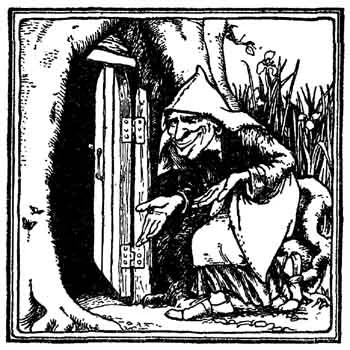
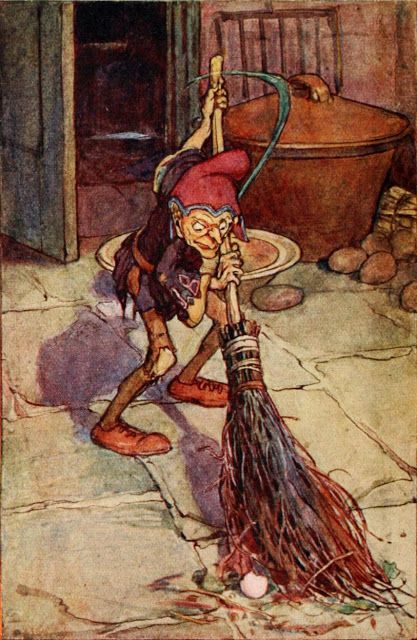
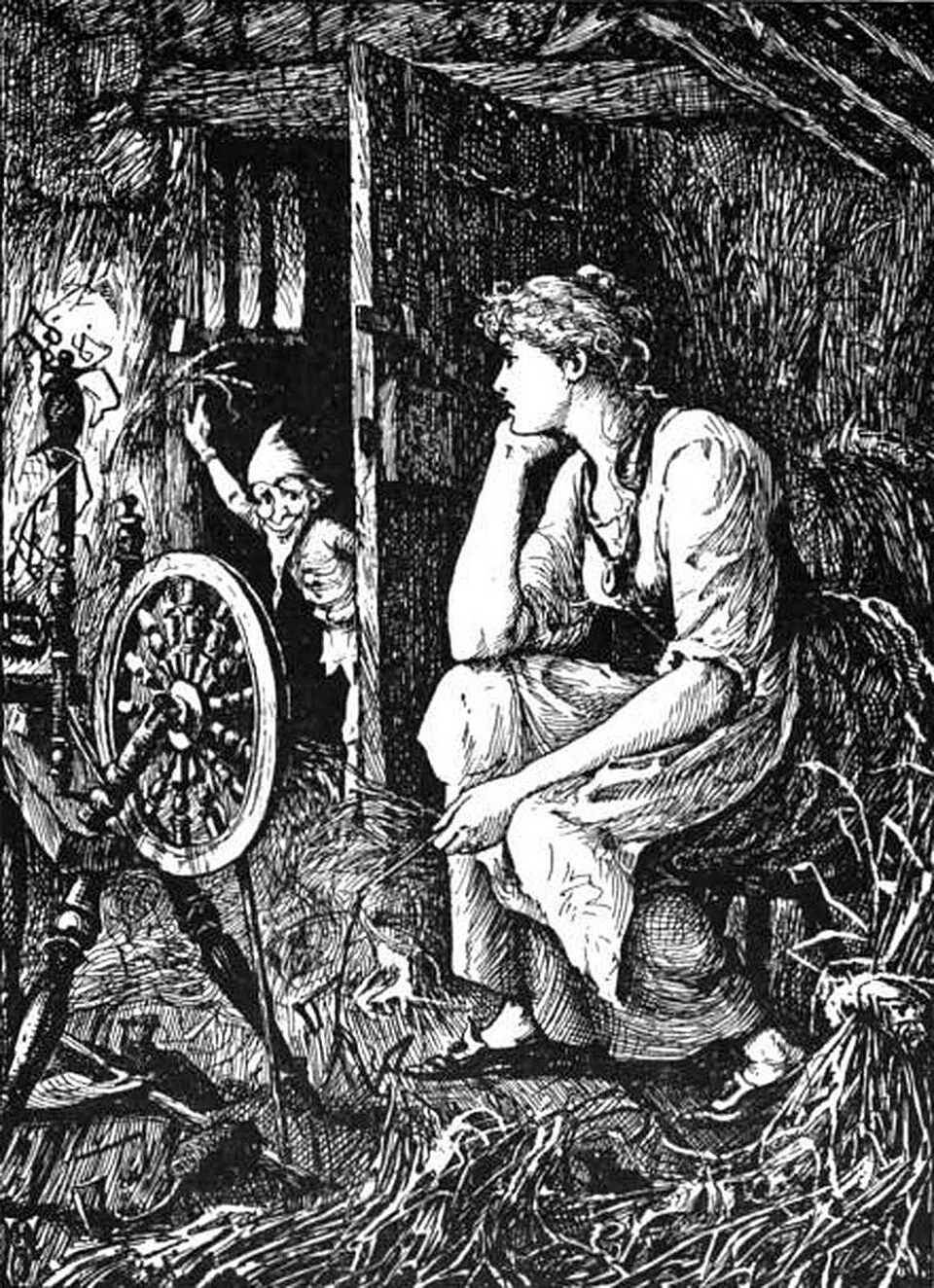
Image associated with the exact linked encyclopedia article; consult credited file description for its interpretation.
Overview
Rumpelstiltskin’s first appearance answers a crisis created by a miller’s boast and a king’s greed. The miller claims that his daughter can spin straw into gold; the king confines her with an impossible task under threat of death. A small man offers to perform the work for her necklace, then returns for her ring when the king demands still more. On the third night she has nothing left, and he takes a promise of her first child should she become queen. In Hunt’s translation, three turns of the wheel fill a reel, and the rooms increase in size as the king’s appetite grows. Rescue and coercion therefore operate together: the spinner accomplishes the miracle, but the woman’s choices have already been narrowed by royal threats. Hunt’s text calls him a little man or manikin and does not supply a beard, tail, green clothing or a biological species.
A year after the marriage he returns for the child, rejecting the kingdom’s riches because a living being matters more to him. Her distress earns a three-day opportunity to discover his name. The decisive knowledge comes from a messenger who hears him singing outside a woodland house while dancing on one leg. The queen first offers false guesses before using the revealed name. In Hunt’s 1884 witness he accuses the devil, stamps a foot into the earth and tears himself apart in rage. The separately inspected Taylor/Edwardes-based English compilation gives a materially different outcome: he blames a witch, frees his foot from the floor and leaves while the court mocks him. Neither ending should silently replace the other. Suffolk’s Tom Tit Tot provides another documented comparison, with a tail, daily flax skeins and a claim upon the woman herself. A shared secret-name contest connects these narratives without erasing their different bargains, forms and endings.
Origins & earliest records
Grimm’s collection chronology begins in 1812, but the detailed account here selects Margaret Hunt’s 1884 translation of tale 55. A separately inspected Taylor/Edwardes-based English compilation supplies a different ending. These English witnesses must be distinguished from the original German publication, and neither establishes the oral beginning of the wider name-guessing tale family.
Records & interpretation
The three exchanges, spinning mechanism, messenger’s report and divergent endings are directly inspectable literary evidence. Comparing the English witnesses demonstrates editorial variation, without proving that straw became gold or a supernatural bargain governed a historical household. The name’s discovery is a plot mechanism, not a verified rule for controlling beings.
In the literature
“the straw was all spun into gold.”
RUMPELSTILTSKIN; paragraph beginning “And round about the wheel went merrily; the work…” · Translator not identified in hosted edition
The little spinner completes the first task in this adaptation.
“the first little child that you may have when you are queen.”
RUMPELSTILTSKIN; paragraph beginning “The king was greatly delighted to see all this…” · Translator not identified in hosted edition
The third spinning bargain demands the future child.
“you tell me my name, you shall keep your child.”
RUMPELSTILTSKIN; paragraph beginning “At the birth of her first little child she…” · Translator not identified in hosted edition
Naming offers escape from the bargain.
Selected bibliography
Documented works and useful reading. This is not a list of every appearance.
- 01
Household Tales, tale 55: Rumpelstiltskin
Full episode inspected; earth-stamping and self-division ending belongs to this witness.
- 02
Grimms’ Fairy Tales: Rumpelstiltskin
Full episode independently inspected; the figure leaves after freeing his stamped foot. This URL does not open the 1812 German edition.
- 03
English Fairy Tales: Tom Tit Tot
Inspected Suffolk narrative and note, used as an attributed comparison rather than an alias.
- 04
Grimms’ Fairy Tales
Gutenberg #2591. The German collection began publication in 1812; that is not this English edition date.
Family & connections
A source-supported family tree or inspiration record has not yet been compiled for this profile. Related reading below indicates a connection in subject matter, not a proven lineage or creative influence.
Located primary passages
Specific passages supporting details in this entry, grouped by their published witness.
Grimms’ Fairy Tales: Rumpelstiltskin
Gutenberg #2591. The German collection began publication in 1812; that is not this English edition date.
- The little spinner completes the first task in this adaptation.
RUMPELSTILTSKIN; paragraph beginning “And round about the wheel went merrily; the work…”
- The third spinning bargain demands the future child.
RUMPELSTILTSKIN; paragraph beginning “The king was greatly delighted to see all this…”
- Naming offers escape from the bargain.
RUMPELSTILTSKIN; paragraph beginning “At the birth of her first little child she…”
Published witness, not zoological proof or an established earliest origin.
Encyclopedia background
An additional attributed reference, separate from the editorial profile above.
Read the open encyclopedia overview
"Rumpelstiltskin" ( RUMP-əl-STILT-skin; German: Rumpelstilzchen [ˈʁʊmpl̩ˌʃtiːltsçn̩] ) is a German fairy tale collected by the Brothers Grimm in the 1812 edition of Children's and Household Tales. The story is about an imp who spins straw into gold in exchange for a woman's firstborn child.
Text from Wikipedia contributors, “Rumpelstiltskin”. CC BY-SA 4.0. Extracted introduction; formatting changed. Retrieved 5 October 2026. The source article may have changed since retrieval.
References
Sources supporting this profile. Linked pages have their own scope and editorial standards.
- Primary textHousehold Tales, tale 55: RumpelstiltskinResearch access: 2026-10-05
- Primary textGrimms’ Fairy Tales: RumpelstiltskinResearch access: 2026-10-05
- Primary textEnglish Fairy Tales: Tom Tit TotResearch access: 2026-10-05
Image credits
Reference illustrationRumpelstiltskin
Image associated with the exact linked encyclopedia article; consult credited file description for its interpretation.