Tom Tit Tot, long-tailed spinning imp, Batten
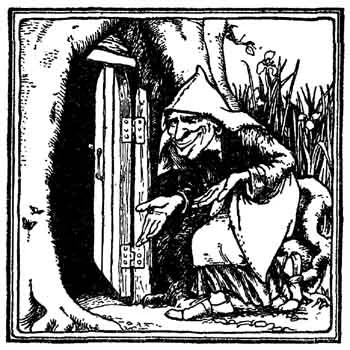
Actual isolated pointed-eared imp with curled tail; primary printed page4 falls inside Tom Tit Tot. Transparent PNG examined on white to see the original black linework.
Overview
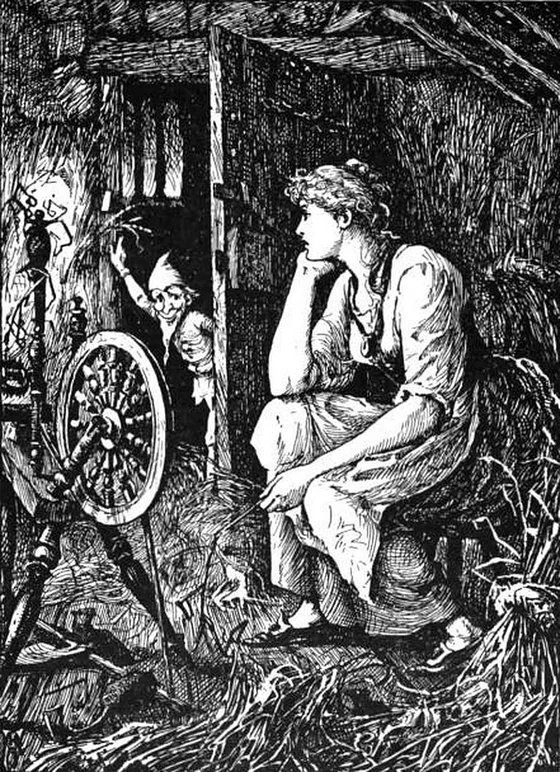
A mother disguises her daughter’s consumption of five pies as a boast that she can spin five skeins a day. The king marries the supposed spinner but threatens death if she fails to achieve that quantity during the appointed month. A small black creature with a long twirling tail offers to take the flax each morning and bring finished skeins each evening. It gives the queen three guesses at its name nightly, claiming her if the month expires without success.
The creature becomes increasingly malicious as the deadline approaches, its eyes likened to burning coal and its tail moving more fiercely. The king then recounts an amusing sight from a chalk pit: a strange small spinner chanting its own name. The queen preserves the discovery until her final guesses, then names Tom Tit Tot and sends it shrieking into the dark. This is a Suffolk member of the name-guessing story family, with distinctive pies, month-long contract, tail and incidental royal witness. It should remain related to Rumpelstiltskin without collapsing their separate collecting histories or importing the German figure’s bodily destruction into this ending.
Origins & earliest records
Jacobs identifies Edward Clodd’s recovery from Suffolk Notes and Queries in the Ipswich Journal and its reprinting in Folk-Lore Journal volume VII. He says he reduced the Suffolk dialect. This provenance supports the selected regional witness, while the wider motif’s oral origin remains unresolved.
Records & interpretation
The inspected text supplies the tail, extraordinary spinning and name wager. These are narrative features rather than observations of an animal or a human ethnic group. Clodd’s historical interpretation of naming customs is an attributed theory, not independent proof of the spirit.
In the literature
“a small little black thing with a long tail”
TOM TIT TOT; The helper first appears at the kitchen door
The text supplies colour and tail without identifying a zoological species.
Selected bibliography
Documented works and useful reading. This is not a list of every appearance.
- 01
English Fairy Tales
Inspected complete selected episode “Tom Tit Tot” and compiler’s editorial source note.
- 02
English Fairy Tales — Tom Tit Tot
Joseph Jacobs, English Fairy Tales; first collection1890 context, selected PG7439 print date unresolved. Preface explicitly acknowledges rewriting and changed incidents. Named tale and observed anchor used, no invented print pagination.
Family & connections
A source-supported family tree or inspiration record has not yet been compiled for this profile. Related reading below indicates a connection in subject matter, not a proven lineage or creative influence.
Located primary passages
Specific passages supporting details in this entry, grouped by their published witness.
English Fairy Tales — Tom Tit Tot
Joseph Jacobs, English Fairy Tales; first collection1890 context, selected PG7439 print date unresolved. Preface explicitly acknowledges rewriting and changed incidents. Named tale and observed anchor used, no invented print pagination.
- A girl married under a false claim of spinning skill must produce five skeins daily in the final month or be killed by the king. A small black, long-tailed being offers daily spinning, allowing three name guesses nightly; unless she names it before month’s end, she belongs to it.
TOM TIT TOT; Five skeins and the helper’s month-long bargain
- The helper delivers the skeins while rejecting successive guesses and growing threatening. The king happens upon it spinning in a chalk pit and recounts its self-naming song. On the final evening the woman uses the disclosed name; the being shrieks and flies into the dark, never returning.
TOM TIT TOT; Daily deliveries, discovery of the name and escape
Complete selected tale and source note read; earlier cited works remain indirect. No song or ritual-formula excerpts. Strange Visitor evidence limited to six words from its narrative presentation; no separate quotation added.
Primary source witness
Joseph Jacobs, English Fairy Tales; first collection1890 context, selected PG7439 print date unresolved. Preface explicitly acknowledges rewriting and changed incidents. Named tale and observed anchor used, no invented print pagination.
- Jacobs credits E. Clodd’s recovery from the Ipswich Journal’s Suffolk Notes and Queries and reprint in Folk-Lore JournalVII pp138–143. He says he reduced the dialect. Comparative name-power interpretations in the note remain attributed theories rather than universal beliefs.
NOTES AND REFERENCES, I TOM TIT TOT; Jacobs’s source and dialect reduction
Verifies Jacobs’s stated editorial practice; comparative interpretation is not treated as historical proof.
References
Sources supporting this profile. Linked pages have their own scope and editorial standards.
- Primary textJacobs, English Fairy Tales: Tom Tit TotResearch access: 2026-10-05
Image credits
Historical illustrationTom Tit Tot, long-tailed spinning imp, Batten
Actual isolated pointed-eared imp with curled tail; primary printed page4 falls inside Tom Tit Tot. Transparent PNG examined on white to see the original black linework.