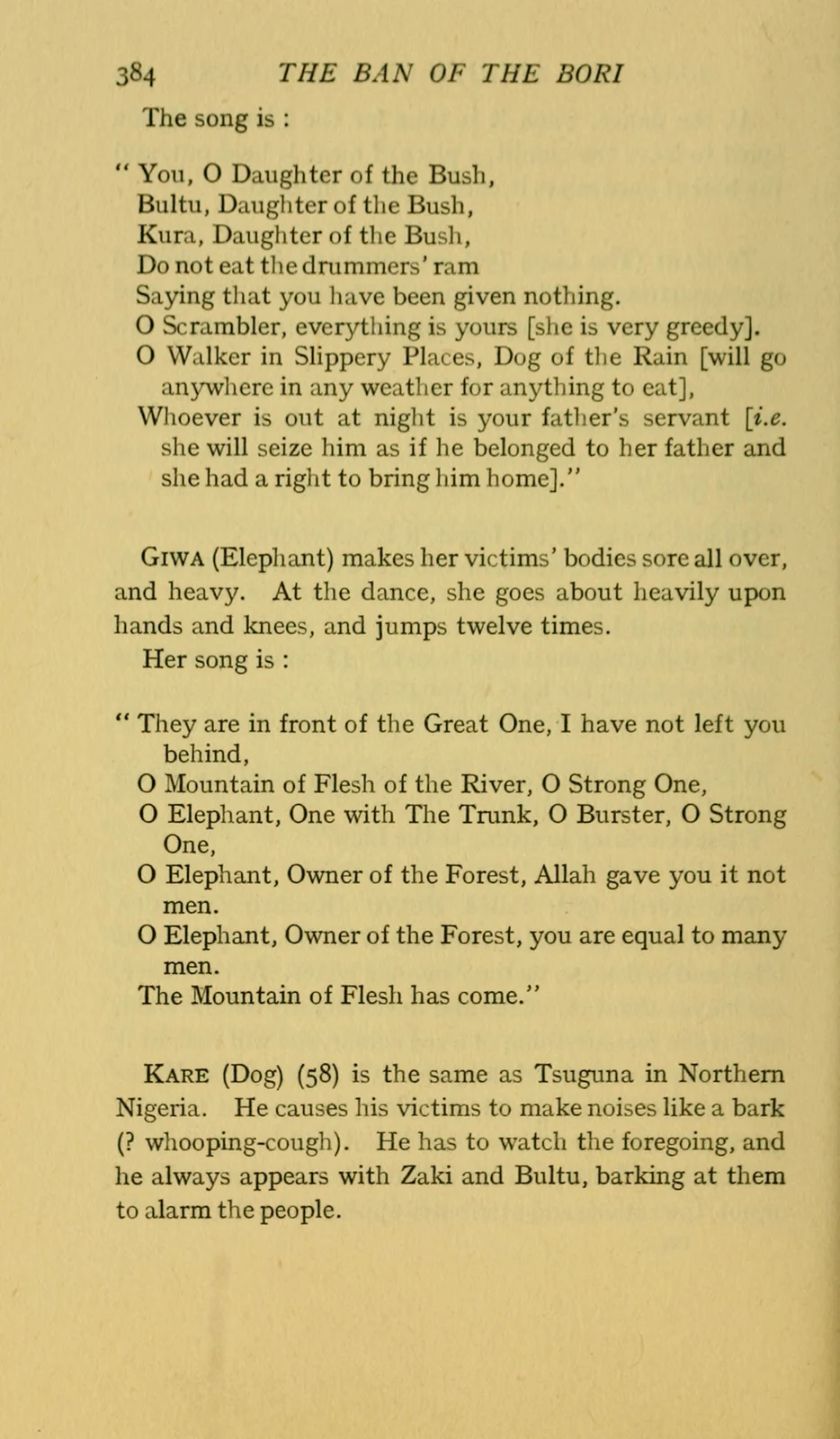
Giwa,1914 historical printed text witness, page384; documentary source-page facsimile
Documentary text facsimile naming Giwa and describing ritual/narrative attributes; not a photograph of a spirit or creature artwork. Colonial observer terminology and interpretations belong to the original1914 text.
Overview
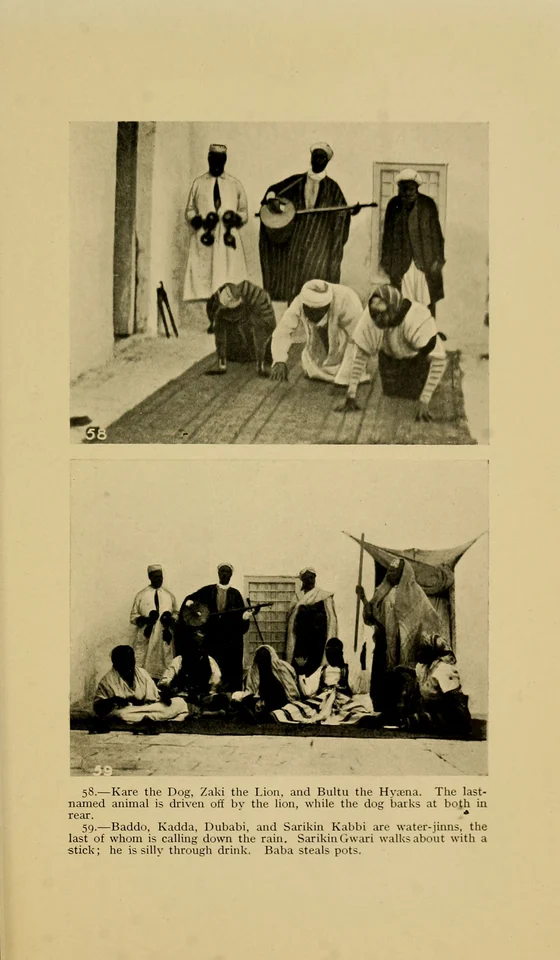
Giwa is the elephant figure among the forest spirits represented in Tunis. The mount proceeds heavily on hands and knees and performs twelve jumps. Tremearne’s account associates the spirit with soreness and bodily heaviness in victims; these are recorded attributions rather than verified effects of an elephant or a ritual. The translated song makes weight and strength its central images: a vast mass of flesh near the river, a trunk-bearing powerful creature and an owner of the forest equal to many people.
The song gives ownership of that forest to Giwa through Allah rather than human grant, so the animal figure is situated within a religious vocabulary rather than presented merely as an ordinary talking elephant. The chapter groups her with lion, hyena and dog spirits whose attributed attacks may be internal and leave no visible wound. It does not provide a separate illustration of her full anatomy or an individual narrator for her song. Her heavy dance should therefore be understood as a performer’s representation, while the song supports an elephant association without establishing a particular biological species.
Origins & earliest records
Tremearne’s historical collection combines accounts and ritual observations in Hausa-associated North African communities and northern Nigeria. Its evolutionary and comparative origin theories are not adopted.
Records & interpretation
The Ban of the Bori, pp 382–384. Ritual movements describe human mounts representing spirits; translated songs and attributed powers are evidence of the recorded representation, not proof of medical causation or uniform contemporary community practice.
Selected bibliography
Documented works and useful reading. This is not a list of every appearance.
- 01
The Ban of the Bori
Selected witness pp 382–384; colonial collection with uneven narrator attribution.
Family & connections
A source-supported family tree or inspiration record has not yet been compiled for this profile. Related reading below indicates a connection in subject matter, not a proven lineage or creative influence.
References
Sources supporting this profile. Linked pages have their own scope and editorial standards.
- Historical ritual observation and translated songsThe Ban of the Bori — GiwaResearch access: 2026-10-05
Image credits
Historical text facsimileGiwa,1914 historical printed text witness, page384; documentary source-page facsimile
Documentary text facsimile naming Giwa and describing ritual/narrative attributes; not a photograph of a spirit or creature artwork. Colonial observer terminology and interpretations belong to the original1914 text.