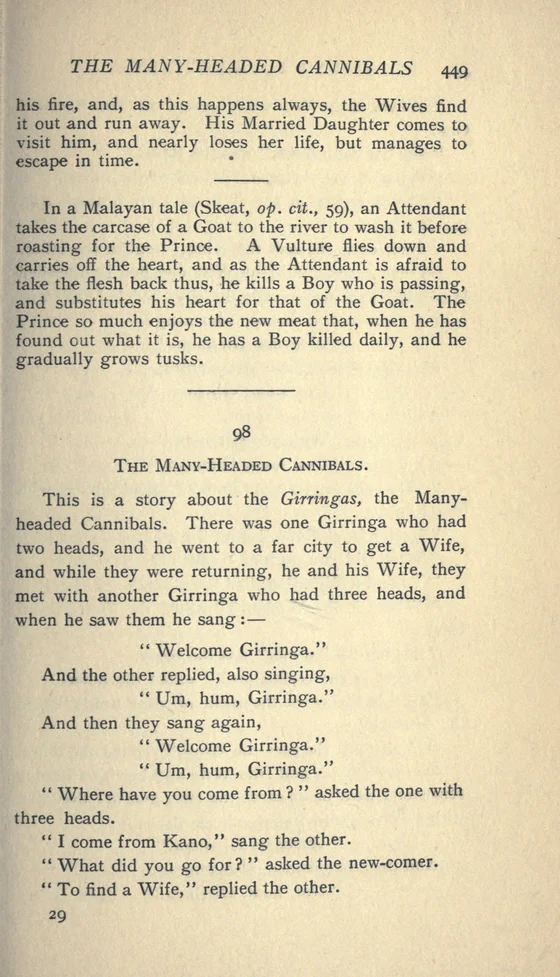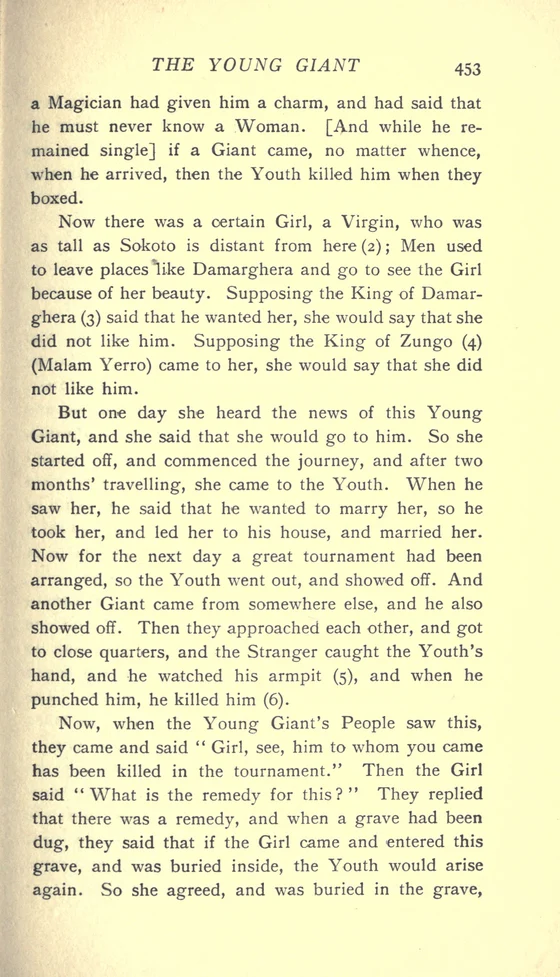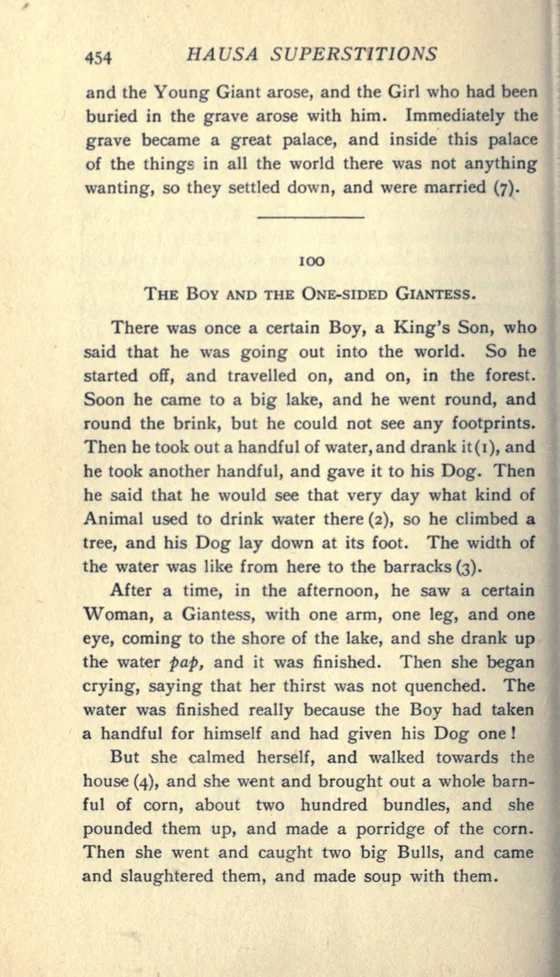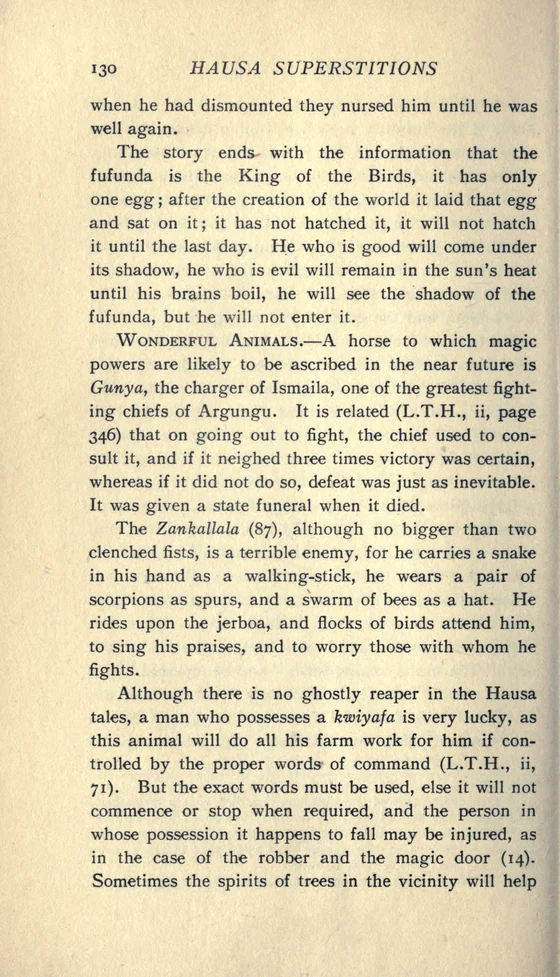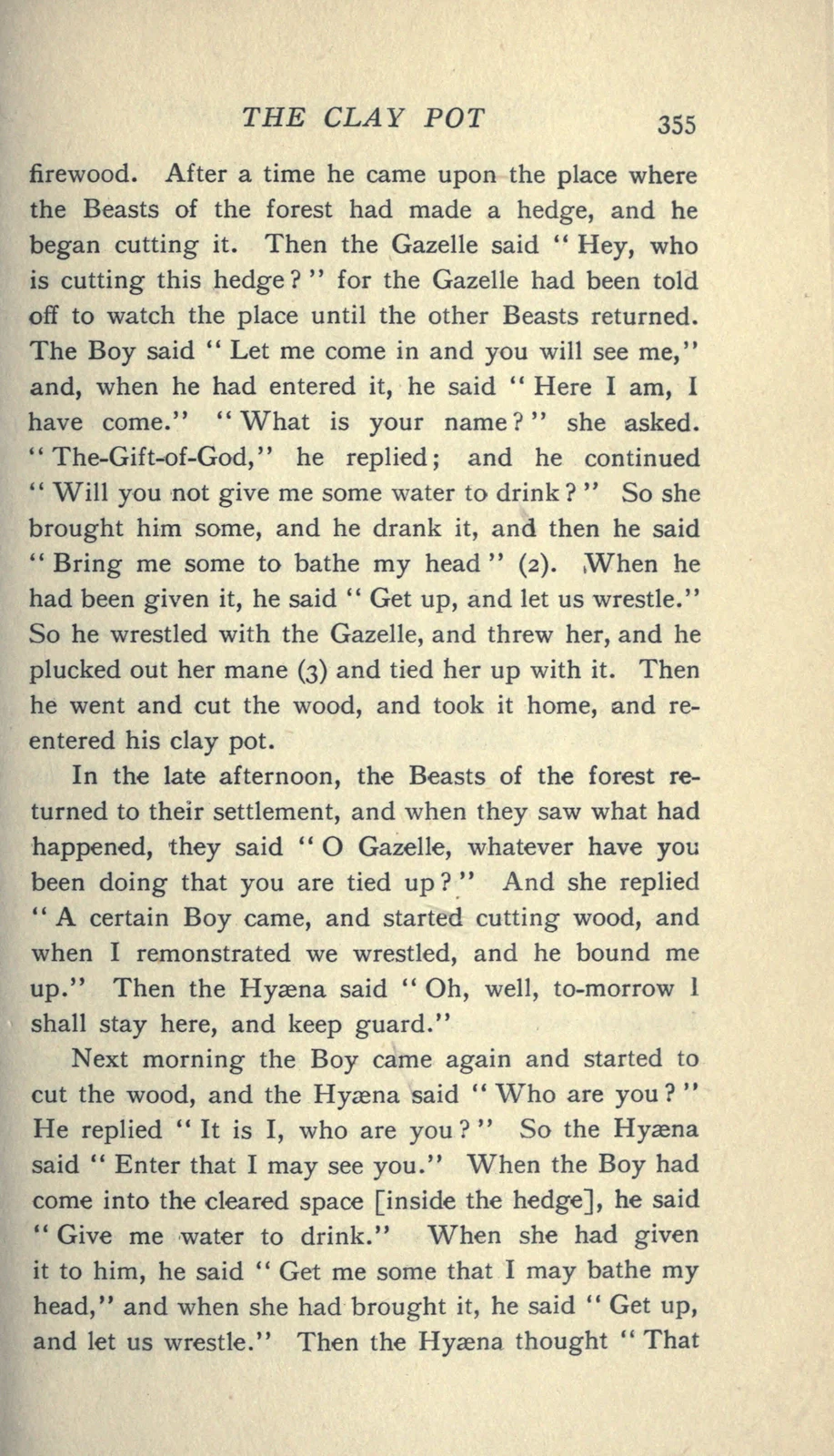
Gift-of-God, the Pot-born Boy:1913 documentary text page355; documentary source-page facsimile
Exact named narrative text facsimile, not a creature illustration. Printed page355; actual returned IIIF canvas400. Catalogue identifies1913 edition, author1877–1915, US NOT_IN_COPYRIGHT; historical translated text is life70 expired. Oral narrator attribution retained from profile. Actual scan directly inspected: exact named tale/episode text read, including printed page number and narrative features.
Overview
A childless woman asks God for offspring even if it is a clay pot. After nine months she gives birth to a large pot and places it among her crockery. The son inside emerges when she leaves to gather firewood, goes into the forest himself and cuts the hedge around the animals’ settlement. Asked his name by the gazelle guarding it, he replies Gift-of-God. He requests water to drink and wash his head, then challenges the guard to wrestle. The tiny boy defeats her, binds her with her own mane and takes wood home before reentering the pot.
Hyena and then elephant replace the defeated guard on successive days, but neither can overcome the boy. When even elephant loses, the animals decide to abandon their settlement. He hides overnight inside their oil jar and is carried with the fleeing community. Hyena tries to steal oil on the journey, receives a blow from within and conceals the encounter from her companions. At the destination elephant opens the jar and the boy leaps out, scattering them. He returns to town, brings people to collect the abandoned goods for his mother and thereafter stops living inside the pot. The vessel is his extraordinary birth and dwelling place; the narrative describes a son emerging from it rather than specifying a clay-bodied doll.
Origins & earliest records
Tremearne credits Sar(r)ikin Dukawa (S.D.), resolved from contents and introductory narrator key. Selected English translation records a narrative, not a historical birth or exact dated collection session.
Records & interpretation
Complete main tale 71, The Woman who Bore a Clay Pot, pp 354–357 read directly. Explicit birth, speech, strength or embodied action supports admission; real species, clay anatomy and appended variant identities are not inferred.
Selected bibliography
Documented works and useful reading. This is not a list of every appearance.
- 01
Hausa Superstitions and Customs
Second edition; main tale 71, The Woman who Bore a Clay Pot, pp 354–357
Family, evolution & connections
Gift-of-God and his mother in Tremearne tale 71
Main tale 71, The Woman who Bore a Clay Pot, pp. 354–357.
Scroll sideways to see all branches. With a keyboard, focus the tree and use the arrow keys.
- Unnamed mother
The narrator explicitly identifies the woman as mother and the emerging boy as son. Divine granting of conception is not separately stated paternal parentage. The pot is the extraordinary birth and dwelling vessel, not another organism or parent. No father or siblings are inserted.
Unnamed mother of Gift-of-God in Tremearne tale 71
The childless woman conceives and bears a pot; the narrator then explicitly calls its emerging boy her son. God grants the conception but is not called the boy’s father. The pot is not a second parent.
References
Sources supporting this profile. Linked pages have their own scope and editorial standards.
- Collected primary narrative with named narrator attributionHausa Superstitions and Customs — tale 71, The Woman who Bore a Clay Pot, pp 354–357Research access: 2026-10-05
Image credits
Historical text facsimileGift-of-God, the Pot-born Boy:1913 documentary text page355; documentary source-page facsimile
Exact named narrative text facsimile, not a creature illustration. Printed page355; actual returned IIIF canvas400. Catalogue identifies1913 edition, author1877–1915, US NOT_IN_COPYRIGHT; historical translated text is life70 expired. Oral narrator attribution retained from profile. Actual scan directly inspected: exact named tale/episode text read, including printed page number and narrative features.