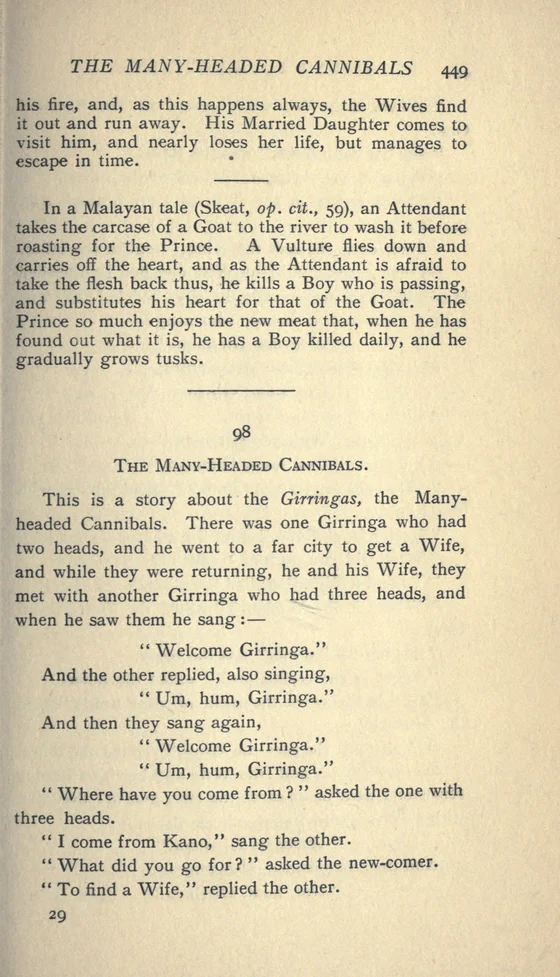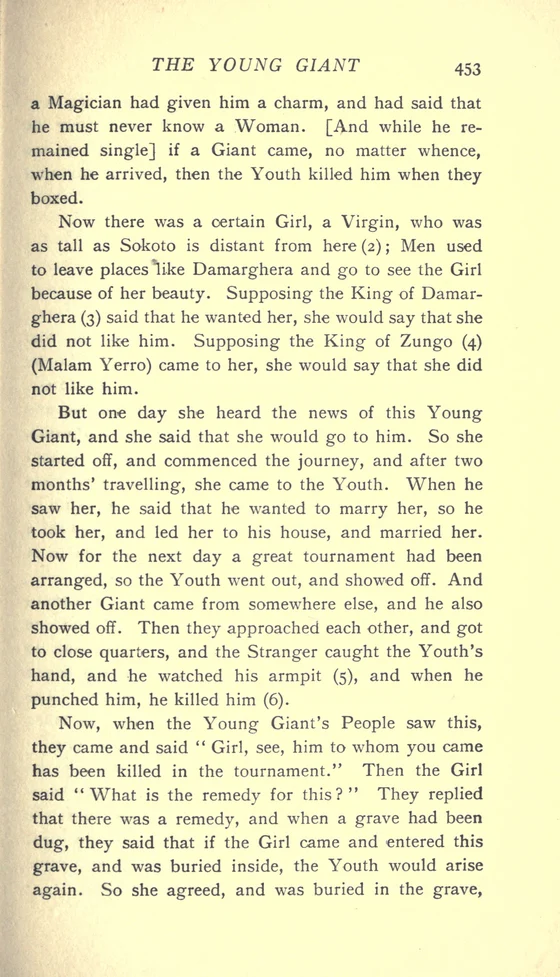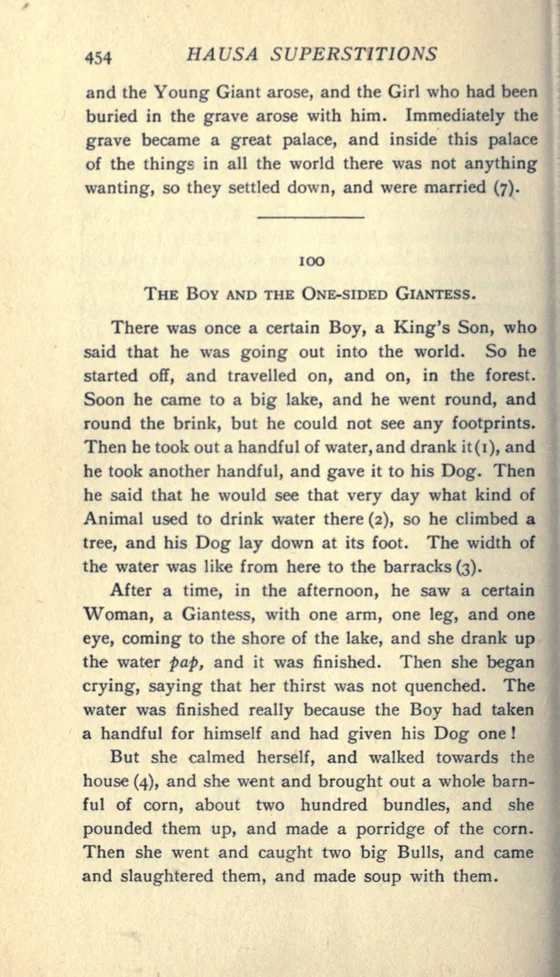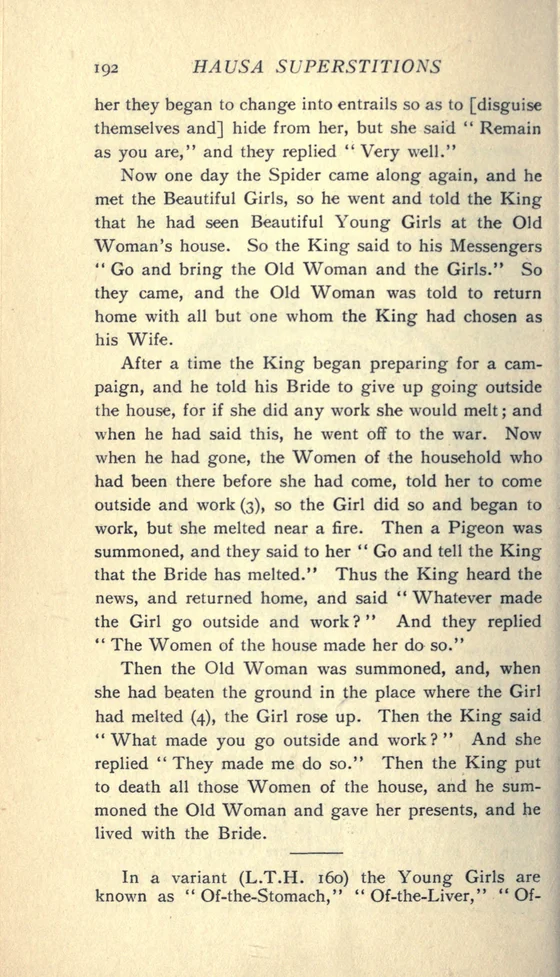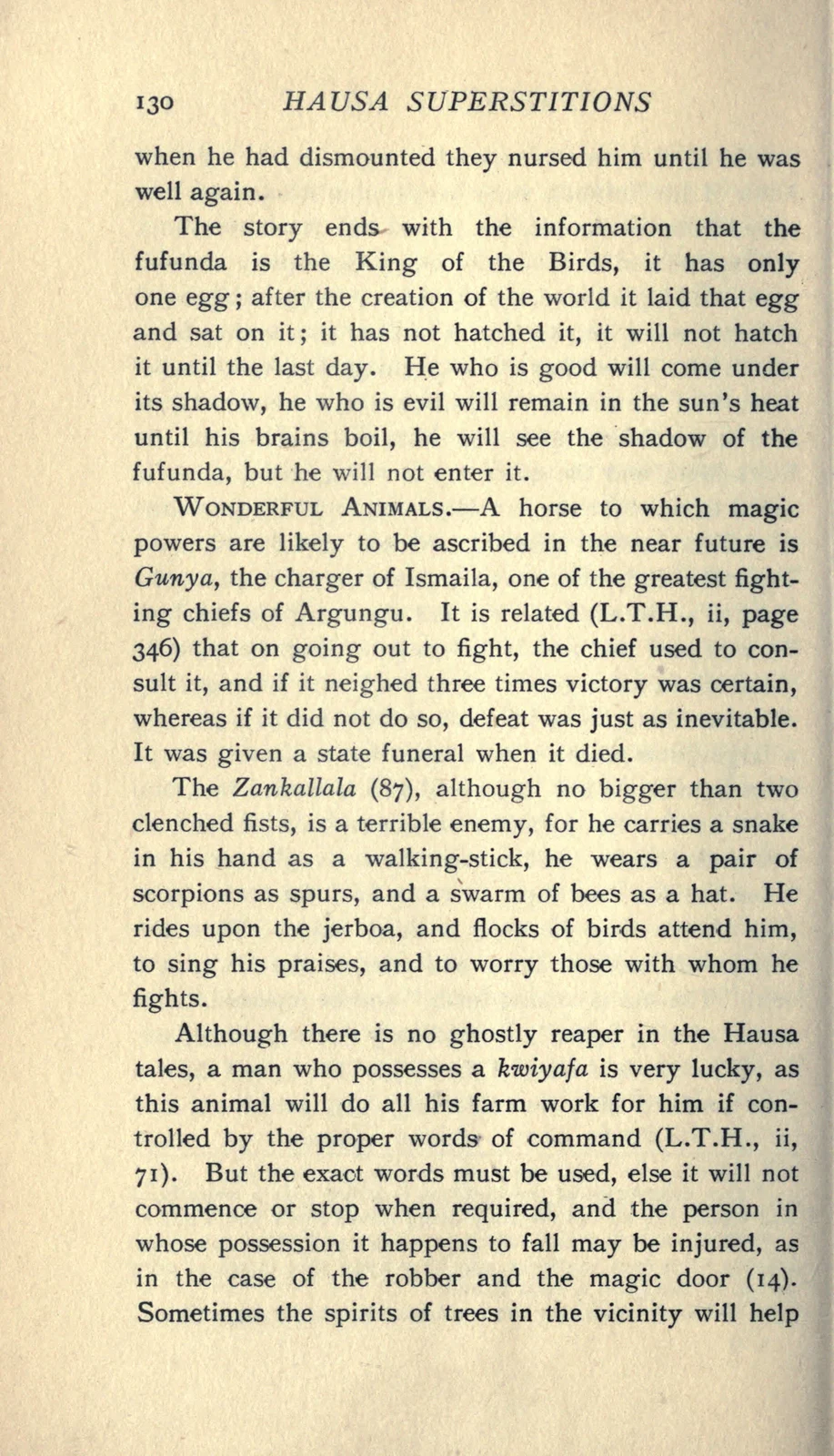
Zankallala:1913 documentary text page130; documentary source-page facsimile
Exact named narrative text facsimile, not a creature illustration. Printed page130; actual returned IIIF canvas163. Catalogue identifies1913 edition, author1877–1915, US NOT_IN_COPYRIGHT; historical translated text is life70 expired. Oral narrator attribution retained from profile. Actual scan directly inspected: exact named tale/episode text read, including printed page number and narrative features.
Overview
Tremearne’s descriptive notice makes Zankallala no larger than two clenched fists, yet equips him with formidable living accessories: a snake serves as his walking stick, paired scorpions as spurs and a swarm of bees as a hat. He rides a jerboa while flocks of birds praise him and harry opponents. A later note preserves the storyteller’s different explanation that he was a kind of locust. These two passages remain distinguishable witnesses rather than a confidently identified insect species or a fabricated composite anatomical drawing.
In Ba Gu(d)du’s tale, a boy fleeing Dodo along a river finds Zankallala, who promises protection. A silk-cotton tree suddenly grows above the defender and its birds sing that even lion, hyena and Dodo fear him. Dodo demands the boy as his prey; refused, he swallows the small rescuer instead. Zankallala emerges through his stomach and summons renewed praise. Swallowed again, he exits from the middle of Dodo’s back; the third swallowing ends with an emergence through the head and Dodo’s death. The boy is then released to travel safely. Victory comes from the supposedly edible defender’s repeated survival and internal assault, overturning the apparent power of the large swallower.
Origins & earliest records
Tale 87 is credited B.G., identified in the introduction as Ba Gu(d)du. Tremearne collected mainly at Jemaan Daroro during 1908–1909, but does not supply an exact dated session for this case. The 1913 second edition is the selected witness.
Records & interpretation
Complete tale 87 directly read, with the separate p 130 Wonderful Animals notice and noteLXXXVII. The locust comparison belongs to the reported narrator, while the fuller equipment description is printed in the collector’s discussion. Comparative non-Hausa stories are not assigned to Zankallala.
Selected bibliography
Documented works and useful reading. This is not a list of every appearance.
- 01
Hausa Superstitions and Customs
Second edition; tale 87, Wonderful Animals p 130, noteLXXXVII.
Family & connections
A source-supported family tree or inspiration record has not yet been compiled for this profile. Related reading below indicates a connection in subject matter, not a proven lineage or creative influence.
References
Sources supporting this profile. Linked pages have their own scope and editorial standards.
- Collected primary tale and historical descriptive noticeHausa Superstitions and Customs — ZankallalaResearch access: 2026-10-05
Image credits
Historical text facsimileZankallala:1913 documentary text page130; documentary source-page facsimile
Exact named narrative text facsimile, not a creature illustration. Printed page130; actual returned IIIF canvas163. Catalogue identifies1913 edition, author1877–1915, US NOT_IN_COPYRIGHT; historical translated text is life70 expired. Oral narrator attribution retained from profile. Actual scan directly inspected: exact named tale/episode text read, including printed page number and narrative features.