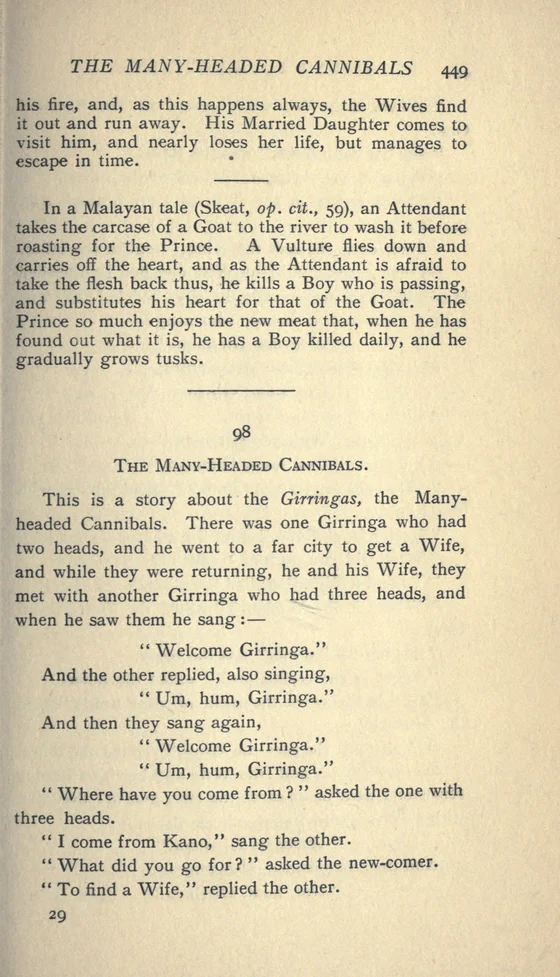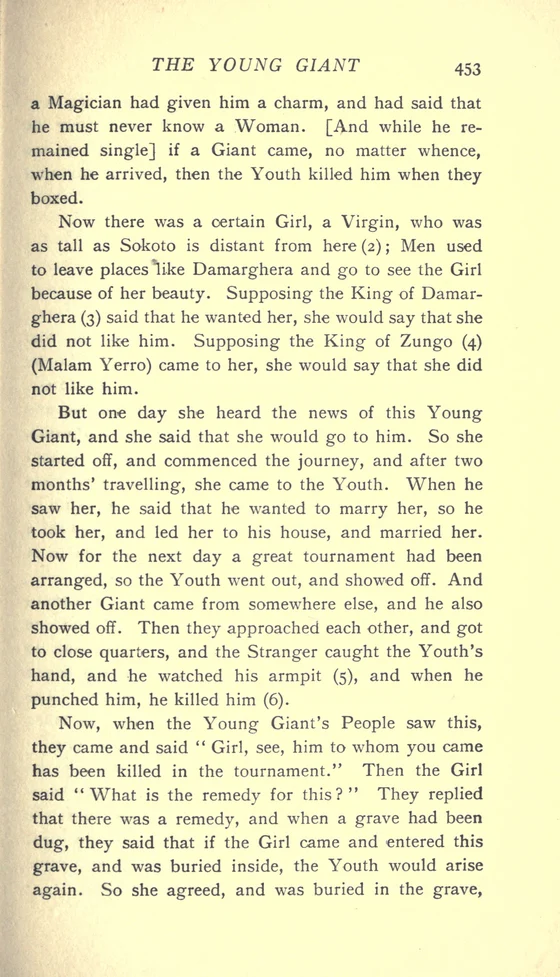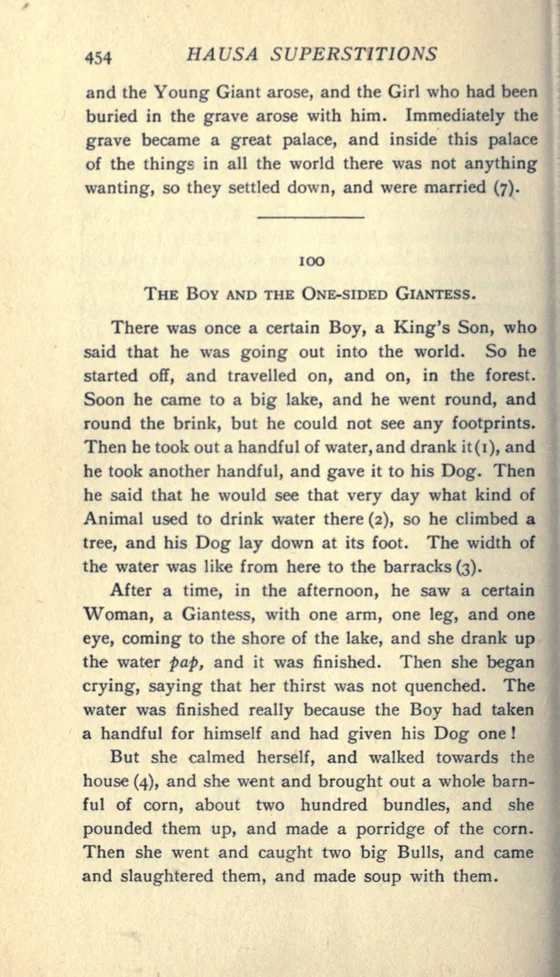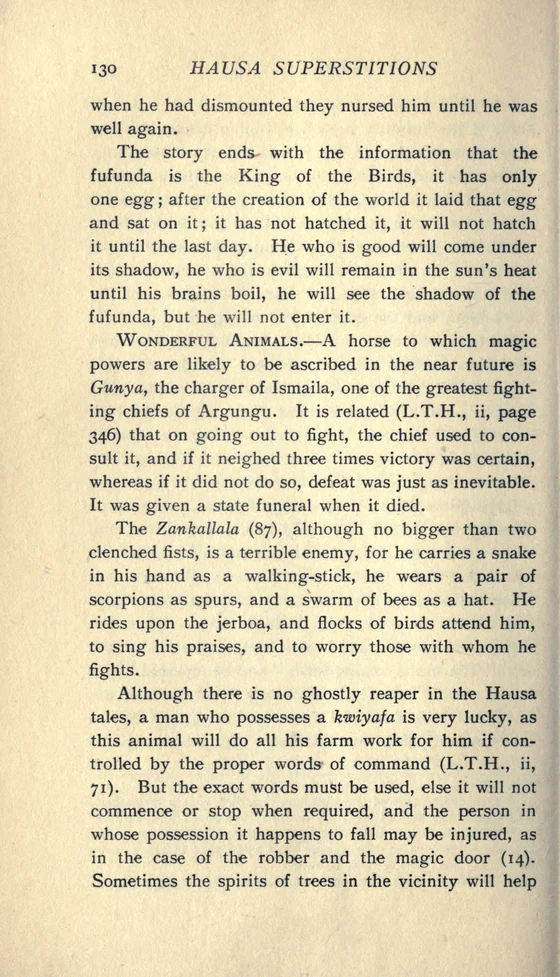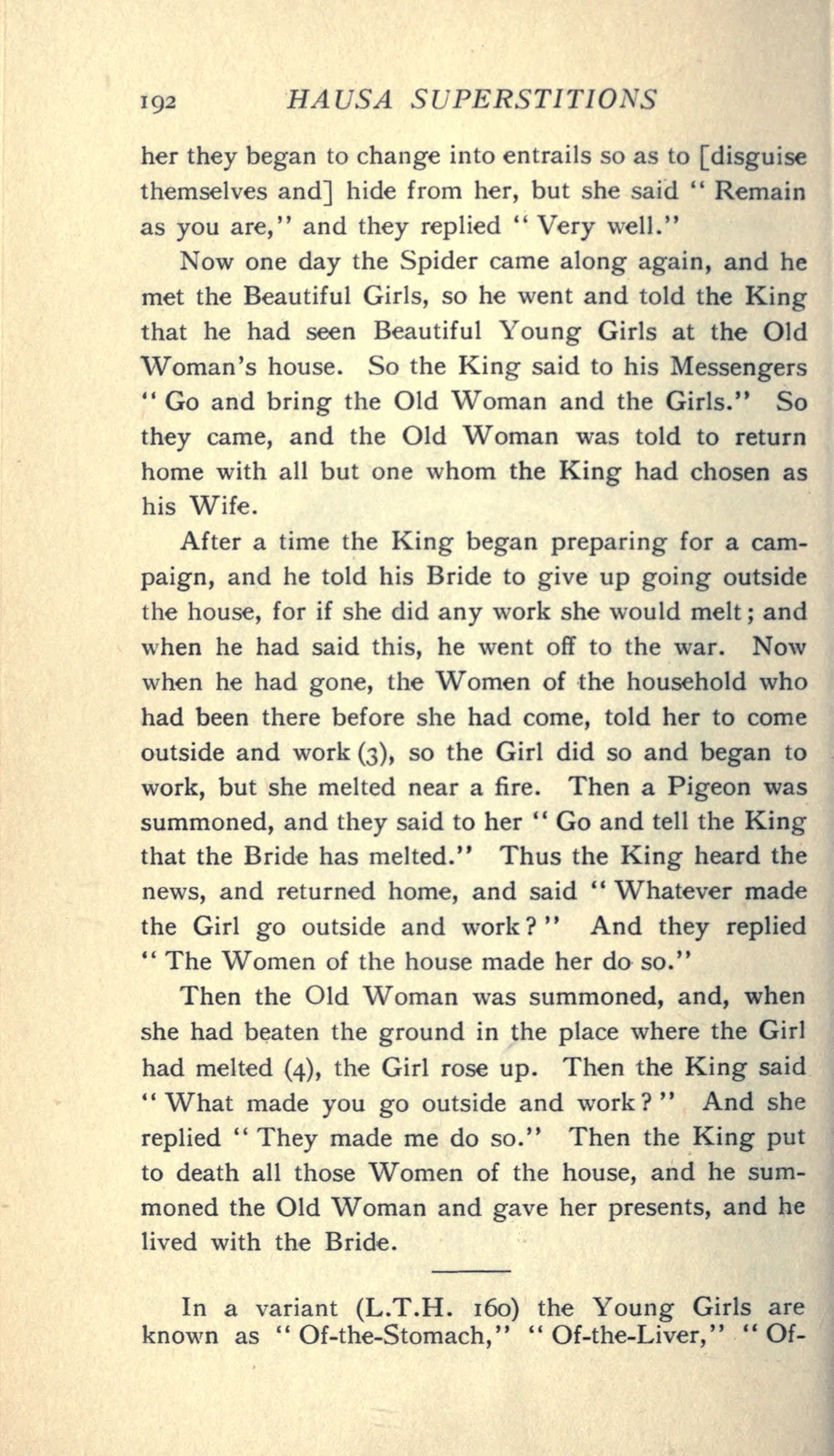
Bull-entrail Maidens in the Hausa Tale:1913 documentary text page192; documentary source-page facsimile
Exact named narrative text facsimile, not a creature illustration. Printed page192; actual returned IIIF canvas227. Catalogue identifies1913 edition, author1877–1915, US NOT_IN_COPYRIGHT; historical translated text is life70 expired. Oral narrator attribution retained from profile. Actual scan directly inspected: exact named tale/episode text read, including printed page number and narrative features.
Overview
An old woman earns enough by selling boiled herbs to buy a bull calf and carefully raises it into a large animal. Spider reports its size to the king. Royal messengers cannot untie or subdue the bull until the woman persuades it to cooperate; she finally tells it to lie down for slaughter. Given its entrails, she returns home to find her cotton already spun. Hiding to discover the worker, she sees young women appear and resume spinning. When spotted, they begin changing back into entrails, but agree to remain as women at her request. The supernatural household helpers therefore emerge from the specific animal’s remains.
Spider again informs the king, who summons the maidens and chooses one as his wife. Before leaving for war he warns her to stay inside, since working would make her melt. The established household women compel her to go out and work, and she melts beside a fire. A pigeon carries the news to the king. The old woman is called back and strikes the ground where the bride melted; the young woman rises again. The conclusion records punishment of the coercing women and gifts to the restorer. A separately printed variant identifies the girls by stomach, liver, heart, kidneys and fat, and restores the fat-maiden in a closed pot; that alternate naming and method remain distinct from the primary ground-striking sequence.
Origins & earliest records
Tale 4 is attributed S.D., identified in the introduction as the Sar(r)ikin Dukawa, Chief of the Leather-workers. The selected English witness is Tremearne’s 1913 second edition; introductory collection dates do not establish an exact tale session.
Records & interpretation
Complete tale 4, printed pp 190–193, directly read. The main story and appended L.T.H.160 variant are distinguished. The king’s ear exchange is an expression discussed in noteIV, not an additional anatomical feature of the maidens.
Selected bibliography
Documented works and useful reading. This is not a list of every appearance.
- 01
Hausa Superstitions and Customs
Second edition; tale 4 pp 190–193; appended L.T.H.160 variant.
Family & connections
A source-supported family tree or inspiration record has not yet been compiled for this profile. Related reading below indicates a connection in subject matter, not a proven lineage or creative influence.
References
Sources supporting this profile. Linked pages have their own scope and editorial standards.
- Collected primary tale with labeled comparative variantHausa Superstitions and Customs — The Spider, the Old Woman, and the Wonderful BullResearch access: 2026-10-05
Image credits
Historical text facsimileBull-entrail Maidens in the Hausa Tale:1913 documentary text page192; documentary source-page facsimile
Exact named narrative text facsimile, not a creature illustration. Printed page192; actual returned IIIF canvas227. Catalogue identifies1913 edition, author1877–1915, US NOT_IN_COPYRIGHT; historical translated text is life70 expired. Oral narrator attribution retained from profile. Actual scan directly inspected: exact named tale/episode text read, including printed page number and narrative features.