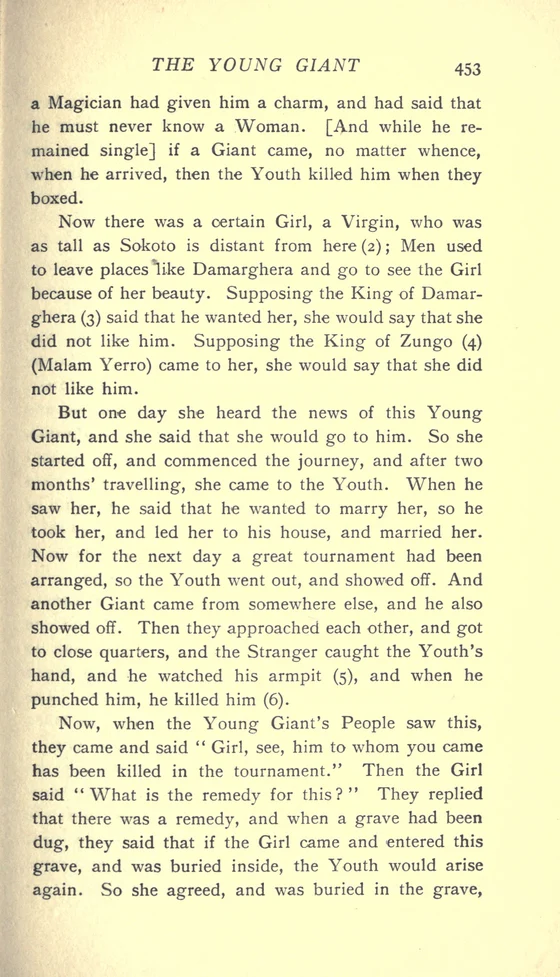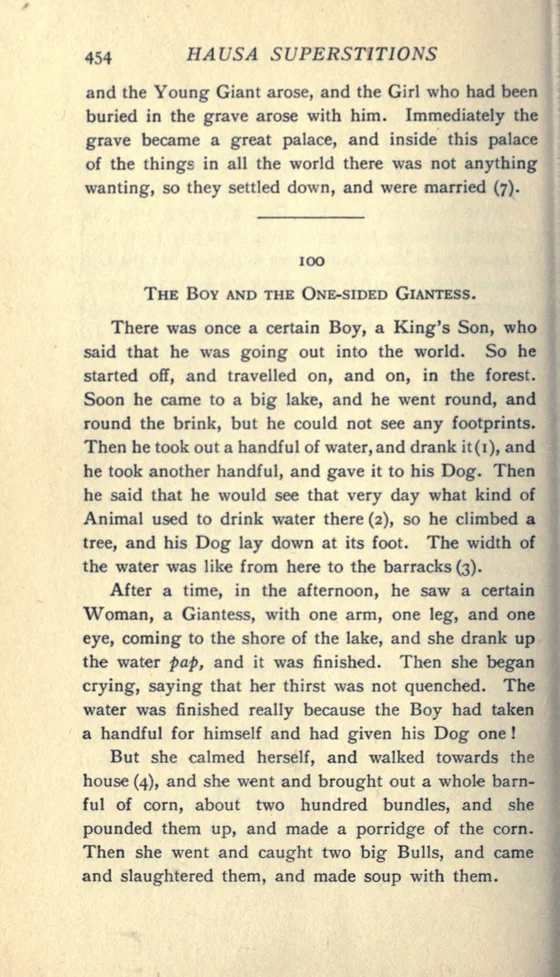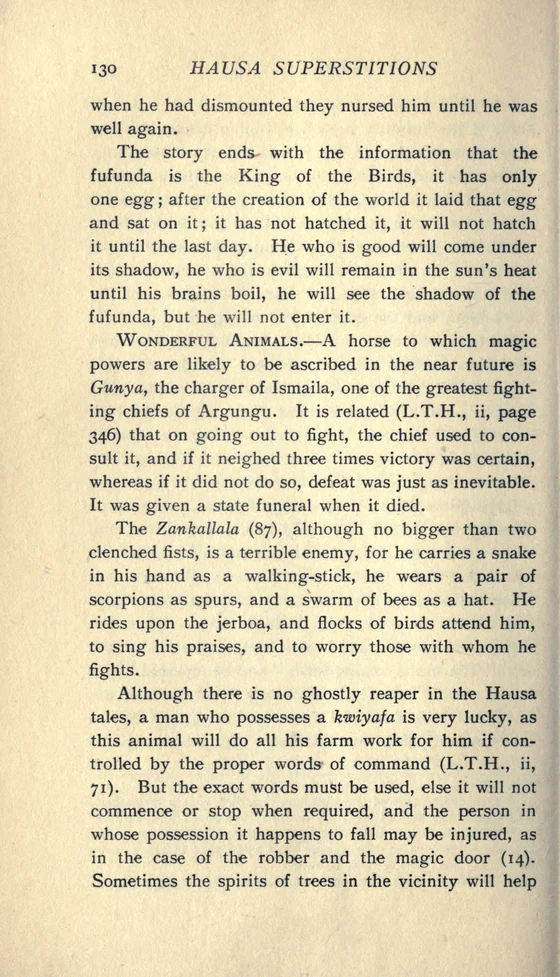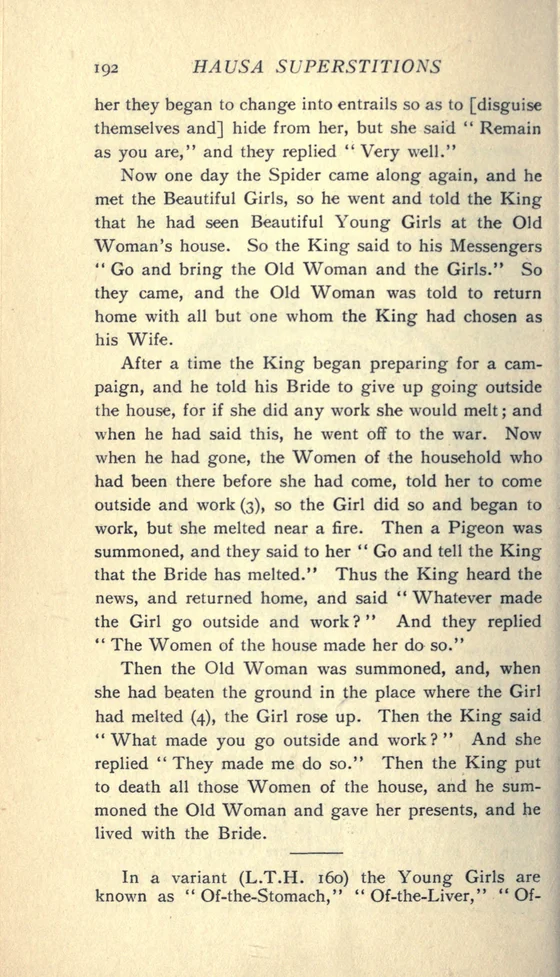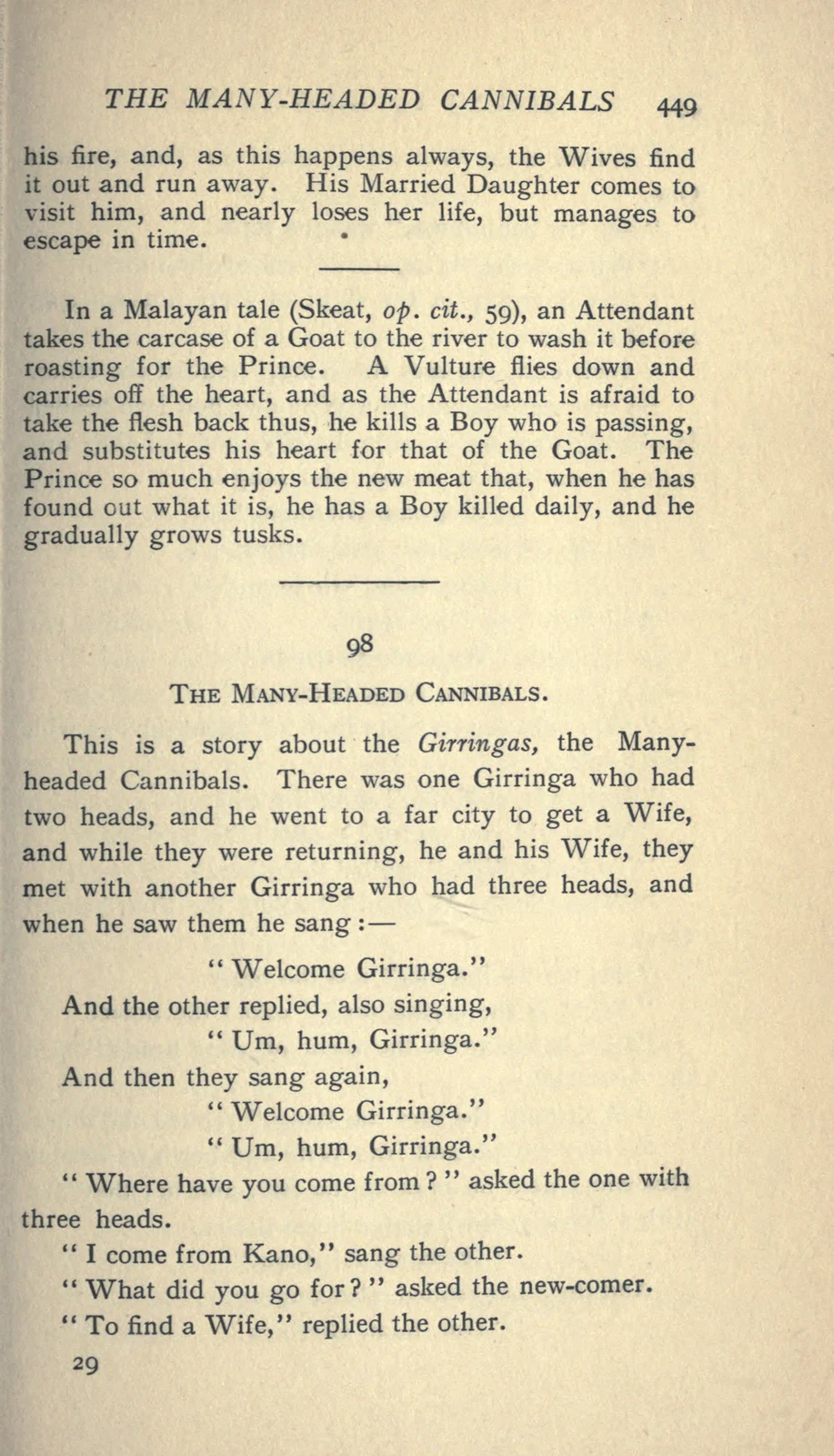
Girringa:1913 documentary text page449; documentary source-page facsimile
Exact named narrative text facsimile, not a creature illustration. Printed page449; actual returned IIIF canvas500. Catalogue identifies1913 edition, author1877–1915, US NOT_IN_COPYRIGHT; historical translated text is life70 expired. Oral narrator attribution retained from profile. Actual scan directly inspected: exact named tale/episode text read, including printed page number and narrative features.
Overview
The tale begins with a two-headed Girringa returning from Kano with a wife. On the journey they meet others with three, four and five heads. Each greeting becomes a sung exchange: the newcomer asks where the husband has been and why the woman is crying, and her alarm at the heads is answered by a warning to wait until she sees the king. The royal figure has ten heads. The repeated dialogue gives the city a social hierarchy as well as an escalating bodily strangeness; the beings speak, marry and maintain households rather than appearing as a single solitary predator.
The woman initially refuses to enter her husband’s house, but is persuaded inside. Three goats are killed in her honor and she is fed until she becomes fat. The apparent welcome prepares her for a planned killing and meal. On the appointed day she is sent to fetch water for washing, although she has never previously been allowed outdoors. Suspecting danger, she transforms into a tree stump beside the river. A Girringa follows her tracks but fails to recognize her. At night she resumes her human form and escapes to her own city. The survivor’s transformation is her own narrated device, not an ability assigned indiscriminately to the Girringas.
Origins & earliest records
Tremearne identifies Sa(r)rikin Samari, designated S.S. in the contents and the preliminary correction. His introduction states that nearly all stories were obtained at Jemaan Daroro in 1908–1909, with a few earlier Ashetu narratives collected at Amar. The general collection dates are not a fabricated exact session date for this tale.
Records & interpretation
Complete primary narrative 98, The Many-headed Cannibals, pp 449–452 read directly in the second-edition OCR. Storyteller attribution follows the contents and introduction. Colonial comparative theories and diagnoses are excluded from the profile; translation and editorial additions remain mediated evidence.
Selected bibliography
Documented works and useful reading. This is not a list of every appearance.
- 01
Hausa Superstitions and Customs
Second edition; tale 98, The Many-headed Cannibals, pp 449–452
Family & connections
A source-supported family tree or inspiration record has not yet been compiled for this profile. Related reading below indicates a connection in subject matter, not a proven lineage or creative influence.
References
Sources supporting this profile. Linked pages have their own scope and editorial standards.
- Collected primary narrative and collector introductionHausa Superstitions and Customs — tale 98, The Many-headed Cannibals, pp 449–452Research access: 2026-10-05
Image credits
Historical text facsimileGirringa:1913 documentary text page449; documentary source-page facsimile
Exact named narrative text facsimile, not a creature illustration. Printed page449; actual returned IIIF canvas500. Catalogue identifies1913 edition, author1877–1915, US NOT_IN_COPYRIGHT; historical translated text is life70 expired. Oral narrator attribution retained from profile. Actual scan directly inspected: exact named tale/episode text read, including printed page number and narrative features.