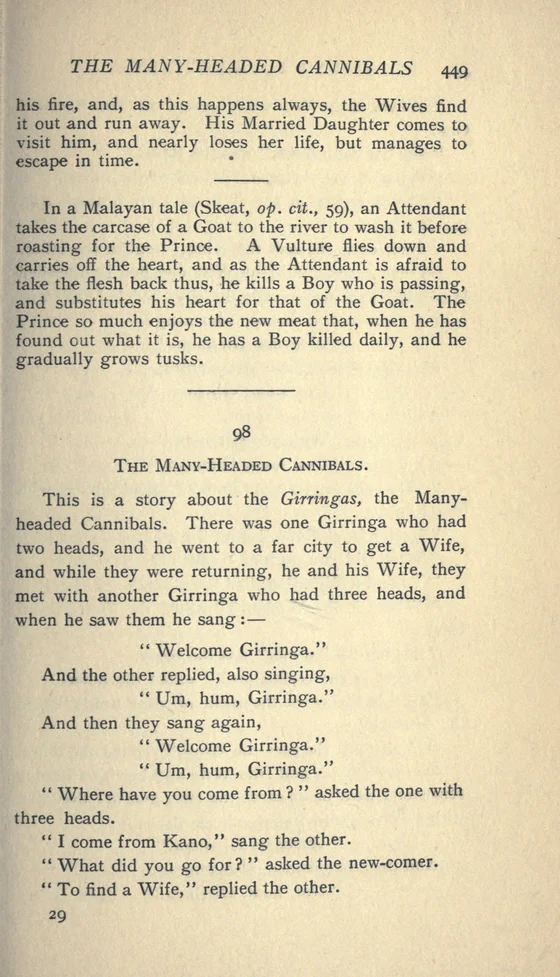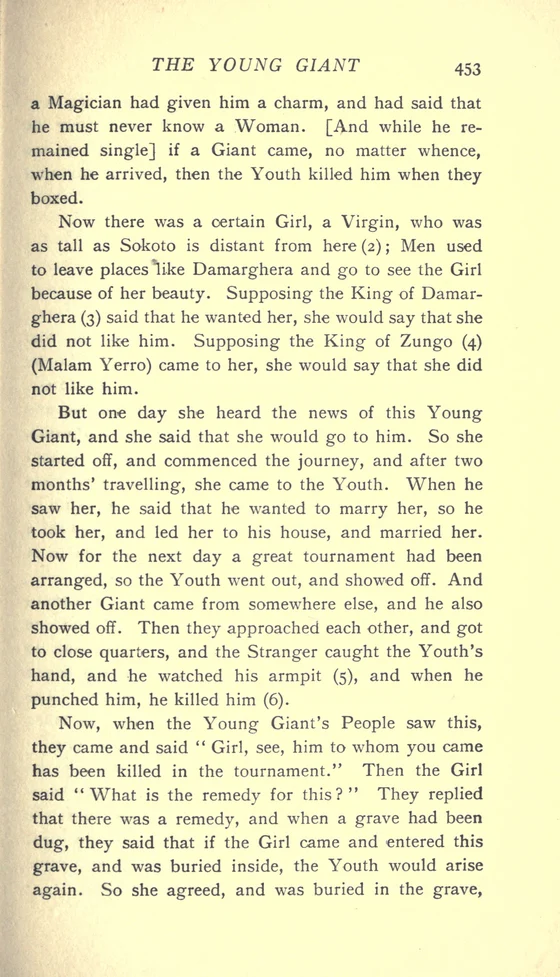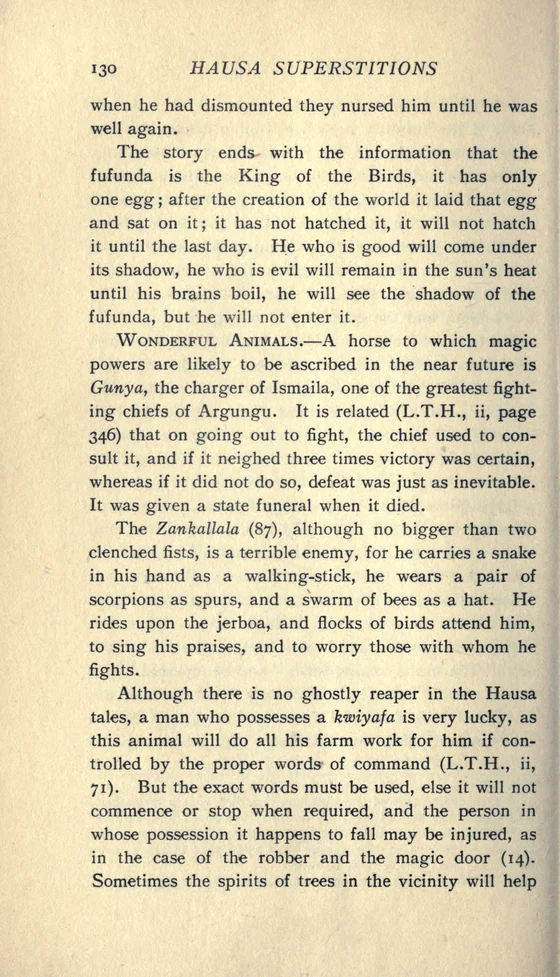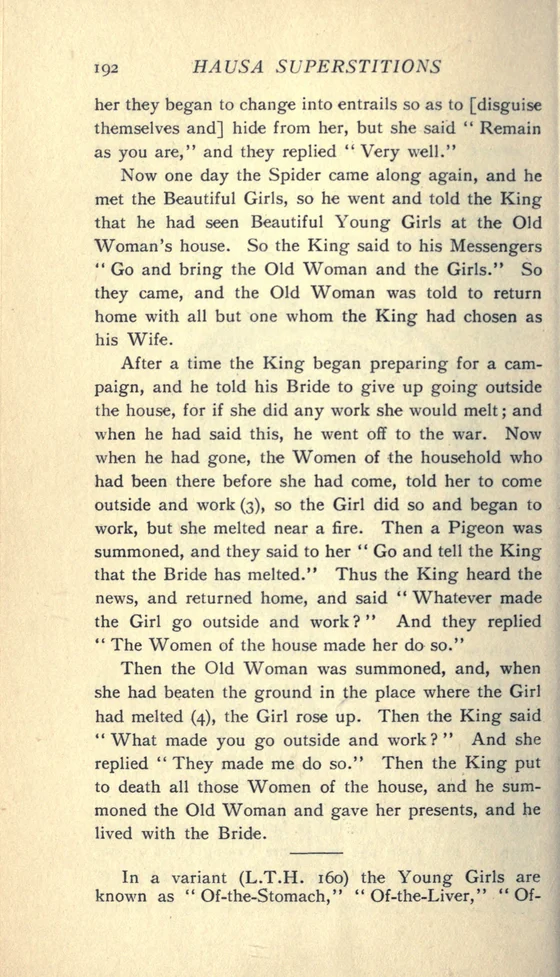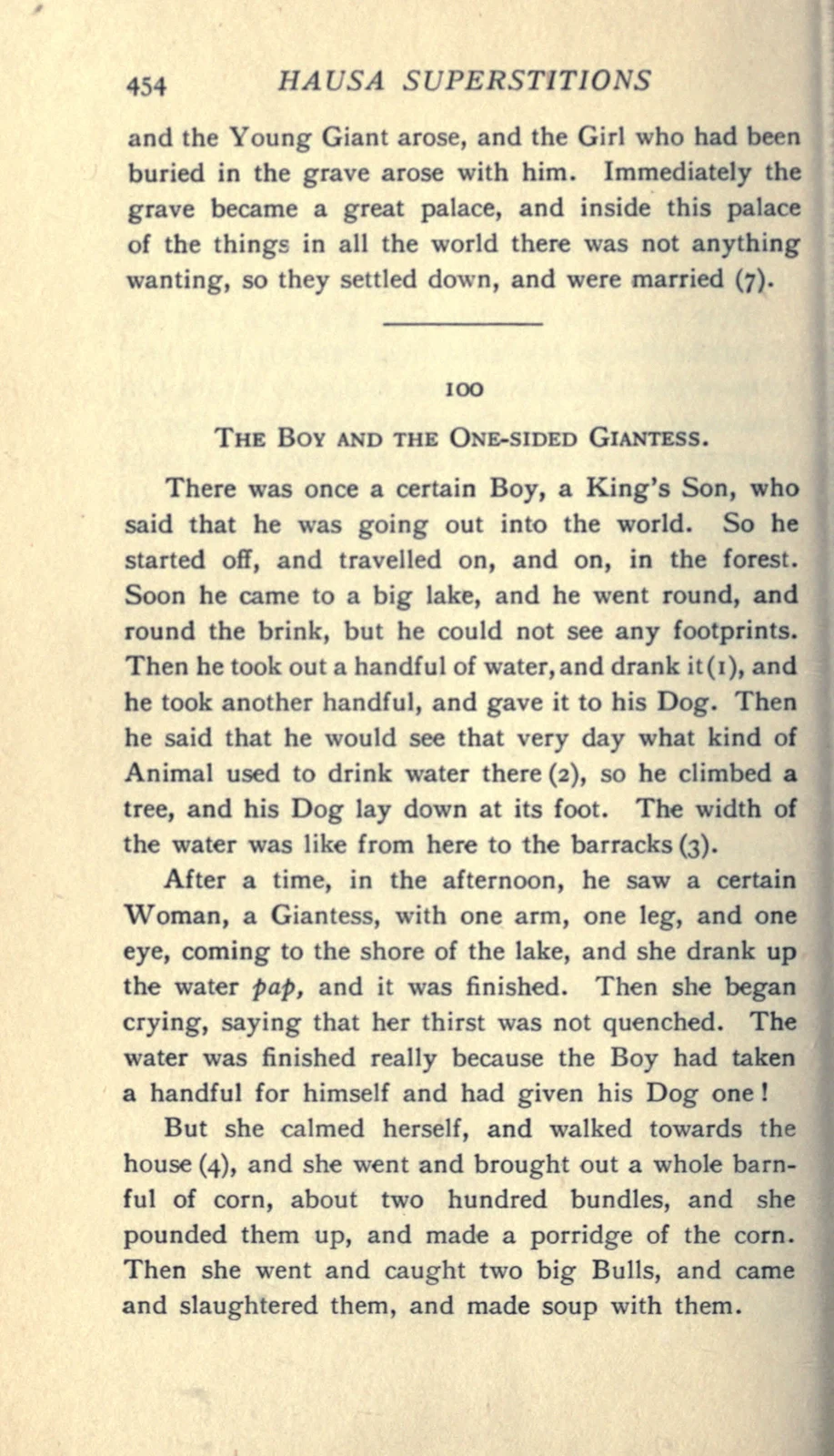
One-sided Giantess in the Hausa Lake Tale:1913 documentary text page454; documentary source-page facsimile
Exact named narrative text facsimile, not a creature illustration. Printed page454; actual returned IIIF canvas505. Catalogue identifies1913 edition, author1877–1915, US NOT_IN_COPYRIGHT; historical translated text is life70 expired. Oral narrator attribution retained from profile. Actual scan directly inspected: exact named tale/episode text read, including printed page number and narrative features.
Overview
A king’s son traveling through the forest reaches a broad lake without footprints around its edge. He drinks a handful and gives another to his dog, then climbs a tree to discover what uses the water. In the afternoon a giantess approaches, possessing one arm, one leg and one eye. She drinks the remaining lake dry but cries because her thirst is still unsatisfied. The narrator makes the boy’s two small withdrawals decisive: what would otherwise have sufficed no longer does. Her enormous appetite therefore coexists with a striking sensitivity to absence.
At her home she pounds about two hundred bundles of corn into porridge, slaughters two large bulls and prepares soup. While she goes inside for the cloth worn when eating, the hidden boy dips his spear into the porridge and divides the little food adhering to it between himself and his dog. On finishing her meal she detects the missing portion and weeps until midnight. Once she retires, the pair flee without stopping until they reach their own town. A separately printed witch variant adds pursuit and threatening drops of blood; those acts are not silently transferred to this giantess’s own completed encounter.
Tremearne places the lake figure within his discussion of Barin Mutum or Bare-Bare, translated as Half-being: a human outline divided lengthwise, rather than a body combining human and animal halves. Another complete tale, credited to Ba Gu(d)du, gives a male Half-man a farm repeatedly robbed by Spider. He makes a beautiful rubber effigy and watches the thief become stuck to it, then punishes and releases him with a warning. This nearby narrative presents the unusual being as an intelligent cultivator defending his harvest, while the giantess embodies overwhelming thirst and appetite. The two roles demonstrate variation within the collection’s category; the farm trap, male identity and punitive action do not become additional events in the giantess’s lake encounter.
Origins & earliest records
Tremearne identifies Umoru Gombe, designated U.G. in the contents. His introduction states that nearly all stories were obtained at Jemaan Daroro in 1908–1909, with a few earlier Ashetu narratives collected at Amar. The general collection dates are not a fabricated exact session date for this tale.
Records & interpretation
Complete primary narrative 100, The Boy and the One-sided Giantess, pp 454–455 read directly in the second-edition OCR. Storyteller attribution follows the contents and introduction. Colonial comparative theories and diagnoses are excluded from the profile; translation and editorial additions remain mediated evidence.
Selected bibliography
Documented works and useful reading. This is not a list of every appearance.
- 01
Hausa Superstitions and Customs
Second edition; tale 100, The Boy and the One-sided Giantess, pp 454–455
Family & connections
A source-supported family tree or inspiration record has not yet been compiled for this profile. Related reading below indicates a connection in subject matter, not a proven lineage or creative influence.
References
Sources supporting this profile. Linked pages have their own scope and editorial standards.
- Collected primary narrative and collector introductionHausa Superstitions and Customs — tale 100, The Boy and the One-sided Giantess, pp 454–455Research access: 2026-10-05
- Historical classification notice and distinct collected primary taleHausa Superstitions and Customs — Half-being discussion and male farm taleResearch access: 2026-10-05
Image credits
Historical text facsimileOne-sided Giantess in the Hausa Lake Tale:1913 documentary text page454; documentary source-page facsimile
Exact named narrative text facsimile, not a creature illustration. Printed page454; actual returned IIIF canvas505. Catalogue identifies1913 edition, author1877–1915, US NOT_IN_COPYRIGHT; historical translated text is life70 expired. Oral narrator attribution retained from profile. Actual scan directly inspected: exact named tale/episode text read, including printed page number and narrative features.