Friulian language communities - AI-generated contextual illustration.
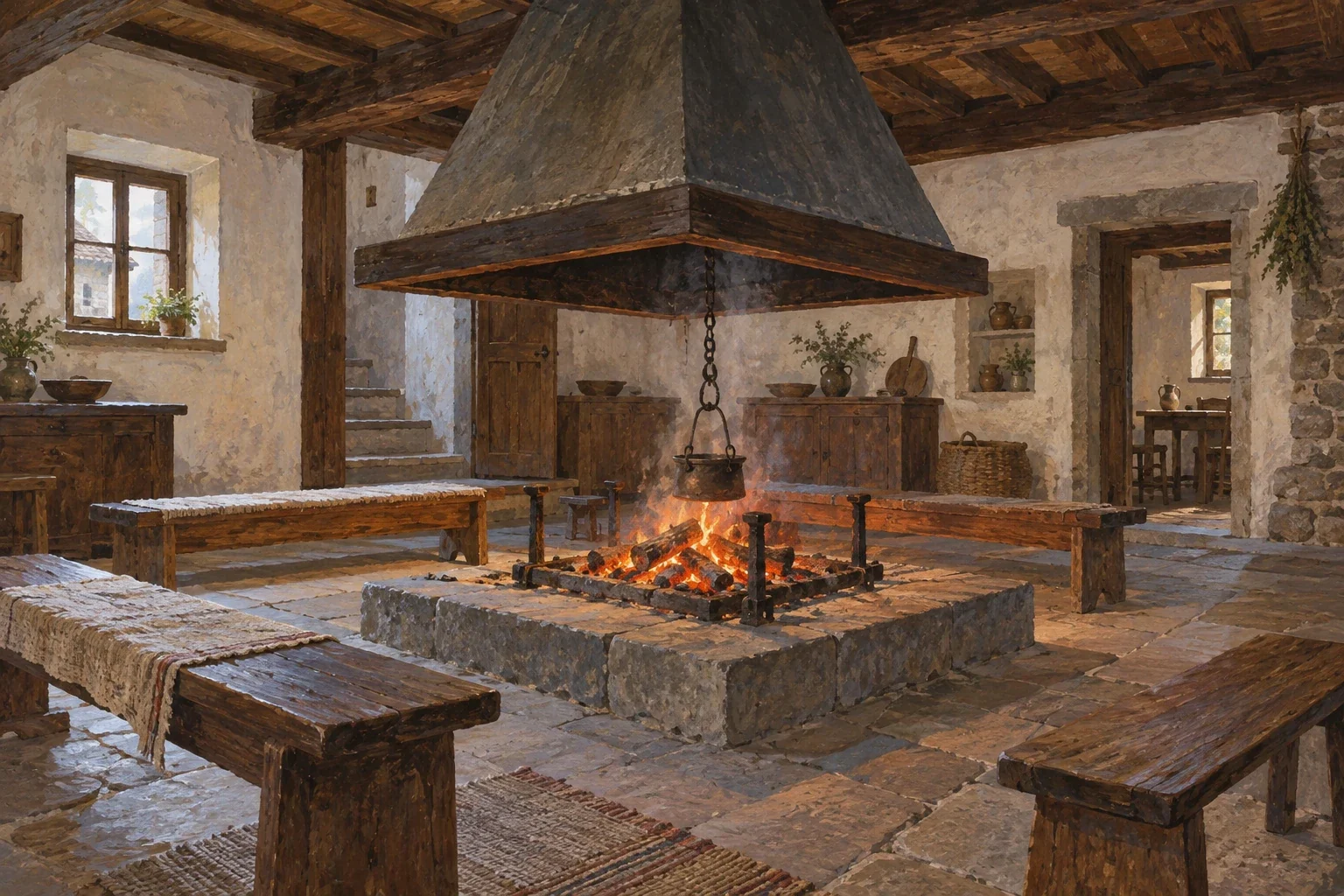
AI-generated contextual illustration of an imagined Friulian fogolâr, inspired by the central-hearth theme of Civici Musei Udine. Hood, masonry, furnishings and light are imagined; not a reproduction of a museum exhibit or a present-day community portrait.
Overview
Friulian, or furlan, is a Romance language developed from the Latin of the Aquileia region. ARLeF's linguistic account describes contacts with Germanic and Slavic languages while stressing the language's Romance structure. It places clearly differentiated features around the year 1000 and practical written records in the later medieval period. These are language-history observations; cultural identity cannot be inferred from a person's biological descent or reduced to a mixture of neighbouring peoples.
The agency describes Friuli as a multilingual meeting region, with Friulian varieties, Italian and neighbouring languages. Its account also identifies migrant associations such as Fogolârs furlans and Fameis furlanis that maintain connections with the region. ARLeF's SuperDizionari combines bilingual, monolingual and surname dictionaries, illustrating contemporary digital language work. Individual competence and identity vary, so this entry does not equate every inhabitant of Friuli with a Friulian-speaking person.
Civici Musei Udine's ethnographic museum develops family and community themes around the fogolâr, the centrally located domestic hearth. It connects this physical space to everyday tasks, social gatherings and annual rituals, then to the name and memory work of migrant cultural associations. The wider itinerary also addresses lighting, timekeeping and craft. An imagined central-hearth illustration highlights that particular material-cultural connection. It is not a surveyed historical interior: the hood, furniture, masonry and light are artistic choices, and the scene does not describe the homes of all present-day Friulian speakers.
History & identity
Friuli and migrant cultural networks; selected ARLeF and Civici Musei Udine accounts.
Sources & representation
Selected authoritative cultural-institution accounts; source-specific findings retained in cache.
Selected bibliography
Documented works and useful reading. This is not a list of every appearance.
- 01
Lingua
Selected institutional account read for this overview; not a complete bibliography.
- 02
SuperDizionari de lenghe furlane
Selected institutional account read for this overview; not a complete bibliography.
- 03
Ethnographic Museum
Selected institutional account read for this overview; not a complete bibliography.
Language & cultural connections
Source-supported language and cultural connections have not yet been compiled for this profile.
References
Sources supporting this profile. Linked pages have their own scope and editorial standards.
- ARLeFLinguaResearch access: 2026-10-10
- ARLeFSuperDizionari de lenghe furlaneResearch access: 2026-10-10
- Civici Musei UdineEthnographic MuseumResearch access: 2026-10-10
Image credits
AI-generated contextual illustrationFriulian language communities - AI-generated contextual illustration.
AI-generated contextual illustration of an imagined Friulian fogolâr, inspired by the central-hearth theme of Civici Musei Udine. Hood, masonry, furnishings and light are imagined; not a reproduction of a museum exhibit or a present-day community portrait.