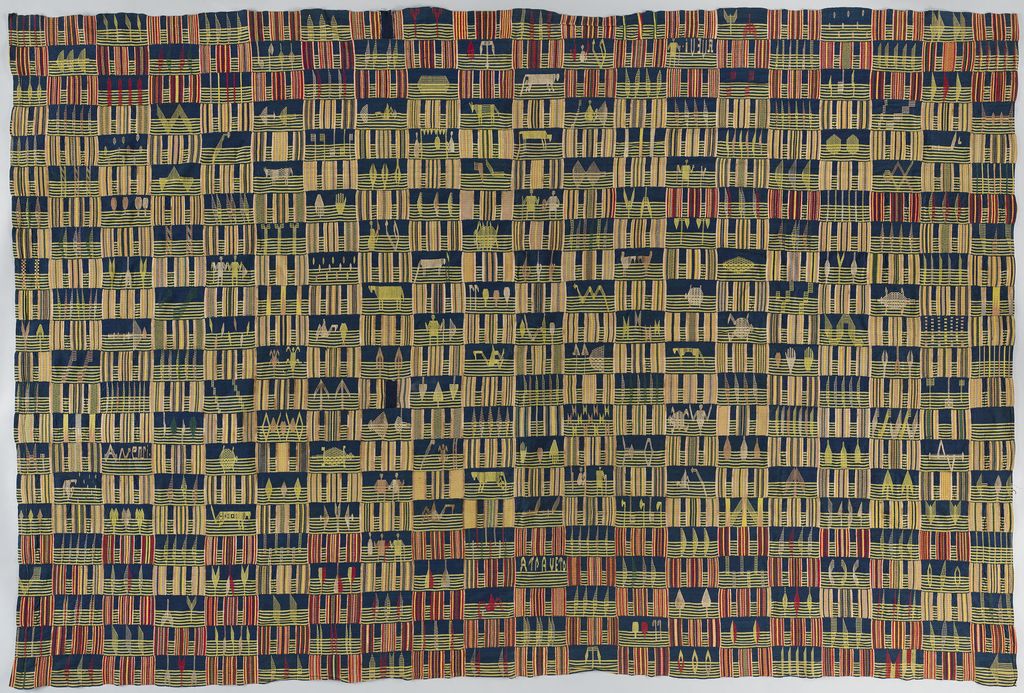
Full Ewe kente wrapper of cotton and dye, Ghana or Togo, circa 1900–20, Princeton University Art Museum 2019-127
This cotton-and-dye kente wrapper was made by an Ewe artist around 1900–20. The museum records its place of manufacture as Ghana or Togo and does not identify the individual maker. The photograph preserves the complete textile, with narrow woven strips and varied geometric motifs. It is a particular historical object, rather than a portrait of contemporary Ewe communities or an assertion that everyone wears the same clothing.
Overview
Ewe communities are documented here through selected language research, cross-border gatherings and diaspora organisation, not a single national citizenship or uniform institutional membership. The Ewe Association of Colorado's own account locates its work among families and friends in Greater Denver and identifies connections with Ghana, Togo, Benin and Nigeria. Its founding story names Derick Glymin, Esther Winfred-Kporha and Cornelius Ackumey in the initial contacts of June 2002, followed by household gatherings and formal organisation that summer. It reports joining the Council of Ewe Associations of North America in 2004. That local organisational history illustrates a diaspora network, not the origin of Ewe people.
A Ghana News Agency report by Frank Kwame Abbor describes the fourth Summit of Ewe Chiefs held in Ho during the 2025 Asogli Te Za celebrations. Participants included chiefs, queen mothers, scholars and cultural advocates from Ghana, Togo and Benin. Togbe Afede XIV's emphasis on younger people's language learning accompanied reported textbook and historical-documentation work. His proposed chiefs' union and pledge to turn his residence into a museum are plans in this dated report, not verified completed institutions. The gathering provides evidence of specific participants debating cultural continuity across borders; their aspirations are not automatically the position of every Ewe community.
Another dated initiative linked language advocacy with recreation. Nelson Ayivor's September 2023 Ghana News Agency report records the West Africa Association of Ewes launching a football tournament in Lomé. Foster Enam Dagadu presented sport as a means of strengthening connections and encouraging language use, while Torgbi Dikenu II of Nogokpo called for cultural learning among younger generations. The account announced a one-week tournament in Accra for December and appealed for support. It documents an association's proposed activity and named advocates' purposes, rather than proving that the later event occurred or that sport produced measurable language revitalisation.
Language research adds a different evidential scale. Mercy Bobuafor's 2021 study, as described in its University of Ghana abstract, compares selected Tafi sayings with Ewe counterparts. The Tafi material came from a small fieldwork corpus; Ewe versions came from existing collections and equivalents supplied by bilingual Tafi speakers. The abstract distinguishes textual meanings from meanings dependent on the circumstances of use and suggests shared practices associated with linguistic and cultural contact. This is a bounded scholarly argument, not a comprehensive account of Ewe speech or culture. Only the abstract and bibliographic record were read here, so the full article's examples and analysis remain selected further reading.
History & identity
Community identity is distinct from citizenship, association founding dates and selected event chronology.
Sources & representation
Community self-description, dated reporting of named participants, and a bounded university research abstract.
Selected bibliography
Documented works and useful reading. This is not a list of every appearance.
- 01
Ewe Association of Colorado: Our Story
Complete public written body read; local diaspora organisation.
- 02
Ewe chiefs call for unity, Language preservation at Ho Summit
Complete indexed report read; named testimony and proposals.
- 03
West Africa Association of Ewes launches football tournament
Complete report read; launch and scheduled event, not later outcome.
- 04
Cultural values and the pragmatic significance of proverbial sayings in Tafi and Ewe
Complete abstract and metadata read; full article not read.
Language & cultural connections
These connections link languages or specific cultural works and institutions; they do not establish biological ancestry or ethnic identity.
Ewe Association of Georgia (EWAGA)
EWAGA describes cultural and civic education, social support and community-development partnerships. Its account records formation in 1994 and participation in CEANA. This is a local association, not a government representing every Ewe person.
References
Sources supporting this profile. Linked pages have their own scope and editorial standards.
- Community self-descriptionEwe Association of Colorado: Our StoryResearch access: 2026-10-05
- News agency reporting of named community advocatesEwe chiefs call for unity, Language preservation at Ho SummitResearch access: 2026-10-05
- News agency reporting of named community advocatesWest Africa Association of Ewes launches football tournamentResearch access: 2026-10-05
- University research abstractCultural values and the pragmatic significance of proverbial sayings in Tafi and EweResearch access: 2026-10-05
Image credits
Contextual cultural object photographFull Ewe kente wrapper of cotton and dye, Ghana or Togo, circa 1900–20, Princeton University Art Museum 2019-127
This cotton-and-dye kente wrapper was made by an Ewe artist around 1900–20. The museum records its place of manufacture as Ghana or Togo and does not identify the individual maker. The photograph preserves the complete textile, with narrow woven strips and varied geometric motifs. It is a particular historical object, rather than a portrait of contemporary Ewe communities or an assertion that everyone wears the same clothing.