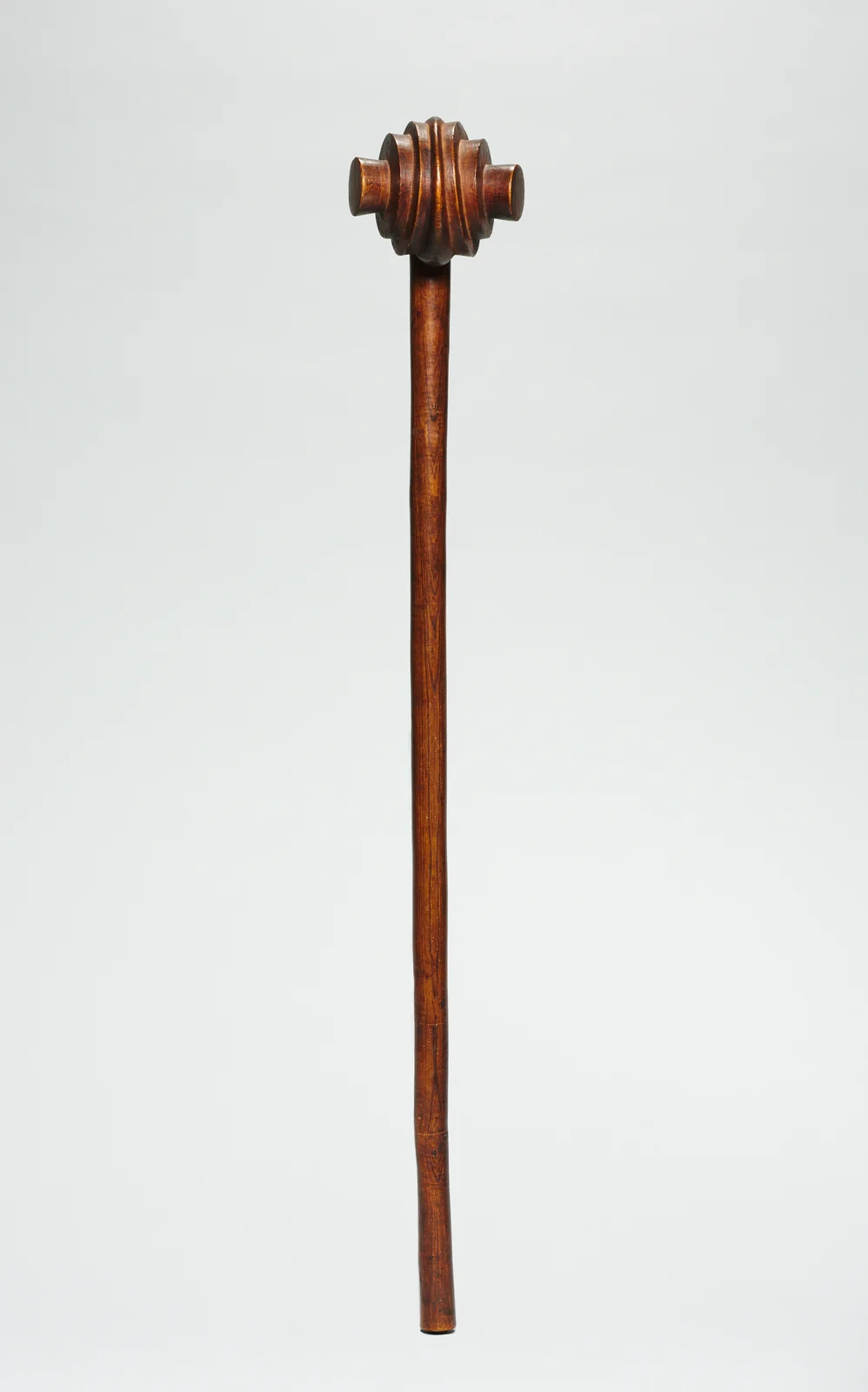
Complete polished brown wooden knobkerrie with a long slender shaft and a ribbed rounded head, catalogued as made by a Swazi-style maker.
Wooden club catalogued as Swazi-style, Kingdom of Eswatini, 1800s–1900s. The named maker and individual owner are unknown; this historical object does not represent all contemporary emaSwati material culture.
Overview
This initial account of emaSwati cultural communities follows selected museum, regional documentation and siSwati scholarship in Eswatini. It keeps cultural affiliation distinct from citizenship and does not assign every resident the same identity. The Eswatini Tourism Authority's November 2018 museum account describes Umsamo Wesive at Lobamba, built in 1972, as combining cultural, historical and natural-history displays. It identifies colonial-era archive photographs, beadwork and contemporary Swazi art among its interpretive materials. This is a dated public description of how a national institution presents history; its chronology and display categories are not dates for the origin of a living people.
A separate UNESCO project account describes heritage inventorying in Shiselweni, implemented by the Eswatini National Trust Commission between October 2019 and April 2022. Local leaders requested the work, which paired community participants with cultural officers and sought to strengthen their ability to document living heritage. The account reports recorded interviews and video sessions contributing to an inventory made available to educational institutions and other stakeholders. Its regional focus matters: a documentation project in Shiselweni is not an exhaustive account of emaSwati experiences elsewhere. The public overview describes the work and its reported products; individual interviews, recordings and the underlying inventory have not been inspected here.
siSwati also has a place in contemporary scholarship and teaching. The University of Eswatini's public profile of Cynthia Hlobsile Mkoko identifies research interests in siSwati phonology and Bantu linguistics, alongside multilingual communication and translanguaging in educational and social settings. It connects academic literacies with advanced phonology and morphology teaching. This is an individual scholar's institutional profile, not evidence that all speakers share one educational experience or an independently reviewed account of her research findings. Its linguistic classification describes scholarly work rather than biological relationships between peoples.
The university's 2019–2020 report gives a concrete example of public translation work. Its Faculty of Humanities section credits linguists G. B. Malambe and V. Magongo with translating the Kingdom of Eswatini Strategic Roadmap for 2019–2022 from English into siSwati. The university describes the original as technically demanding and presents the translation as a way to widen participation in public planning. That argument belongs to the institution's report: publication of a translation does not by itself demonstrate universal access, comprehension or economic recovery. The complete indexed translation passage was read, while the roadmap and the full annual report remain selected-reading leads.
History & identity
Institutional and project dates are not a first-origin chronology for the people.
Sources & representation
Three complete public bodies and one complete indexed annual-report translation passage.
Selected bibliography
Documented works and useful reading. This is not a list of every appearance.
- 01
50 Reasons to Visit Eswatini in 50/50 Year, #37–40: Museums
Complete written article read; focal National Museum section used, objects not inspected.
- 02
Shiselweni heritage inventory
Complete project overview read; underlying inventory and recordings not inspected.
- 03
Dr C. H. Mkoko
Complete public biography read; research interests, no full publications inspected.
- 04
Vice-Chancellor Report 2019–2020
Complete indexed translation passage, printed 100–101; not whole report or roadmap.
Language & cultural connections
Source-supported language and cultural connections have not yet been compiled for this profile.
References
Sources supporting this profile. Linked pages have their own scope and editorial standards.
- Institutional public documentation50 Reasons to Visit Eswatini in 50/50 Year, #37–40: MuseumsResearch access: 2026-10-05
- Institutional public documentationShiselweni heritage inventoryResearch access: 2026-10-05
- Institutional public documentationDr C. H. MkokoResearch access: 2026-10-05
- Institutional public documentationVice-Chancellor Report 2019–2020Research access: 2026-10-05
Image credits
Contextual historical object photographComplete polished brown wooden knobkerrie with a long slender shaft and a ribbed rounded head, catalogued as made by a Swazi-style maker.
Wooden club catalogued as Swazi-style, Kingdom of Eswatini, 1800s–1900s. The named maker and individual owner are unknown; this historical object does not represent all contemporary emaSwati material culture.